When UK documents need to be used for official purposes, accurate translation may be required before they can be accepted by an overseas authority, government department, university, employer, or legal organisation. This is where certified translations services can provide an important solution.
Whether you are applying for a visa, getting married abroad, studying overseas, applying for citizenship, handling legal matters, or preparing business documents for international use, you may need a certified translation that meets the requirements of the receiving organisation.
The translation process can sometimes seem confusing, particularly when different countries and authorities have specific requirements for translated documents. At Legalisation4you, we provide professional document legalisation and translation support to help individuals and businesses prepare documents for official and international use.
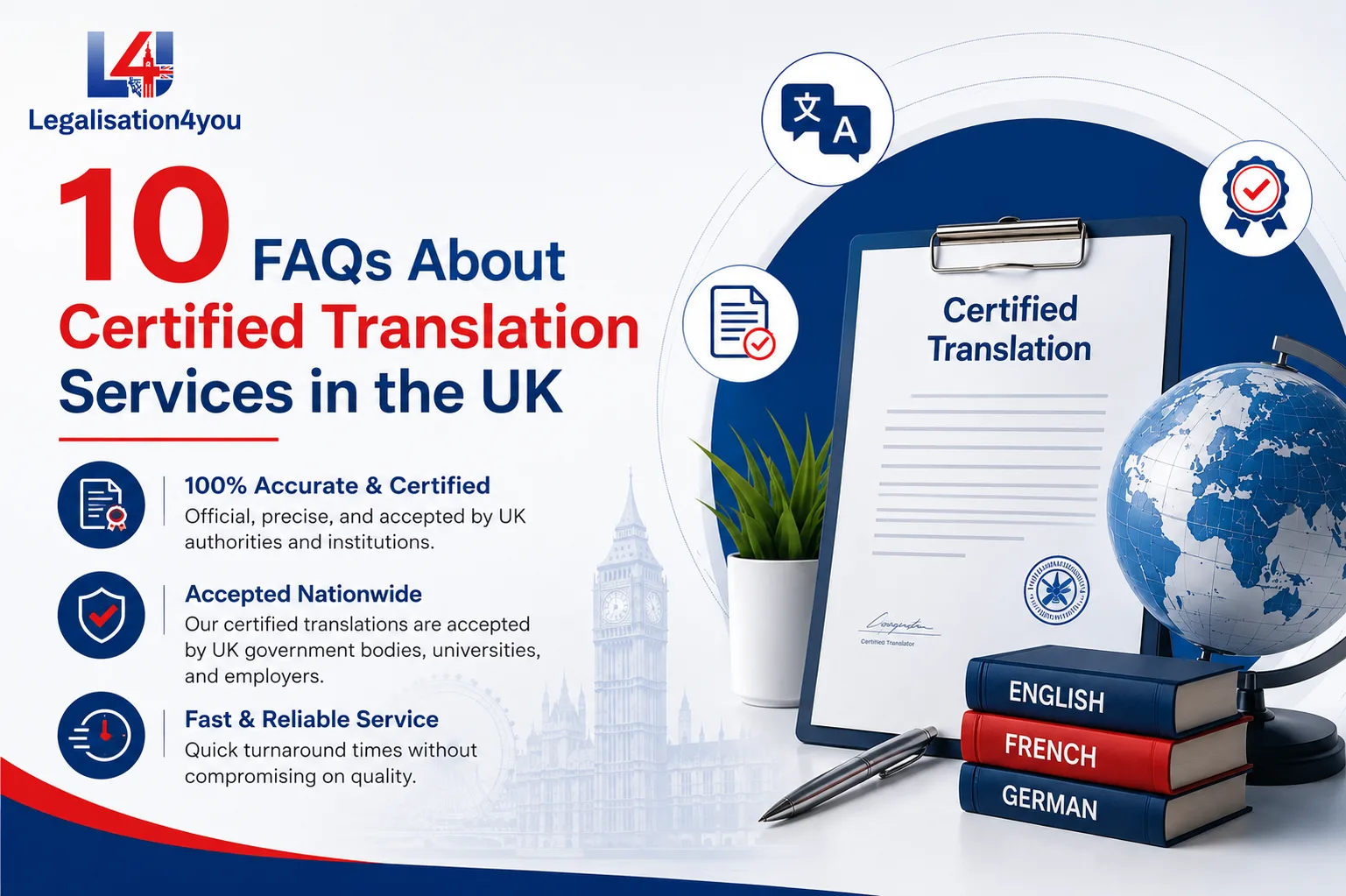
Here are 10 frequently asked questions about certified translation services in the UK.
1. What Are Certified Translation Services?
Certified translation services involve translating an official document and providing certification to confirm that the translation is accurate and complete.
Unlike an informal translation, a certified translation is prepared for use where an organisation or authority requires confirmation of the translator's accuracy and credentials. The certification may include details such as the translator or translation provider, the language involved, and a declaration confirming the accuracy of the translated document.
Certified translations may be required for documents such as:
- Birth certificates
- Marriage certificates
- Divorce certificates
- Educational certificates
- Academic transcripts
- Passports and identity documents
- Police certificates
- Legal documents
- Business documents
The exact requirements depend on the organisation or country where the translated document will be submitted.
2. Why Do I Need a Certified Translation?
A certified translation may be required when an official document is written in a language that the receiving authority does not accept.
For example, if you are submitting a foreign-language birth certificate to a UK government organisation, university, court, or other official body, you may be asked to provide an English certified translation.
Certified translations are commonly used for:
- Visa and immigration applications
- Citizenship applications
- Marriage registration
- University applications
- Employment purposes
- Legal proceedings
- Property transactions
- Business documentation
- Overseas document applications
Providing the correct type of translation can help prevent unnecessary delays and ensure your documents meet the requirements of the receiving authority.
3. What Documents Can Be Certified Translated?
Many personal, educational, legal, and commercial documents can be translated and certified, provided the translation provider can accurately translate the source document.
Common examples include:
- Birth and marriage certificates
- Divorce certificates
- Death certificates
- Degree certificates
- Diplomas and transcripts
- Police certificates
- Contracts and agreements
- Powers of attorney
- Company documents
- Identity documents
- Immigration documents
The requirements can vary depending on the document and its intended use. Before ordering a translation, it is important to check whether the receiving organisation requires a certified translation, notarised translation, or another specific form of authentication.
4. Is a Certified Translation the Same as a Notarised Translation?
No. Certified and notarised translations are different, although they can sometimes be required together.
A certified translation generally includes a certification confirming that the translation is accurate and complete. A notarised translation involves a notary public witnessing or authenticating a declaration or signature associated with the translation.
The receiving authority determines which type is required.
For some applications, a certified translation may be sufficient. In other situations, the organisation may specifically request notarisation or additional legalisation.
If you are unsure which service you need, Legalisation4you can help you understand the appropriate process based on the document and its intended destination.
5. How Long Do Certified Translation Services Take?
The timeframe depends on the type and number of documents, the language combination, the length of the document, and the service required.
Simple documents such as certificates may generally be completed more quickly than lengthy legal agreements or academic records containing multiple pages.
Factors that can affect turnaround time include:
- Number of documents
- Number of pages
- Source and target languages
- Document complexity
- Certification requirements
- Urgent processing requirements
- Additional legalisation or notarisation
If you have an important application deadline, it is advisable to arrange your translation well in advance. This allows enough time for any additional certification, Apostille, or embassy legalisation that may be required.

6. Are Certified Translations Accepted by UK Authorities?
Certified translations are commonly used for official applications in the UK, but the specific requirements depend on the authority receiving the document.
Some organisations may have their own rules regarding who can provide or certify a translation. They may specify particular wording, certification details, translator qualifications, or other requirements.
For this reason, you should always check the instructions provided by the organisation before arranging your translation.
If the translated document will also be used internationally, additional authentication may be necessary depending on the destination country and the purpose of the document.
7. Do Certified Translations Need an Apostille?
Not always. Whether a certified translation requires an Apostille depends on where and how the document will be used.
An Apostille authenticates certain signatures, stamps, or seals so that a UK document can be recognised for official use in another country that participates in the Hague Apostille Convention.
For some international applications, you may need to have the original document apostilled, while in other circumstances the translation may also need certification or further authentication.
The correct process depends on the destination country and the requirements of the receiving authority.
Legalisation4you can provide guidance on document legalisation requirements to help you understand whether Apostille or additional authentication may be necessary.
8. Can Birth and Marriage Certificates Be Certified Translated?
Yes. Birth certificates, marriage certificates, and other civil status documents are among the documents that may require certified translation.
These translations can be needed for:
- Immigration applications
- Marriage abroad
- Citizenship applications
- Family registration
- Dual nationality applications
- Legal proceedings
- Overseas employment
- Residency applications
It is important that names, dates, places, registration details, and other information are translated accurately. Even small errors in official documents can potentially cause problems with an application.
Using professional certified translations services can help ensure that your translated document is prepared appropriately for its intended purpose.
9. How Much Do Certified Translation Services Cost?
The cost of a certified translation varies depending on several factors.
These can include:
- The number of pages
- The type of document
- The language pair
- The complexity of the content
- Certification requirements
- Urgent turnaround
- Notarisation requirements
- Apostille or additional legalisation
For example, translating a short certificate will normally involve different requirements from translating a lengthy legal contract or academic transcript.
Because every document is different, it is advisable to provide the translation provider with a clear copy of your document so that the required service can be assessed accurately.
Legalisation4you can help you understand the services required based on your specific documents and intended use.
10. How Do I Choose the Right Certified Translation Service in the UK?
Choosing the right provider is important when your translation is being used for an official or legal purpose.
Before selecting a provider, consider:
- Whether they offer the required language combination
- Whether they provide certified translations
- Whether they understand official document requirements
- Whether they can assist with Apostille or legalisation
- Their expected turnaround time
- How documents are handled and returned
- Whether they can explain the process clearly
It is also important to identify the exact requirements of the organisation receiving your document. A translation that is suitable for one application may not automatically meet the requirements of another.
Working with an experienced provider can make the process easier and reduce the risk of submitting an unsuitable translation.
What Should I Check Before Ordering a Certified Translation?
Before arranging your translation, check the following:
- What type of translation does the receiving authority require?
- Does the document need to be certified?
- Is notarisation required?
- Does the original document need an Apostille?
- Does the destination country have additional requirements?
- What is your application deadline?
- Do you need standard or urgent processing?
Having this information ready can help avoid delays and unnecessary costs.

Why Choose Legalisation4you for Certified Translation Services?
Preparing documents for official or international use can be complicated when translation, certification, Apostille, and legalisation requirements are involved. Legalisation4you helps individuals and businesses navigate these processes with professional support.
Our services can assist with:
- Certified document translations
- Document assessment
- Apostille services
- Notarisation support
- Document legalisation
- Guidance on international document requirements
- Secure document handling
- Support throughout the process
Whether you need a certified translation for immigration, education, marriage, citizenship, legal matters, or overseas business purposes, getting the correct service from the beginning can help make the process more straightforward.
Need Certified Translation Services in the UK?
Official documents often need to meet specific requirements before they can be accepted by UK or overseas authorities. Choosing the appropriate certified translations services can help ensure your documents are accurately translated and prepared for their intended purpose.
Legalisation4you supports clients with professional document translation and legalisation services, helping make the process clearer and more manageable.
If you need a certified translation for a birth certificate, marriage certificate, academic document, legal document, or another official document, contact Legalisation4you for professional guidance on your requirements.