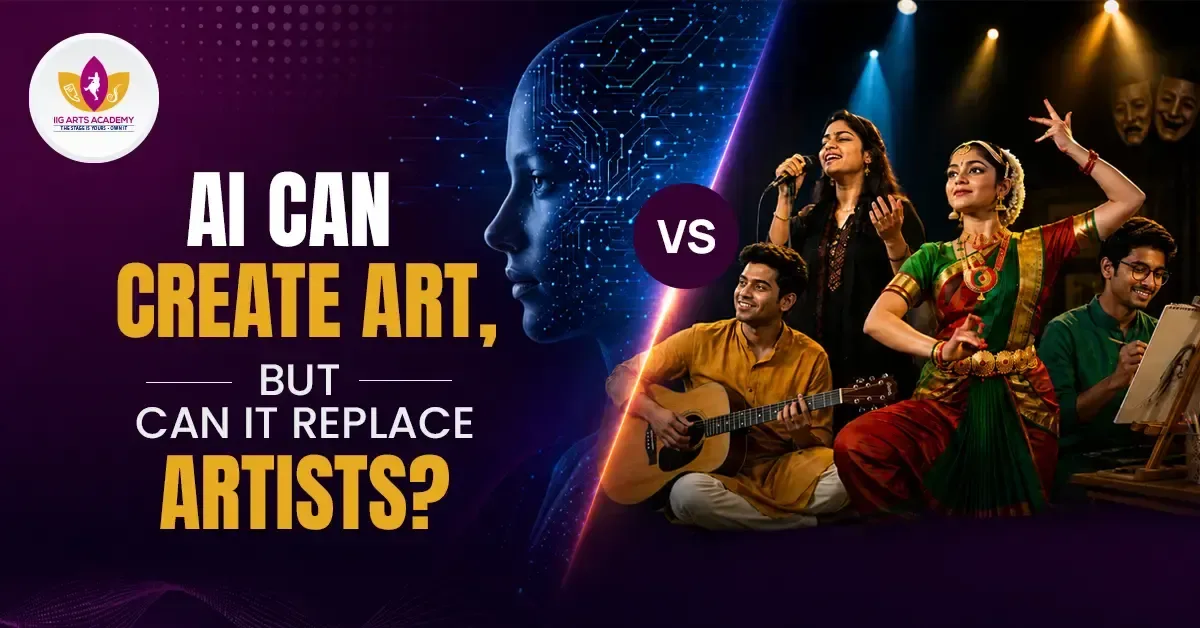
AI Can Create Art, But Can It Replace Artists?
Type "sad piano music, rainy city" into an app today and you'll have a finished track before your tea goes cold. It's genuinely impressive. It's also a completely different thing from a student sitting down and running through the same scales for forty minutes because that's what actually builds a musician. Somewhere between the instant result and the slow, boring practice sits the whole question this article is trying to work through.
Can AI replace artists? People keep asking this, and the answer tends to shift depending on who you ask and what they've just seen a chatbot do. For students at a performing arts school in Bhubaneswar, though, it's not a hypothetical debate. These tools are already sitting in the same room as their training.
How We Got Here
AI art systems are trained on huge piles of existing paintings, photos, songs, and text. Give one a prompt, and it hunts through everything it has absorbed for patterns, then remixes those patterns into something that looks new.
You type a sentence, pick a style, and there's your image. Same story for backing tracks, rough choreography ideas, video edits, even set design mockups. Genuinely useful stuff. Saves time. Gets you unstuck when you can't picture something.
But producing an image is not the same thing as understanding what you just made. That's the part that gets skipped over a lot.
Where Actual Art Comes From
Most art that sticks with you came out of something real. A painting carrying a memory from childhood. A song written by someone who was, frankly, a mess when they wrote it. A dancer saying something through movement that they couldn't have said out loud. An actor lending the character pieces of their own history without even meaning to.
AI hasn't lived any of that. It can spot what grief tends to look like in a dataset. It has never actually been sad about anything.
And that gap shows up more than people expect. We don't just react to how a piece looks or sounds — we react to what it cost someone to make it. A painting that came out of a real experience carries weight a technically flawless but hollow image just doesn't have, no matter how good the lighting is.
Copying Isn't the Same as Understanding
AI systems learn by studying what already exists. They notice patterns in colour, in rhythm, in sentence structure, and remix those patterns into something that reads as new. It can look original on the surface. Underneath, it's stitched together from thousands of earlier works, whether anyone credits them or not.
Human artists learn from other artists too. Obviously. Nobody starts from nothing. But there's a difference between absorbing an influence and running it through your own memories and your own strange sense of what matters. Put two painters in front of the same sunset and you'll probably get two very different paintings, because each of them is looking for something different in it.
Sometimes an artist breaks a rule on purpose. Leaves something unfinished. Hits a note slightly wrong because that's what the moment needed. AI mostly reaches for the statistically safe option. Artists, when they're good, often do the opposite.
Fast Isn't the Same as Good
AI's real edge is speed. It'll hand you a dozen options while you're still deciding what to have for dinner. A human artist might spend years on one piece and never feel finished with it.
But quicker doesn't mean better. It just means quicker.
Honestly, most of what makes art worth anything happens in the boring part — sketching the same thing for the twentieth time, running the same four bars over and over until they sit right, rehearsing a scene so many times it stops feeling like acting. Discipline gets built there, not in a text box.
Kids who show up to art classes in Bhubaneswar aren't only learning brush technique or a few dance steps. Somewhere along the way they're also picking up patience, the ability to actually take feedback without getting defensive, and a habit of noticing things other people walk past. None of that shows up after five seconds of generation. It shows up after months of someone correcting your form.
Could AI Actually Perform on Stage?
Sure, it can write a soundtrack. It can animate a digital performer that looks unnervingly real. What it hasn't figured out, and probably can't, is the messy back-and-forth between a live performer and a live audience.
A singer changes how she sings a song depending on how the room feels that night. An actor catches something in his scene partner's face and shifts a line he's delivered a hundred times before. A dancer's smallest, almost accidental movement can land harder than something choreographed down to the frame.
The nerves before you walk out. The tunnel focus while you're up there. The applause after, which never sounds the same twice. Those are human things, full stop, and nothing built so far comes close to reproducing that.
Where AI Actually Fits In
This doesn't need to be a fight between two sides. The better question is just — how do artists use this stuff without letting it take over the decisions that should be theirs?
In practice, that can look like using AI to pull together visual references, rough out a storyboard, test a few color palettes before committing, brainstorm costume ideas, clean up an audio track, or just keep a messy project organized. Small, practical stuff. Nothing that touches the actual creative decision.
Photography didn't kill painting. Digital production didn't kill musicians. If anything both gave artists more room to work in, not less. AI is probably going the same direction — another tool on the shelf, not a replacement for the person holding it.
Because someone still has to decide what's worth saying. That part hasn't changed.
Why Training Still Matters, Maybe More Now
As these tools get better, good teaching becomes more important, not less. Technique is still part of it, sure. But students also need to actually think about originality, ethics, and where the line is between inspiration and just copying something wholesale.
A decent teacher is the one who can tell you which of those two you just did. That's genuinely hard to figure out on your own at fifteen. Learning in a group helps too — you start to notice there's no single "right" way to paint a hand or land a jump, and that takes some of the pressure off.
Formal training also puts you in front of people. You perform, you show your work, you get told honestly what isn't working yet. That's how a pile of learned techniques eventually turns into something that sounds or looks like you specifically.
What Actually Makes an Artist Hard to Replace
It was never really about drawing accurately or hitting every note. That part's almost beside the point. What makes an artist hard to replace is the ability to say something true about what it's like to be a person, and have someone else recognize it.
Artists ask questions people would rather not think about. They keep old traditions alive when nobody else bothers. Their work can sit with someone on a genuinely bad day in a way nothing else quite does.
AI can generate a picture that represents loneliness. It has no idea what loneliness feels like at two in the morning. It can write a melody that sounds sad on paper, but there's no memory behind the sadness. It can render a face, but it can't bring thirty years of watching real faces to how that face moves.
The Artists Who'll Do Fine
AI isn't going anywhere. It'll keep showing up in film, music, theatre, dance, photography, design and pretty much everywhere you can imagine. Some of the repetitive grunt work will probably get automated out. Meanwhile, some genuinely new kinds of work are going to open up that didn't exist five years ago.
The artists who come out ahead won't necessarily be the ones refusing to touch it out of principle. More likely it'll be the ones who use it for interactive shows, digital performance, virtual sets — while still sounding unmistakably like themselves underneath it.
Technology can sharpen your technique. It can't give you a reason to make something in the first place. It'll hand you a hundred options, but it won't tell you which one deserves your name on it.
Where This Leaves Us
AI can make genuinely impressive stuff now — nobody's arguing otherwise. What it still can't do is replace the imagination and the lived experience that a human artist brings into a room. Most likely the future here isn't a takeover; it's a messy, useful collaboration between the two. Students who build real skills first, and pick up these tools second, are going to be in the best position for whatever comes next. That's the foundation we focus on at IIG Arts Academy, helping students find their own voice through art, music, dance, photography amd much more combined with professional training in Bhubaneswar rather than lean on a shortcut.
for more details contact - +919090030088