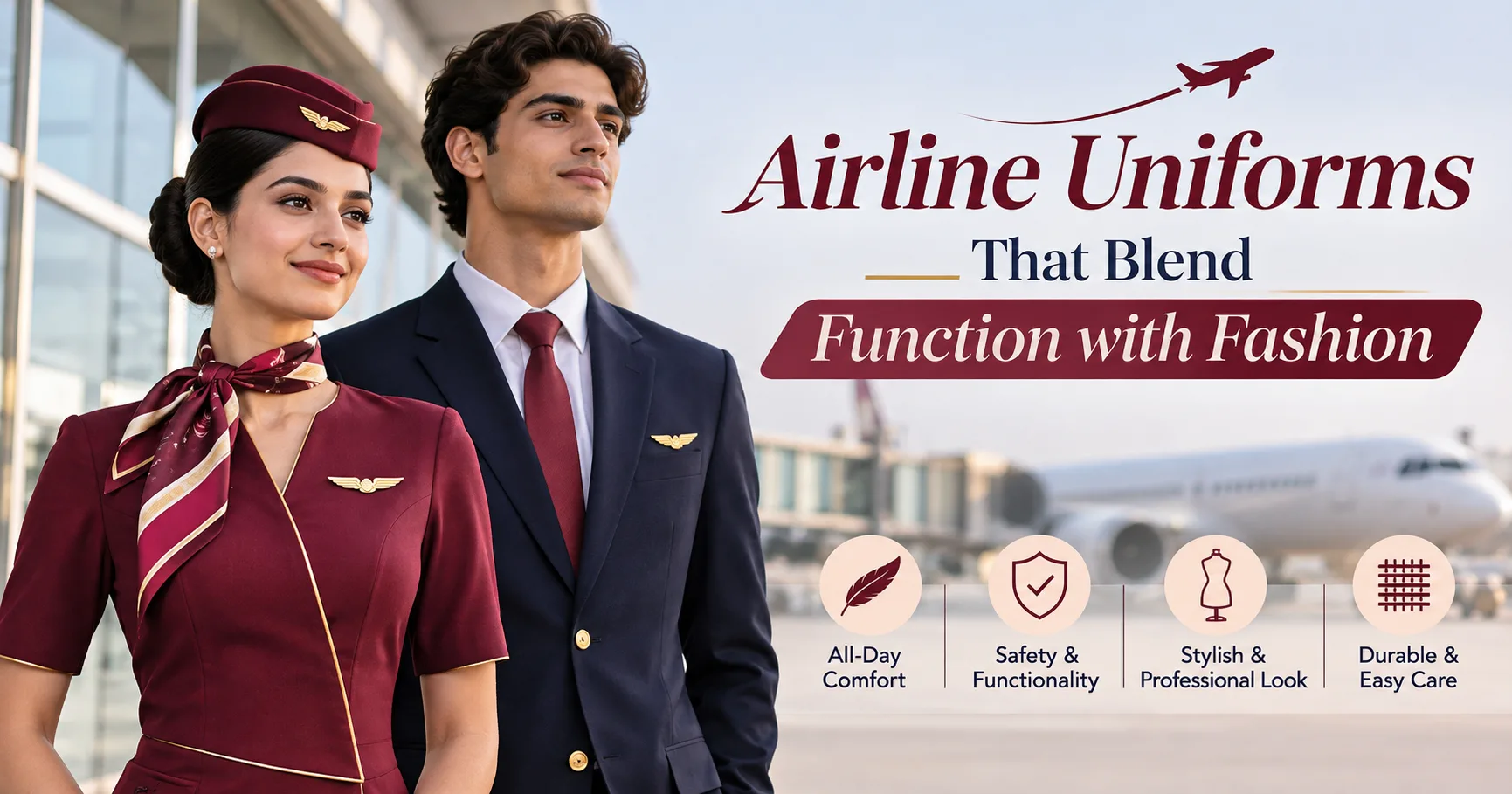
Think about the last time you boarded a flight. Before you found your seat or heard the safety announcement, you noticed the crew. The colour of the scarf, the cut of the jacket, how sharp the whole team looked. You probably didn’t think about it for long, but you formed an opinion in about three seconds.
That’s what a uniform does. It tells passengers who works here, who to trust, and what kind of airline this is. And it has to do all that while the person wearing it is on their feet for 12 hours.
Why Uniforms Matter More Than Airlines Admit
A uniform is the one thing every passenger sees, every single flight. Ads can be skipped. Websites can be closed. A crew member walking down the aisle can’t be ignored.
Staff feel it too. When a uniform fits well and feels comfortable, people stand taller. When it itches, pinches or fades after three washes, you can see that on the face of the person serving you coffee at 2 a.m.
What the Numbers Say
The business behind this is bigger than most people expect. One market report puts the airline crew uniform market at $1.23 billion in 2025, rising to $1.3 billion in 2026. The same publisher expects it to reach $1.65 billion by 2030, growing at roughly 6% a year. Other firms publish different totals, but almost all of them point the same way: up. wbocthebusinessresearchcompany
The reason is simple. More people are flying. IATA expects its member airlines to carry about 5.1 billion passengers in 2026. More passengers means more planes, more crew, and more people who need a uniform that works. thesun
Function Comes First
Fashion gets the attention, but comfort decides whether a uniform succeeds. Ask any cabin crew member what matters and the answers are very practical:
- Fabric that breathes. Cabin air is dry, galleys get hot, and terminals can be freezing. Poly-viscose and wool-blend fabrics handle this far better than stiff cotton.
- Stretch and ease of movement. Pushing a trolley, lifting a bag, bending down to help a child. If the jacket pulls across the shoulders, it’s the wrong jacket.
- Wrinkle and stain resistance. Crew change clothes in tiny spaces and wear one uniform for a long duty day. It has to look fresh at the end of it.
- Fit for every body. A good range of sizes, and cuts that work for different heights and builds, matters more than most airlines realise.
- Safety compliance. Fabrics and finishes should meet the airline’s own safety requirements and local regulations.
Ground teams have their own needs, like high-visibility details, weather protection and tough fabric. We covered that in our airport ground staff uniforms guide.
Then Comes the Fashion
Once the basics are right, design is where an airline becomes recognisable. Colour, cut, accessories, even how a scarf is tied. These small details make a crew look like one team instead of a group of individuals.
This is also where custom airline uniforms beat ready-made options. Off-the-shelf pieces can look decent, but they rarely say anything about your airline. A custom design lets you pick the exact shade of your brand colour, add subtle patterns, and match the look to your routes and your passengers. If you want to go deeper on this, read how custom airline uniforms shape brand identity.
A Recent Example from India
Air India Express is a good example of design meeting function. Its new uniforms launched on 1 September 2026 across cabin crew, airport services, aviation security and flight operations, with over 5,200 of its roughly 8,000 staff receiving them. The designs draw on Indian textile traditions, including Kanjeevaram, Patola and Gamosa. business-standardbusiness-standard
Notice what happened there. The airline didn’t pick fashion or practicality. It gave different teams different pieces, kept the colours consistent, and added a local story passengers can recognise.
Picking the Right Partner
This is where many airlines struggle. Not every company that stitches clothes can handle airline work. Airline orders mean hundreds or thousands of pieces, strict colour matching, repeat orders that look identical a year later, and deadlines tied to a launch date.
When you compare airline uniform suppliers, ask a few direct questions:
- Have they made uniforms for airlines or airports before?
- Can they send fabric swatches and wear-test samples?
- Do they handle sizing for a large, varied team?
- Will the colour match on your next order, and the one after?
- What happens if you need 200 extra pieces in a hurry?
An airline uniforms manufacturer that controls design, fabric and stitching under one roof usually delivers more consistent results than one that outsources half the job. You can see the kind of work we do for carriers on our airline uniforms page.
Conclusion
A good airline uniform doesn’t make people choose between comfort and style. It does both quietly. The crew feel good, passengers notice the polish, and the brand stays in memory long after landing.
If you’re planning a refresh, start with the people who wear it every day, get the fabric and fit right, then build the design on top. That order works almost every time.