College affordability has become one of the biggest concerns in American higher education. For many families, the cost of earning a degree now extends far beyond tuition bills. Among the groups most affected are Asian American and Asian diaspora students, many of whom face significant financial barriers that often remain hidden from public discussion. Recent research reveals that rising college costs and high levels of unmet financial need are influencing where these students enroll, what they study, and how they finance their education.
The findings challenge a long-standing assumption that Asian students generally enjoy financial security and easy access to educational opportunities. While some students do benefit from strong family resources, the broader picture is far more complicated. Large differences exist between ethnic subgroups, generations, and socioeconomic backgrounds. As tuition continues to rise, these differences are becoming harder to ignore.
The Growing Impact of Unmet Financial Need
Unmet financial need refers to the gap between the total cost of attending college and the financial aid, grants, and expected family contributions available to a student. When that gap becomes too large, students must find alternative ways to cover expenses.
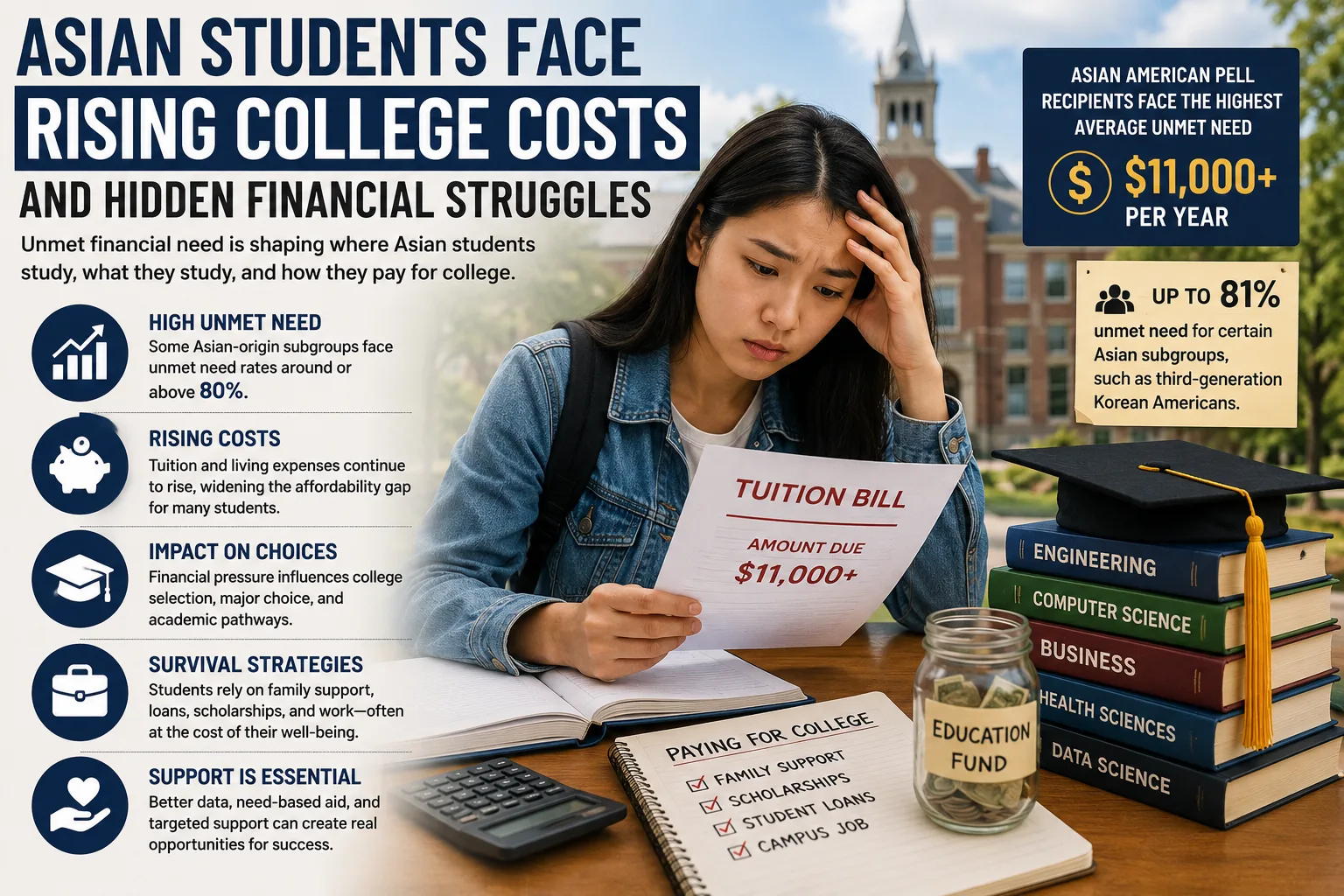
Research shows that many Asian students face some of the highest levels of unmet need among college populations. In several Asian-origin subgroups, unmet need rates approach or exceed 80 percent. Even students receiving Pell Grants often face affordability gaps exceeding $11,000 annually after aid is applied.
Imagine trying to buy a house when every month begins with a large unpaid balance before you even receive your paycheck. That is the reality many students face at the start of every academic year. The financial gap forces difficult decisions that can affect academic success and long-term financial stability.
These affordability challenges are often hidden because data frequently group all Asian students into a single category. When researchers examine specific ethnic communities separately, major disparities become visible. Some students experience financial pressures comparable to or greater than those faced by other traditionally underserved populations.
How Rising Costs Shape Educational Decisions
Financial pressure influences college choices long before students arrive on campus. Many families must decide between prestigious universities and more affordable alternatives. For some, the dream of attending a highly ranked institution comes with substantial sacrifices, including depleted savings, increased borrowing, and years of financial strain.
These pressures also affect academic pathways. Students often choose majors based on earning potential rather than personal interest. Fields such as engineering, computer science, business, and healthcare continue to attract many Asian students because they are perceived as offering stronger returns on educational investment.
The trend reflects a practical calculation. When education costs continue climbing, students become more concerned about securing employment that can justify those expenses. Some even switch from humanities or arts programs into STEM disciplines after evaluating future debt obligations and salary expectations.
This shift may improve career prospects, but it can also come at a personal cost. Students sometimes abandon subjects they genuinely enjoy in favor of programs they believe will provide financial security. Over time, this pressure can contribute to stress, burnout, and reduced academic engagement.
At this stage, many students seek academic support services to maintain performance while balancing financial responsibilities. Platforms like Expertsmind.com that connect students with verified tutors and subject experts can provide additional learning support when demanding schedules make traditional academic assistance difficult to access.
Loans, Work, and Family Support as Survival Strategies
To bridge funding gaps, many students rely on a combination of scholarships, student loans, family assistance, and employment. Family support remains particularly important within many Asian communities, where education is often viewed as a shared family investment rather than an individual responsibility.
However, family contributions frequently require significant sacrifice. Parents may delay retirement, liquidate savings, or assume debt to support a child's education. When family resources are limited, students often increase their work hours to compensate.
Working during college can help cover expenses, but excessive work intensity creates new risks. Students balancing coursework with employment often struggle to maintain academic performance. Some reduce course loads, postpone graduation, or temporarily leave school altogether.
International students face additional challenges. Many pay higher tuition rates and have limited access to federal financial aid programs. Visa restrictions also limit employment opportunities, reducing their ability to respond to unexpected financial emergencies. Currency fluctuations and economic conditions in home countries can further increase financial uncertainty.
Breaking the Cycle of Invisible Financial Hardship
One of the most important findings in the research is the role of stereotypes in masking financial challenges. The model minority narrative often portrays Asian students as universally successful and economically secure. This perception can discourage policymakers and institutions from recognizing the real financial needs that many students face.
When financial struggles remain invisible, students may receive less targeted support. They can also be overlooked for emergency funding, financial counseling, and outreach programs designed to improve student retention. The result is a cycle where financial stress persists without adequate institutional attention.
The research points toward several solutions. Better data collection can reveal disparities among different Asian ethnic groups. Expanded need-based financial aid can reduce affordability gaps. Universities can also provide culturally responsive advising, emergency assistance, and mental health services that address the unique pressures faced by many Asian students.
The broader lesson is clear. Asian students are not a single financial category. Their experiences vary widely, and many face serious affordability challenges that influence nearly every aspect of college life. Recognizing those realities is the first step toward creating a higher education system where opportunity is determined by talent and ambition rather than the size of a family's financial resources.