
Market Overview
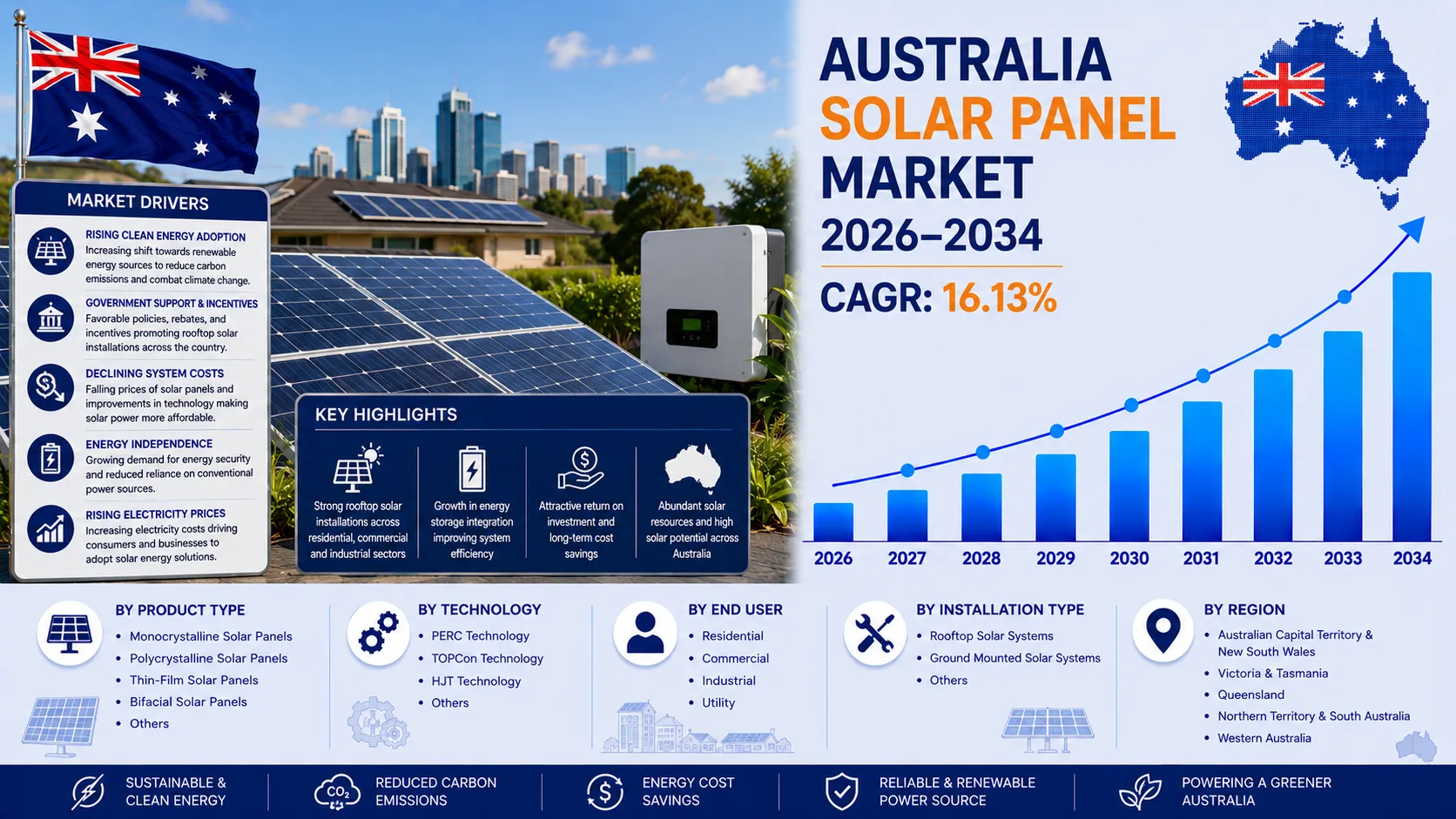
The Australia solar panel market is experiencing exceptional growth, driven by Australia's exceptional solar irradiance, rising residential and commercial electricity costs, strong government incentive programs, and the nation's accelerating transition to renewable energy under its 82% clean electricity by 2030 target. The market size reached 9.93 Gigawatt (GW) in 2025 and is projected to reach 46.61 GW by 2034, growing at a compound annual growth rate (CAGR) of 16.13% from 2026 to 2034.
Australia leads the world in per-capita rooftop solar installations; approximately one in three Australian households had solar panels installed as of 2024, a penetration rate unmatched in any other country. The market is strategically important to Australia's economy as it enables the nation to transition from coal-dominated generation to renewable-first electricity supply, reduces household electricity bills, and supports corporate net-zero commitments.
Request a Sample Report for In-Depth Market Insights: https://www.imarcgroup.com/australia-solar-panel-market/requestsample
Australia Solar Panel Market Summary
- The Australia solar panel market encompasses the installation of photovoltaic (PV) solar panels across residential rooftops, commercial and industrial facilities, and utility-scale ground-mounted solar farms, covering all PV technology types and installation scales.
- These solar panels are valued for their role in generating clean renewable electricity, reducing grid electricity costs, lowering carbon emissions, enabling energy independence, and supporting Australia's renewable energy targets.
- The ecosystem includes solar panel manufacturers (Jinko Solar, LONGi, Trinasolar, Canadian Solar, JA Solar), distributors (One Stop Warehouse), CEC-accredited installers, government regulators (Clean Energy Council, ARENA, CEFC), grid operators (AEMO), and end users across residential, commercial, and industrial sectors.
- Major segments identified in the market include type (monocrystalline silicon, polycrystalline silicon, crystal silicon, thin film, others), end use (residential, commercial, industrial), and region (Australia Capital Territory & New South Wales, Queensland, Victoria & Tasmania, Western Australia, Northern Territory & Southern Australia).
- The market is benefiting from government incentives (Small-scale Renewable Energy Scheme providing STCs reducing upfront costs by 30-40%), rising residential and commercial grid electricity prices, corporate power purchase agreements and net-zero commitments, and declining solar panel and battery storage costs.
- The federal government's 82% renewable energy target by 2030 requires approximately 60 GW of new solar and wind capacity, creating a mandated, policy-guaranteed demand pipeline.
PORTER'S FIVE FORCES ANALYSIS — AUSTRALIA SOLAR PANEL MARKET
Bargaining Power of Suppliers — Moderate
- Solar panel suppliers include Chinese tier-1 manufacturers (Jinko Solar, LONGi, Trinasolar, Canadian Solar, JA Solar) supplying an estimated 85-90% of installed panel capacity. Jinko Solar and LONGi together account for an estimated 30-35% of Australian panel installations.
- Approximately 80-85% of solar panels originate from Chinese manufacturers, creating supply chain concentration risk. Geopolitical tensions, anti-dumping trade measures, or supply disruptions could cause panel price spikes.
- The JA Solar 1 GW distribution agreement with One Stop Warehouse (September 2024), the largest single-brand Australian solar distribution contract on record, demonstrates that large-scale supply chain agreements are becoming standard, giving large distributors moderate leverage.
Bargaining Power of Buyers — Moderate to High
- Buyers include residential homeowners, commercial property owners, and industrial facility operators. Approximately 4,000+ CEC-accredited solar retailers and installers operate nationally, giving buyers significant choice.
- The competitive pressure from ultra-low-cost solar panel imports from smaller Chinese manufacturers compresses installer margins and gives price-sensitive buyers negotiating power.
- However, consumer price erosion from low-quality imports creates quality concerns, and many buyers prioritize brand recognition (Jinko Solar, LONGi) and CEC-accredited status over minimal price differences.
Threat of New Entrants — Moderate
- The solar panel manufacturing market is highly concentrated, with Chinese tier-1 manufacturers dominating. New manufacturing entrants face significant capital and technology barriers.
- The Australian installation market is highly fragmented, with approximately 4,000+ CEC-accredited solar retailers and installers operating nationally. Consolidation is underway, with larger national installers growing share through brand recognition and volume purchasing advantages.
- CEC accreditation requirements and installer certification (Certificate III in Electrotechnology) create barriers for new installation entrants, with a skilled installer shortage limiting the pace of installation volume growth.
Threat of Substitutes — Low
- Grid electricity is a substitute for solar-generated electricity, but rising residential and commercial grid electricity prices make solar increasingly attractive. Average quarterly prices ranged from AUD 50 per MWh in Victoria to AUD 144 per MWh in South Australia.
- Other renewable energy sources (wind, hydro) are complementary rather than substitutes for rooftop solar, which serves distributed generation needs that utility-scale wind cannot address.
- The federal government's 82% renewable energy target by 2030 reduces the long-term viability of fossil-fuel-based electricity substitutes.
Competitive Rivalry — High
- The Australia solar panel market is highly concentrated, with Chinese tier-1 manufacturers (Jinko Solar, LONGi, Trinasolar, Canadian Solar, JA Solar) competing on module efficiency, price-per-watt, warranty terms, and distributor relationship depth.
- Competition centers on N-type TOPCon and HJT technologies. Jinko Solar's Tiger Neo 3.0 launched October 2025; LONGi and Origin signed MOU (May 2026) to expand commercial solar collaboration.
- The installation market sees intense competition among approximately 4,000+ CEC-accredited installers, with consolidation favoring larger national players with national warranty programs.
MARKET GROWTH DRIVERS
Government Incentives
Australia's Small-scale Renewable Energy Scheme (SRES) provides Small-scale Technology Certificates (STCs) that reduce the upfront cost of solar installations by approximately 30-40% on typical systems. Victoria's Solar Homes program offers additional AUD 1,400 rebates for eligible households, and Queensland's Solar for Rentals scheme is expanding access to renters. The ACT government achieved its 100% renewable electricity target ahead of schedule, with one of the nation's highest solar penetration rates at 35.62% of households.
Rising Residential and Commercial Grid Electricity Prices
Average quarterly electricity prices ranged from AUD 50 per MWh in Victoria to AUD 144 per MWh in South Australia, among the highest of any developed economy. Australia's high retail electricity prices make the efficiency premium of monocrystalline panels commercially compelling, delivering payback on the technology premium within 2-3 years. Time-of-use tariff structures that reduce the value of daytime solar exports are driving solar-battery co-installation adoption.
Corporate Power Purchase Agreements and Net Zero Commitments
Major Australian corporates including BHP, Rio Tinto, Commonwealth Bank, and Woolworths have announced Science-Based Targets (SBTs) requiring near-100% renewable electricity by 2030. This corporate demand creates a stable pipeline for commercial and industrial solar installations and utility-scale solar farms under long-term PPAs.
Declining Solar Panel and Battery Storage Costs
Rooftop solar installation costs per kilowatt of installed capacity fell 75% from 2010-11 to 2024-25. In 2024, turnkey energy storage system prices declined by approximately 40% year-on-year, reaching USD 165/kWh. This ongoing cost deflation continuously expands the addressable market to lower-income households and smaller-scale commercial properties. The proportion of new solar installations co-installed with battery storage reached approximately 25% in 2025 and is forecast to exceed 60% by 2030.
N-Type TOPCon and HJT Panel Technology Transition
Australian installers are rapidly transitioning from P-type PERC monocrystalline to N-type TOPCon and Heterojunction (HJT) technologies offering 21.5-23.5% module efficiency. Jinko Solar's Tiger Neo and LONGi's Hi-MO 6 captured a rapidly growing share of Australian residential installations in 2024-2025. N-type technologies offer lower temperature coefficients and lower Light-Induced Degradation (LID), delivering 3-5% more lifetime energy output than P-type equivalents.
AUSTRALIA SOLAR PANEL MARKET SEGMENTATION
- Type Insights:
- Monocrystalline Silicon
- Polycrystalline Silicon
- Crystal Silicon
- Thin Film
- Others
- End Use Insights:
- Residential
- Commercial
- Industrial
- Regional Insights:
- Australia Capital Territory & New South Wales
- Queensland
- Victoria & Tasmania
- Western Australia
- Northern Territory & Southern Australia
COMPETITIVE LANDSCAPE
The Australia solar panel supply market is highly concentrated at the manufacturing level, with Chinese tier-1 manufacturers supplying an estimated 85-90% of installed panel capacity. Jinko Solar, LONGi, Trinasolar, Canadian Solar, and JA Solar collectively hold an estimated 45-55% of Australian solar panel installation volume. Competition centers on module efficiency, price-per-watt, warranty terms, CEC-approved product listing status, and distributor relationship depth.
Key players include:
- Jinko Solar: World's largest PV module manufacturer; Tiger Neo N-type TOPCon platform. In October 2025, launched Tiger Neo 3.0 48-cell rooftop module and SunGiga 261 kWh liquid-cooled energy storage system at All Energy Australia 2025.
- LONGi: Vertically integrated mono-Si wafer and module producer. In May 2026, LONGi and Origin signed an MOU to expand collaboration on commercial solar supply, customer engagement, and market development across Australia's C&I energy sector.
- Trinasolar: Vertex N-type TOPCon module series; strong local accreditation portfolio.
- Canadian Solar: HiKu6, TOPHiKu6, BiHiKu, TOPBiHiKu; active in regional utility-scale project development.
- JA Solar: DeepBlue 5.0 and DeepBlue 4.0 Pro. In September 2024, JA Solar and One Stop Warehouse signed a 1 GW PV module distribution agreement covering 2025-2027.
REGIONAL ANALYSIS
- Australia Capital Territory & New South Wales: The largest market by installed capacity, anchored by Sydney's population of 5+ million and the large stock of suitable residential rooftops. The ACT has one of the nation's highest solar penetration rates at 35.62% of households, supported by the ACT government's 100% renewable electricity target achieved ahead of schedule. NSW's expanding renewable energy zones (Central-West Orana REZ, New England, Hunter Valley) create utility-scale demand.
- Queensland: Driven by the state's highest annual solar irradiance levels, averaging 5-6 peak sun hours per day across most of the state compared to the national average of 4.5. Rising household cooling demand boosts residential adoption. Renewable energy zone development (Central Queensland REZ) and an expanding utility-scale solar project pipeline support growth.
- Victoria & Tasmania: Dense urban rooftop potential in Melbourne, expanding interstate transmission infrastructure, and growing renewable energy export ambitions. Victoria's Solar Homes program offers additional AUD 1,400 rebates for eligible households.
- Western Australia: Strong solar resource potential, rising residential uptake, industrial demand for diesel displacement in the mining sector (Fortescue's green iron commitment implies 3+ GW of dedicated solar capacity for Pilbara operations), and a standalone utility-scale solar development pipeline.
- Northern Territory & Southern Australia: Advanced grid flexibility initiatives, growing virtual power plant (VPP) adoption, abundant solar resources, remote community solar deployment, and progressive battery-storage integration policies. South Australia has achieved 100% renewable generation across multiple 30-minute intervals and operates the world's largest VPP network.
RECENT INDUSTRY DEVELOPMENTS
June 2026: Australia remains the global leader in residential rooftop solar adoption. By the end of 2025, the country had installed approximately 22 GW of rooftop solar capacity, while analysis indicated the commercial sector still has the potential to deploy more than 80 GW of additional solar capacity, creating significant opportunities for solar panel installations.
June 2026: The Clean Energy Council reported that Australia had installed 26.8 GW of rooftop solar capacity across 4.2 million homes and small businesses by mid-2025. Based on current installation trends, total rooftop solar capacity is expected to reach 37.2 GW by 2030, exceeding national projections.
June 2026: Australia's home battery market continued to accelerate alongside solar panel adoption. The Australian Energy Market Operator estimated that improved integration of consumer batteries with rooftop solar systems could deliver approximately AUD 7.2 billion in electricity system savings. Around 600,000 home batteries were installed nationwide, with more than 400,000 added in the previous year alone.
May 2026: Australia's rooftop solar sector reached a new milestone as changes to the federal battery rebate program continued to support solar-plus-storage installations. Eligible households and businesses remained entitled to discounts of up to 30% on battery installation costs, encouraging greater utilization of rooftop solar generation.
February 2026: Research from the University of New South Wales found that approximately 20% of solar panels in Australia degrade faster than expected, with some systems losing up to 45% of their efficiency after 25 years, highlighting growing demand for panel replacement and system upgrades.
January 2026: Australia's battery storage boom reshaped the solar market. More than 183,000 home batteries were installed during the second half of 2025, bringing the national total to 454,473 units, while average rooftop solar system sizes increased to 11.6 kW, reflecting consumer preference for larger solar installations paired with storage.
Note: If you need any specific information that is not currently covered within the scope of the report, we will provide the same as a part of customization.
Speak to an analyst: https://www.imarcgroup.com/request?type=report&id=32494&flag=C
About Us
IMARC Group is a global management consulting firm that helps the world's most ambitious changemakers to create a lasting impact. The company provides a comprehensive suite of market entry and expansion services. IMARC offerings include thorough market assessment, feasibility studies, company incorporation assistance, factory setup support, regulatory approvals and licensing navigation, branding, marketing and sales strategies, competitive landscape and benchmarking analyses, pricing and cost research, and procurement research.
Contact Us
IMARC Group
134 N 4th St., Brooklyn, NY 11249, USA
Email: sales@imarcgroup.com
Tel No: (D) +91 120 433 0800
United States: +1-201-971-6302