
Market Overview
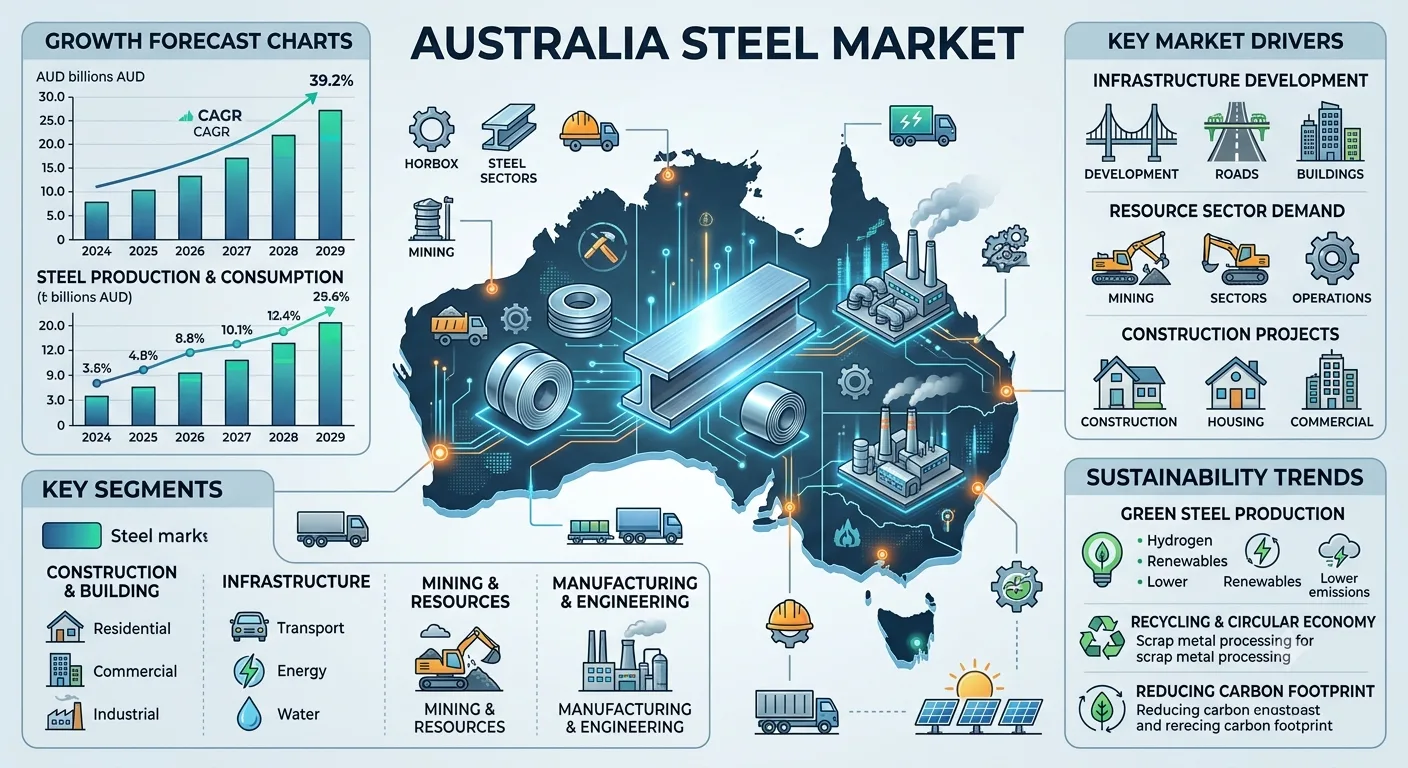
The Australia steel market size was valued at USD 20.1 Billion in 2025 and is projected to reach USD 26.6 Billion by 2034, growing at a compound annual growth rate of 3.03% during 2026-2034. The market is expanding due to large-scale infrastructure investment, rising residential and commercial construction activity, and the accelerating transition to low-emission steelmaking technologies. The growing government expenditure on transportation networks, renewable energy installations, and defense modernization is reinforcing consistent steel demand. Domestic manufacturing initiatives, strategic export partnerships with Asia-Pacific economies, and increasing adoption of electric arc furnace and hydrogen-based production methods are collectively contributing to the Australia steel market share.
This market is strategically important to Australia's industrial and construction economy, supporting the nation's position as a producer and consumer of steel across infrastructure, building, manufacturing, and renewable energy sectors. The Australian steel market encompasses integrated domestic steel producers, specialized fabrication companies, and international material suppliers operating across flat and long product categories, serving construction, automotive, transportation, and industrial applications.
The Australia steel market is poised for sustained expansion, underpinned by infrastructure pipelines, green steel investment, and industrial modernization. With a projected CAGR of 3.03% through 2034, the market presents significant opportunities for providers focusing on sustainable production, value-added fabrication, and supply chain resilience.
AUSTRALIA STEEL MARKET SUMMARY
The Australia steel market encompasses the production, processing, fabrication, and distribution of flat and long steel products for construction, infrastructure, manufacturing, and industrial applications across the country.
The ecosystem spans iron ore miners, integrated steel producers, electric arc furnace operators, fabrication companies, distributors, and end users across building and construction, automotive, transportation, and machinery sectors.
By Type, the market is segmented into Flat Steel (52.4% share in 2025) and Long Steel.
By Product, the market serves Structural Steel (34.2% share in 2025), Prestressing Steel, Bright Steel, Welding Wire and Rod, Iron Steel Wire, Ropes, and Braids.
By Application, the market serves Building and Construction (42.3% share in 2025), Electrical Appliances, Metal Products, Automotive, Transportation, Mechanical Equipment, and Domestic Appliances.
By Region, the market serves Australia Capital Territory & New South Wales (32.1% share in 2025), Victoria & Tasmania, Queensland, Northern Territory & Southern Australia, and Western Australia.
Key trends shaping the market include technological advancements in steel processing and fabrication, expansion of renewable energy infrastructure projects, government-led support for green iron and domestic supply chain security, and industry-research collaboration on decarbonization.
PORTER'S FIVE FORCES ANALYSIS – AUSTRALIA STEEL MARKET
Competitive Rivalry: Moderate to High. The market features integrated domestic steel producers, specialized fabrication companies, and international material suppliers competing across flat and long product categories. Companies differentiate through production capacity, processing capabilities, supply reliability, regional distribution networks, and sustainability credentials. Business implication: Companies must differentiate through sustainable production, value-added fabrication, and strong logistics capabilities.
Supplier Power (Iron Ore, Scrap, and Energy Providers): Moderate to High. Australia possesses abundant iron ore resources, providing domestic supply security, but energy costs and coking coal availability influence production economics. Scrap steel availability is critical for electric arc furnace operators. Business implication: Vertical integration, long-term supply agreements, and investment in renewable energy can reduce supplier dependency.
Buyer Power (Construction, Infrastructure, and Manufacturing End Users): Moderate. Large construction firms and infrastructure contractors have significant purchasing power and demand consistent quality, delivery reliability, and competitive pricing. However, the essential nature of steel and the scale of major projects moderate pure price-based buyer power. Business implication: Providers must invest in supply reliability, technical support, and project management capabilities.
Threat of Substitutes: Low to Moderate. Alternative materials including aluminium, concrete, and engineered timber can substitute for steel in certain applications. However, steel's strength, durability, recyclability, and cost-effectiveness maintain its dominance in structural and infrastructure applications. The transition to low-carbon steel production is strengthening steel's competitiveness against alternative materials on sustainability grounds.
Threat of New Entrants: Moderate. Significant capital requirements for production facilities, rolling mills, and processing equipment create barriers. However, government support for green steel development and the growth of modular and niche production technologies have enabled new entrants focused on low-emission steelmaking.
KEY ASPECTS REQUIRED FOR THE AUSTRALIA STEEL MARKET
Market Performance: USD 20.1 Billion in 2025, projected to reach USD 26.6 Billion by 2034, driven by infrastructure investment, construction activity, and renewable energy development.
Market Outlook: A 3.03% CAGR through 2034 reflects steady growth led by flat steel demand, structural steel applications, and green steel investment.
Growth Drivers: Adoption of sustainable and low-carbon steel production technologies; growing collaboration between industry and research institutions; growth in residential and commercial construction activities; expansion of renewable energy infrastructure; government-led support for domestic supply chain security.
Competitive Landscape: A competitive structure comprising integrated domestic steel producers, specialized fabrication companies, and international material suppliers. Key players include Australian Steel, BlueScope Steel Limited, Greensteel Australia, InfraBuild, LIBERTY Steel Group, Southern Steel Group, Swiss Steel Group, and Vulcan Australia.
Value Chain Analysis: From iron ore mining and scrap collection through steelmaking, casting, rolling, fabrication, distribution, and end-use application in construction, infrastructure, and manufacturing.
Industry Trends: Low-carbon steel production using hydrogen and electric arc furnaces; advanced fabrication and automation technologies; renewable energy infrastructure demand; government support through Green Iron Fund and Future Made in Australia Innovation Fund; industry-research partnerships.
Strategic Recommendations: Invest in green steel production capabilities; expand value-added fabrication services; pursue government partnerships and supply chain security initiatives; strengthen regional distribution networks; develop workforce training programs to address labor shortages; target renewable energy and infrastructure project demand.
Request for Sample Report: https://www.imarcgroup.com/australia-steel-market/requestsample
MARKET GROWTH DRIVERS
Adoption of Sustainable and Low-Carbon Steel Production Technologies
Steel producers in Australia are increasingly investing in technologies that reduce carbon emissions and improve energy efficiency in manufacturing processes. The industry is gradually adopting cleaner production methods, greater recycling of steel scrap, and advanced low-emission technologies to align with evolving environmental regulations and sustainability goals. As governments and industries place greater emphasis on responsible manufacturing, demand for sustainable steel products is increasing across construction, infrastructure, and industrial sectors. Reflecting this transition, in 2025, BlueScope participated as a Gold Partner at the TRANSFORM 2025 sustainability conference hosted by the Green Building Council of Australia, which focused on strategies to decarbonize the steel industry. Such initiatives demonstrate how industry collaboration and sustainability commitments are accelerating modernization within steel production while strengthening the long-term competitiveness of Australia's steel market.
Expansion of Renewable Energy Infrastructure Projects
Large renewable energy developments, including wind farms, solar power installations, and electricity transmission networks, require durable structural materials capable of supporting long-term energy production systems. Steel is widely used in wind turbine towers, transmission structures, and supporting frameworks due to its strength and reliability in large-scale infrastructure. Reflecting this growing demand, in 2025, the Australian Government announced a $500 million investment through the Future Made in Australia Innovation Fund to support domestic steelmaking and manufacturing capacity. Delivered through ARENA, the initiative focuses on strengthening local production of materials required for renewable energy infrastructure, including wind tower steel fabrication. Such policy support is encouraging industry expansion while reinforcing steel's critical role in Australia's renewable energy transition.
Government-Led Support for Green Iron and Domestic Supply Chain Security
Government-led initiatives aimed at strengthening domestic steel supply chains are emerging as an important trend shaping the Australia steel market. Policymakers are increasingly introducing financial support programs to secure the long-term viability of local steel production while ensuring that Australian iron ore remains competitive in a global market transitioning toward lower-emission manufacturing. These initiatives focus on supporting domestic processing capacity, stabilizing key production facilities, and promoting the development of green iron as a strategic industrial resource. Reflecting this trend, in 2025, Australia launched a A$1 billion Green Iron Fund to support low-carbon iron production and reinforce domestic steel supply chains. The package included an initial A$500 million allocation aimed at stabilizing the Whyalla steelworks in South Australia while supporting the broader transition toward sustainable steel production.
Growth in Residential and Commercial Construction Activities
The expansion of residential housing developments and commercial building projects is strengthening the demand for steel products across Australia. Rapid urbanization, population growth, and increasing housing requirements are encouraging large-scale residential construction across metropolitan regions. Steel is widely used in building frameworks, reinforcement bars, roofing structures, and structural components due to its durability and versatility. Commercial real estate developments, including office complexes, retail centers, and mixed-use properties, also rely heavily on steel for construction. Developers prefer steel materials because they enable faster construction timelines and provide strong structural integrity. Continuous growth in real estate development is therefore supporting stable demand for steel products.
Growing Collaboration Between Industry and Research Institutions
Collaboration between steel manufacturers and research institutions is becoming increasingly important in driving technological advancement across Australia's steel sector. These partnerships support the development of innovative production methods, sustainable manufacturing technologies, and resource-efficient steelmaking processes. Joint research initiatives also enable knowledge exchange between industry experts and academic researchers, accelerating the commercialization of new technologies. Reflecting this trend, in 2024, Tata Steel and Monash University signed an agreement to establish a Centre for Innovation on Environment and Intelligent Manufacturing. The center focused on research areas, including decarbonization, resource recovery, and advanced manufacturing systems, supporting the development of next-generation steel production technologies while strengthening research cooperation within the industry.
AUSTRALIA STEEL MARKET SEGMENTATION
Segmentation analysis provides a detailed view of the Australia steel market by category:
Type Insights: Flat Steel dominates with a market share of 52.4% in 2025. Flat steel holds the biggest market share because of its extensive use across multiple industrial and commercial applications. Industries, such as construction, automotive manufacturing, infrastructure development, and machinery production, rely heavily on flat steel products, including metal sheets, plates, and coils. This material is widely used in building structures, roofing systems, pipelines, and industrial equipment due to its strength, durability, and adaptability in fabrication processes. Long Steel serves reinforcement, structural, and engineering applications, benefiting from construction and infrastructure demand.
Product Insights: Structural Steel leads with a market share of 34.2% in 2025. Structural steel represents the largest segment due to its widespread use in construction, infrastructure, and large-scale engineering projects. It is widely utilized in building frameworks, bridges, industrial facilities, and commercial structures because of its high strength, durability, and load-bearing capacity. Structural steel products, such as beams, columns, and sections are essential components in modern construction projects that require stable and long-lasting structural support. Prestressing Steel serves bridge and infrastructure applications. Bright Steel supports precision engineering. Welding Wire and Rod, Iron Steel Wire, Ropes, and Braids serve specialized industrial applications.
Application Insights: Building and construction exhibits a clear dominance with a 42.3% share in 2025. Building and construction dominates the market driven by the extensive use of steel in residential, commercial, and infrastructure development projects across the country. Steel is widely used in structural frameworks, roofing systems, reinforcement bars, and cladding materials due to its strength, durability, and ability to support modern architectural designs. Electrical Appliances, Metal Products, Automotive, Transportation, Mechanical Equipment, and Domestic Appliances round out the application portfolio.
Regional Insights: Australia Capital Territory and New South Wales dominate with a market share of 32.1% in 2025. These regions lead attributed to the high concentration of construction, infrastructure development, and commercial projects across these areas. Major urban centers like Sydney and Canberra continue to experience strong demand for residential housing, commercial buildings, and public infrastructure. Victoria & Tasmania, Queensland, Northern Territory & Southern Australia, and Western Australia represent significant regional markets with growing infrastructure and industrial activity.
COMPETITIVE LANDSCAPE
The Australia steel market features a competitive structure characterized by the presence of integrated domestic steel producers, specialized fabrication companies, and international material suppliers operating across different segments of the value chain. These participants compete by offering diverse steel product portfolios that serve construction, infrastructure, manufacturing, and industrial applications. Companies also differentiate through production capacity, processing capabilities, supply reliability, and regional distribution networks. Strong logistics and delivery capabilities enable suppliers to support large infrastructure and commercial construction projects across various states. In addition, sustainability initiatives, including lower-emission steel production methods and recycling practices, are becoming important competitive factors. Firms are also focusing on strengthening customer relationships, improving service responsiveness, and expanding fabrication capabilities to enhance their market positioning.
BlueScope Steel Limited remains a leading domestic producer with extensive flat steel production capabilities serving construction, automotive, and manufacturing sectors. The company has demonstrated commitment to sustainability through participation in industry decarbonization initiatives.
Greensteel Australia is advancing low-carbon steel production through significant investments. In 2024, Greensteel Australia partnered with Danieli to develop a 600,000-ton-per-year rolling mill in New South Wales powered entirely by green hydrogen. The facility utilized a hydrogen-fueled reheating furnace designed to eliminate fossil fuel use and significantly reduce emissions during steel production. In 2025, Greensteel Australia announced plans to invest $1.6 billion to build a new steel plant focused on low-carbon steel production, incorporating a direct reduced iron unit, electric arc furnaces, and advanced rolling mills.
InfraBuild serves the construction and infrastructure sectors with long steel products and fabrication services. LIBERTY Steel Group maintains significant Australian operations serving construction and industrial markets. Southern Steel Group, Swiss Steel Group, and Vulcan Australia represent additional competitors across specialized steel segments.
Recent Developments:
March 2026: Metal Logic acquired a 1,000-hectare site in Western Australia's Pilbara region to deploy its modular clean steel smelting technology. The project aims to establish an initial one-million-ton-per-year facility capable of producing lower-emission steel while processing a wide range of iron ore grades.
November 2025: The Western Australian government launched an Expression of Interest to encourage the use of locally produced green steel in major public infrastructure projects. Green steel could be used in projects such as railways, roads, hospitals, and energy infrastructure as part of the state's "Made in WA" economic strategy.
2026: Sydney Metro West advanced into a major construction phase after authorities awarded approximately $7.7 billion in contracts covering stations, track systems, trains, and operations. The 24-km underground rail line highlights how major infrastructure programs are increasing the consumption of structural and reinforcement steel.
2025: Australia reported that more than 1,800 tons of structural steel were used to construct a major aircraft maintenance hangar in northern Adelaide, with over half sourced from Whyalla Steelworks.
Investment opportunities exist in green steel production, value-added fabrication, renewable energy infrastructure supply, and regional distribution expansion.
REGIONAL ANALYSIS
Australia Capital Territory and New South Wales dominate with a market share of 32.1% in 2025, attributed to the high concentration of construction, infrastructure development, and commercial projects across these areas. Major urban centers like Sydney and Canberra continue to experience strong demand for residential housing, commercial buildings, and public infrastructure, all of which require significant volumes of steel. Structural steel, reinforcement bars, and fabricated steel components are widely used in high-rise buildings, bridges, transportation systems, and institutional facilities. The ongoing expansion of urban infrastructure and population growth in these regions further increases the need for durable construction materials. In 2024, Green Steel Australia contracted Danieli to build a 600,000-ton-per-year rolling mill in New South Wales for producing rebar and coil products, highlighting the region's role in supporting both infrastructure growth and sustainable steel production.
Victoria & Tasmania maintains a significant market position supported by Melbourne's construction activity, infrastructure investment, and manufacturing base. The region benefits from major transport projects and urban development initiatives driving steel demand.
Queensland is experiencing growth driven by population migration, infrastructure investment, and resource sector activity. Brisbane's expanding urban footprint and major projects including rail and road infrastructure are supporting steel consumption.
Western Australia serves the mining and resources sector with steel products for infrastructure, processing facilities, and equipment. The state's iron ore industry provides raw material supply while government initiatives promote local green steel production.
Northern Territory & Southern Australia represent emerging markets with growing infrastructure and defence sector demand, including shipbuilding and defence facility construction.
RECENT INDUSTRY DEVELOPMENTS
2026 Activity: The Australia steel market continued its growth trajectory from USD 20.1 Billion in 2025 toward USD 26.6 Billion by 2034 at a CAGR of 3.03%.
March 2026: Metal Logic acquired a 1,000-hectare site in Western Australia's Pilbara region to deploy modular clean steel smelting technology.
November 2025: The Western Australian government launched an Expression of Interest to encourage the use of locally produced green steel in major public infrastructure projects.
2026: Sydney Metro West advanced into a major construction phase with approximately $7.7 billion in contracts awarded.
2025: Australia launched a A$1 billion Green Iron Fund to support low-carbon iron production and reinforce domestic steel supply chains.
2025: The Australian Government announced a $500 million investment through the Future Made in Australia Innovation Fund to support domestic steelmaking for renewable energy infrastructure.
FREQUENTLY ASKED QUESTIONS
Q1: What is the current size of the Australia steel market?
A: The Australia steel market size was valued at USD 20.1 Billion in 2025 and is projected to reach USD 26.6 Billion by 2034, growing at a compound annual growth rate of 3.03% during 2026-2034.
Q2: What are the key drivers of the Australia steel market?
A: The market is driven by: (i) adoption of sustainable and low-carbon steel production technologies; (ii) growing collaboration between industry and research institutions; (iii) growth in residential and commercial construction activities; (iv) expansion of renewable energy infrastructure; and (v) government-led support for green iron and domestic supply chain security.
Q3: What are the major types in the Australia steel market?
A: Major types include Flat Steel (52.4% share in 2025) and Long Steel. Flat steel dominates due to its extensive use across construction, automotive manufacturing, and renewable energy infrastructure.
Q4: What are the major products in the Australia steel market?
A: Major products include Structural Steel (34.2% share in 2025), Prestressing Steel, Bright Steel, Welding Wire and Rod, Iron Steel Wire, Ropes, and Braids.
Q5: What are the major applications in the Australia steel market?
A: Major applications include Building and Construction (42.3% share in 2025), Electrical Appliances, Metal Products, Automotive, Transportation, Mechanical Equipment, and Domestic Appliances.
Q6: Which region leads the Australia steel market?
A: Australia Capital Territory and New South Wales dominate with a market share of 32.1% in 2025, attributed to the high concentration of construction, infrastructure development, and commercial projects.
Q7: How is technology impacting the Australia steel market?
A: Technology is transforming the market through low-carbon steel production using hydrogen and electric arc furnaces, advanced fabrication and automation systems, digital production management tools, and industry-research collaboration on decarbonization and intelligent manufacturing.
Q8: Who are the major players in the Australia steel market?
A: Major players include Australian Steel, BlueScope Steel Limited, Greensteel Australia, InfraBuild, LIBERTY Steel Group, Southern Steel Group, Swiss Steel Group, and Vulcan Australia.
Q9: What are the challenges facing the Australia steel market?
A: Key challenges include import competition pressuring domestic fabricators, volatile global steel prices and supply chain disruptions, and labor shortages and skilled workforce constraints.
Note: If you need any specific information that is not covered currently within the scope of the report, we will provide the same as a part of customization.
https://www.imarcgroup.com/request?type=report&id=31666&flag=E
Report Format, Delivery, and Customization Details
Report Format Mode: PPT, PDF, and Excel
Report Delivery Mode: Online Delivery, Physical Delivery
Report Delivery Time: Report Delivered Over Email within 24 to 48 hours. If requested by the client, a physical copy will be delivered within three to ten days.
Report Confirmation Mode: Yes via Email
Report Customization Mode: Yes via Email / Call
Report Table of Content: Yes
Report List of Figures: Yes
Report Methodology Mode: Yes
Request For Sample Report: Yes