
Market Overview
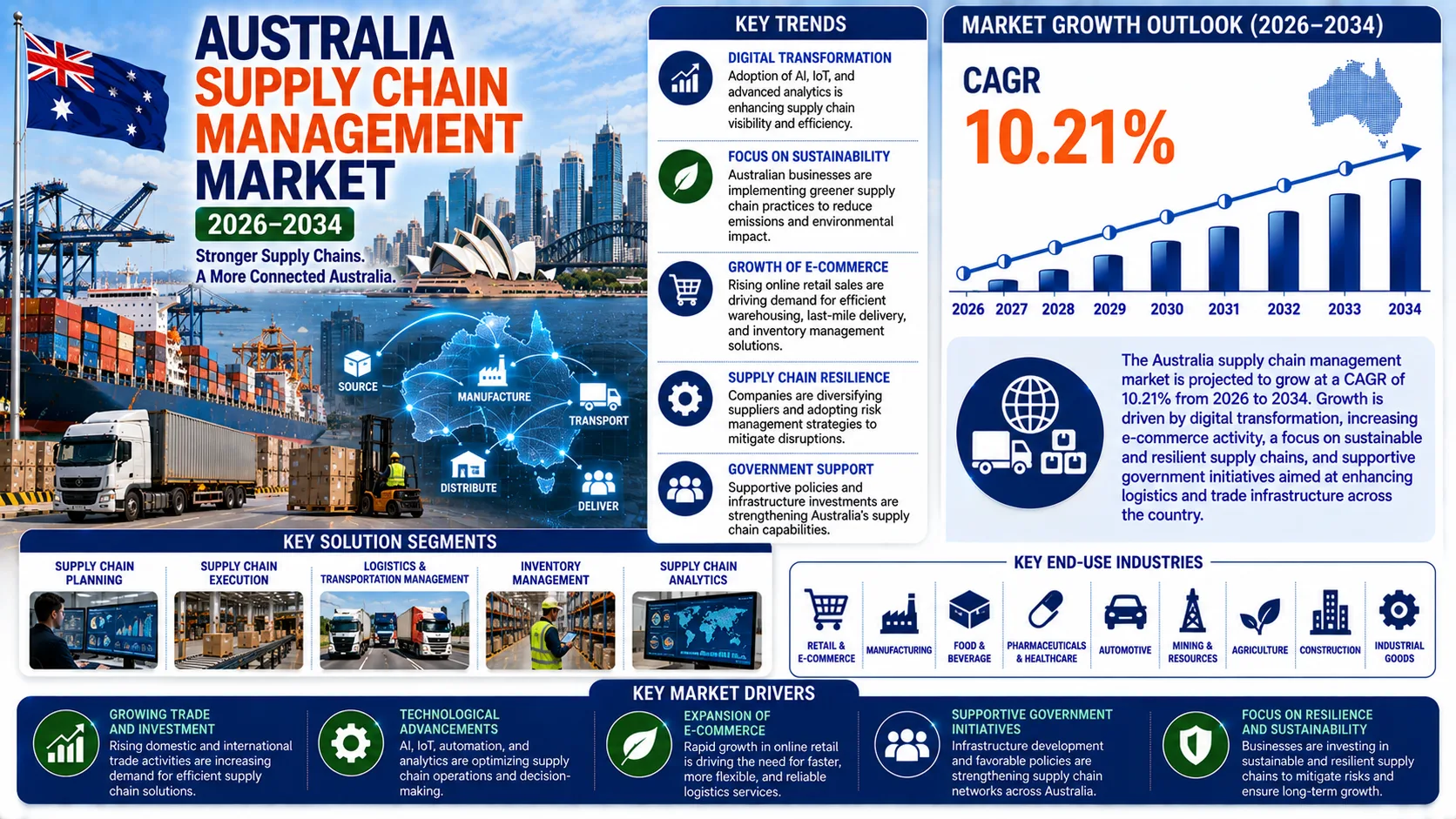
The Australia supply chain management market size reached USD 949.4 Million in 2025 and is projected to reach USD 2,277.9 Million by 2034, exhibiting a CAGR of 10.21% during 2026-2034. The market is witnessing significant growth, driven by heightened emphasis on supply chain robustness, sustainability initiatives, and increased digital transformation. Moreover, businesses are rapidly adopting green practices and cutting-edge technologies to upgrade logistics, enhance efficiency, and improve supply chain networks, which, in turn, is favoring the market expansion. In August 2024, the Australian Government unveiled the 2024 Defense Digital Strategy, which encompasses deployment of AI to strengthen supply chain resilience.
Request a Sample Report for In-Depth Market Insights: https://www.imarcgroup.com/australia-supply-chain-management-market/requestsample
Australia Supply Chain Management Market Summary
- The Australia supply chain management market encompasses solutions (transportation management, warehouse and inventory management, procurement, manufacturing execution) and services, deployed on-premises or on-demand, serving large enterprises and SMEs across retail, healthcare, manufacturing, food and beverage, transportation, and automotive sectors.
- These solutions are valued for their role in optimizing logistics, enhancing visibility, improving efficiency, and building resilience in supply chain operations.
- The ecosystem includes supply chain software vendors, logistics providers, technology partners, government agencies, and enterprises.
- Major segments identified in the market include component (solution, services), deployment mode (on-premises, on-demand), enterprise size (large enterprises, SMEs), industry vertical (retail, healthcare, manufacturing, food and beverage, transportation, automotive), and region.
- The market is benefiting from a surge in automation and digital transformation, increasing shift toward green supply chains and sustainability, and magnifying emphasis on supply chain resilience.
- In February 2024, Palantir Technologies and Coles Supermarket announced a strategic partnership to enhance the retail chain's supply chain functions by adopting advanced AI tools.
PORTER'S FIVE FORCES ANALYSIS
- Competitive Rivalry: High, with numerous global and local software vendors and logistics providers competing on technology, functionality, and service. Business implication: Companies must differentiate through AI capabilities, integration, and industry-specific solutions.
- Supplier Power (Technology and Platforms): Moderate. Suppliers of SCM software and cloud platforms have some leverage, but the presence of multiple vendors and open-source alternatives moderates this power. Business implication: Providers should maintain diverse technology partnerships.
- Buyer Power (Enterprises): Moderate to high. Large enterprises have bargaining power through volume purchasing and multi-year contracts, but the critical nature of SCM solutions gives vendors some leverage. Business implication: Vendors must focus on innovation, integration, and value-added services.
- Threat of Substitutes: Low. While in-house solutions are an alternative, the complexity and sophistication of modern supply chains favor specialized vendors. Business implication: The industry should emphasize the expertise and innovation of specialized providers.
- Threat of New Entrants: Moderate. Higher barriers for established vendors (scale, R&D, brand), but lower barriers for niche and AI-focused entrants. Business implication: Established players should build defensible positions through innovation, partnerships, and industry expertise.
MARKET GROWTH DRIVERS
Surge in Automation and Digital Transformation
Australia supply chain management market is experiencing a substantial inclination toward automation and digital transformation. Automation in warehousing, including deployment of robotics for packing and picking, is significantly minimizing errors and labor. Companies are rapidly adopting cutting-edge technologies, such as IoT, blockchain, and AI to improve visibility, upgrade operations, and enhance forecast precision. In August 2024, the Australian Government unveiled the 2024 Defense Digital Strategy, which encompasses deployment of AI to strengthen supply chain resilience. The incorporation of such technologies facilitates real-time goods tracking, optimization of logistics, and forecasted management of equipment.
Increasing Shift Toward Green Supply Chains and Sustainability
Sustainability is increasingly becoming a prime objective in the Australia supply chain management market, primarily driven by heightened regulatory strains and environmental awareness. According to the Australian Government Department of Health and Aged Care, it is evaluated that global supply chains account for approximately 75% of the carbon footprint of the health sector in Australia. In response, major companies are rapidly adopting eco-friendly methods, including leveraging renewable energy sources, minimizing waste, and lowering carbon emissions. Businesses are intensely emphasizing upgrading transportation routes and utilizing sustainable raw materials to decrease their carbon footprint.
Magnifying Emphasis on Supply Chain Resilience
The recent global interruptions, such as the COVID-19 pandemic, have highlighted the urgent requirement for robust supply chains in Australia. According to a research article published in June 2023, more than 60% businesses in Australia were impacted by the pandemic, with the manufacturing industries experiencing the most significant impact. Most of the businesses are increasingly prioritizing tactics that lower risks and facilitate continuity during global disruptions. Such strategies include heavy investments in local sourcing, deployment of resilient framework for risk management, and diversification of supplier network.
AUSTRALIA SUPPLY CHAIN MANAGEMENT MARKET SEGMENTATION
Component Insights:
- Solution
- Transportation Management System
- Planning and Analytics
- Warehouse and Inventory Management System
- Procurement and Sourcing
- Manufacturing Execution System
- Services
- Professional Services
- Managed Services
Deployment Mode Insights:
- On-premises
- On-demand
Enterprise Size Insights:
- Small and Medium Enterprises (SMEs)
- Large Enterprises
Industry Vertical Insights:
- Retail and Consumer Goods
- Healthcare and Pharmaceuticals
- Manufacturing
- Food and Beverages
- Transportation and Logistics
- Automotive
- Others
Regional Insights:
- Australia Capital Territory & New South Wales
- Victoria & Tasmania
- Queensland
- Northern Territory & Southern Australia
- Western Australia
COMPETITIVE LANDSCAPE
The Australia supply chain management market features a competitive landscape of numerous global and local software vendors and logistics providers competing on technology, functionality, and service. Competition is intensifying as companies invest in AI capabilities, integration, and industry-specific solutions. Differentiation occurs through AI capabilities, integration, and industry-specific solutions.
Key players mentioned in the report context include:
- Palantir Technologies Inc.
- Fujitsu
- Blue Yonder
- (Complete list provided in the full report)
REGIONAL ANALYSIS
- ACT & New South Wales: A key market driven by Sydney's status as Australia's economic hub, with a high concentration of corporate headquarters, retailers, and logistics providers. The region leads in adoption of advanced SCM technologies and digital transformation initiatives.
- Victoria: A significant market with Melbourne's strong retail, manufacturing, and logistics sectors. Victoria benefits from major port infrastructure and a growing focus on supply chain resilience and sustainability.
- Queensland: A growing market with expansion driven by population growth, increasing e-commerce activity, and infrastructure development. Queensland's resource and agricultural sectors also drive demand for specialized SCM solutions.
- Western Australia: A growing market driven by Perth's mining and resource sector, which requires efficient logistics and supply chain management for remote operations. The region's export-oriented economy supports demand for integrated SCM platforms.
- NT & South Australia: Emerging markets with growing SCM demand, supported by infrastructure development, government initiatives, and increasing awareness of digital supply chain benefits. These regions benefit from improving connectivity and logistics networks.
RECENT INDUSTRY DEVELOPMENTS
August 2026: Supply-chain resilience remained a major priority for Australian businesses amid geopolitical disruptions, elevated freight costs and uncertainty across global trade routes. The Queensland Government reported that global container freight rates increased 23% during May 2026 to around US$2,800 per 40-foot container, while shipping reliability remained below historical levels.
August 2026: The Australian Government accelerated financial support for supply-chain resilience. Businesses gained access to A$6.15 billion in concessional funding, including a A$1 billion Economic Resilience Program providing zero-interest loans to eligible businesses involved in critical supply chains such as freight, fuel, plastics and fertilisers.
August 2026: Digitalisation and AI are becoming increasingly important in supply-chain management. DHL's 2026 industry assessment identifies agentic AI, automated shipment rerouting, inventory optimisation and automated supplier communication as emerging capabilities, while Australian businesses are increasingly using AI and data analytics to improve visibility and operational decision-making.
August 2026: Warehouse automation is continuing to expand as businesses seek higher productivity and greater resilience. DHL opened a 21,078-square-metre multi-customer facility in Erskine Park, Western Sydney, in March 2026, adding capacity for technology and automotive supply chains and integrating storage, distribution and value-added services.
August 2026: Industrial and logistics property demand remains supportive of supply-chain infrastructure investment. CBRE recorded approximately 680,000 square metres of gross industrial and logistics take-up in Q1 2026, while about 700,000 square metres of new supply was delivered during the quarter. Nearly 40% of the 2026–27 supply pipeline was already pre-committed.
August 2026: Sustainability is becoming more closely integrated into supply-chain management. Mandatory climate reporting for Australia's largest companies is increasing the need for businesses to measure supply-chain emissions, while logistics operators are investing in route optimisation, lower-emission transport and energy-efficient warehousing. DHL also identifies carbon reporting and sustainable logistics as key 2026 priorities.
August 2026: Freight-network investment is being positioned as a long-term supply-chain resilience measure. Infrastructure Australia highlighted high-productivity freight networks and intermodal connectivity as national investment priorities, noting that domestic freight could increase by up to 26% between 2020 and 2050, while road freight is expected to rise substantially faster than rail freight.
August 2026: Supply-chain resilience is also being incorporated into Australia's industrial and investment policy. The National Reconstruction Fund's 2026 investment framework explicitly prioritises industrial capability, supply-chain resilience, decarbonisation, regional development and circular-economy outcomes, broadening the role of supply-chain management from operational efficiency toward national economic resilience.
Key Aspects Required for the Australia Supply Chain Management Market
- Market Performance: USD 949.4 Million in 2025, with a projected trajectory to USD 2,277.9 Million by 2034.
- Market Outlook: A 10.21% CAGR through 2034 indicates robust growth across components and verticals, driven by digital transformation, sustainability, and resilience demands.
- Growth Drivers: Surge in automation and digital transformation; increasing shift toward green supply chains and sustainability; magnifying emphasis on supply chain resilience; geographic diversity and demand for intermodal transport; technological innovations; and sustainability pressures and regulatory compliance.
- Competitive Landscape: A competitive market with global and local vendors. Differentiation occurs through AI capabilities, integration, and industry-specific solutions.
- Value Chain Analysis: From solution development and service provision through deployment and integration to end-use by enterprises across industries, with digital transformation and sustainability shaping market dynamics.
- Industry Trends: Surge in automation and digital transformation; increasing shift toward green supply chains and sustainability; magnifying emphasis on supply chain resilience; expansion of e-commerce and omnichannel retail; and logistics innovation in remote and regional areas.
- Strategic Recommendations: Invest in AI and IoT-enabled SCM solutions; develop sustainability and green supply chain capabilities; expand regional and remote logistics solutions; leverage government incentives and infrastructure investments; and target e-commerce and omnichannel retail opportunities.
Note: If you need any specific information that is not currently covered within the scope of the report, we will provide the same as a part of customization.
Speak to an analyst: https://www.imarcgroup.com/request?type=report&id=24724&flag=C
Report Format, Delivery, and Customization Details
- Report Format Mode: PDF and Excel (Editable version in PPT/Word format available on special request)
- Report Delivery Mode: Online Delivery, Physical Delivery
- Report Delivery Time: report delivered over email within 24 to 48 hours. If requested by the client, a physical copy will be delivered within three to ten days.
- Report Confirmation Mode: Yes, via email
- Report Customization Mode: Yes, via Email / Call
- Report Table of Content: Yes
- Report List of Figures: Yes
- Report Methodology Mode: Yes
- Request For Sample Report: Yes
About Us
IMARC Group is a global management consulting firm that helps the world's most ambitious changemakers to create a lasting impact. The company provides a comprehensive suite of market entry and expansion services. IMARC offerings include thorough market assessment, feasibility studies, company incorporation assistance, factory setup support, regulatory approvals and licensing navigation, branding, marketing and sales strategies, competitive landscape and benchmarking analyses, pricing and cost research, and procurement research.
Contact Us
IMARC Group
134 N 4th St., Brooklyn, NY 11249, USA
Email: sales@imarcgroup.com
Tel No: (D) +91 120 433 0800
United States: +1-201-971-6302