Nobody joins a finance or operations team hoping to spend their days chasing purchase approvals, reconciling mismatched invoices, or following up with vendors about orders that should have arrived last week.
Yet for most teams operating without structured procurement, this is exactly where time goes. Not into analysis. Not into strategy. Into the grind of managing a process that was never properly designed.
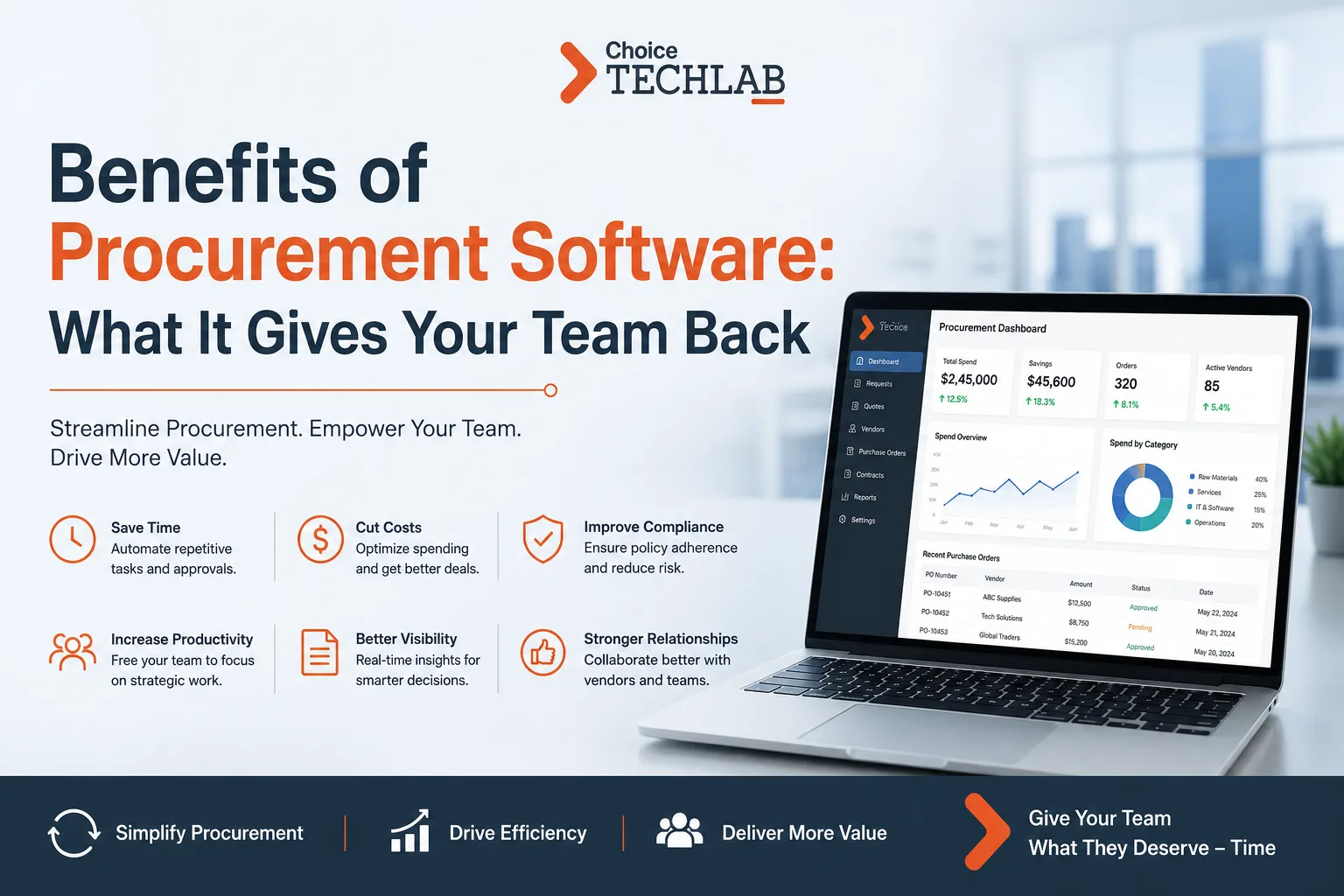
The benefits of procurement software are frequently framed around cost savings and efficiency metrics. Both are valid. But the more immediate and human benefit is simpler: it gives your team their time and energy back.
The Hidden Workload Nobody Accounts For
Manual procurement is deceptively labour intensive. On the surface, it looks like a series of simple tasks. Send a purchase request. Get approval. Place an order. Receive the goods. Pay the invoice.
In practice, each of these steps generates multiple touchpoints. Emails that need follow-up. Approvals that get stuck. Vendors who need reminders. Invoices that do not match purchase orders. Discrepancies that need investigation.
When this happens across dozens of purchases a week, the cumulative workload is significant. And because it is distributed across multiple people in multiple departments, it rarely shows up clearly on any single person's task list. It just quietly consumes capacity that could be used elsewhere.
One of the foundational benefits of procurement software is that it compresses this hidden workload dramatically — automating the routine so people can focus on the consequential.
Approval Fatigue Is a Real Operational Problem
In organizations without structured procurement, approvals often become the single biggest source of delay and frustration.
Requests sit in inboxes waiting for managers who are in meetings, traveling, or simply overwhelmed. Urgency forces shortcuts. Purchases get made informally to avoid the bottleneck. And by the time the formal approval comes through, the purchase has already happened through an unofficial channel.
This is not a discipline problem. It is a design problem. When approval processes are not built into a system, they depend entirely on individual responsiveness — which is inherently unreliable at scale.
Procurement software replaces this with structured digital workflows. Requests are routed automatically to the right approvers based on predefined rules. Reminders are sent without anyone having to chase. Approvals happen faster because the process is clear, visible, and tracked.
The benefits of procurement software here are felt immediately — less back and forth, fewer delays, and a process that moves forward without constant human intervention.
Vendor Relationships Suffer Without Structure
Managing vendors manually is manageable when you have five. It becomes unworkable when you have fifty.
Without a central system, vendor information is scattered. Contracts live in email threads. Performance history is remembered rather than recorded. Pricing agreements are informal. Renewal dates are missed. And when the person who managed a particular vendor relationship leaves the organization, their knowledge leaves with them.
This fragility has real consequences. Businesses end up overpaying vendors they cannot negotiate with because they lack historical data. They miss contract renewals because nobody was tracking them. They continue working with underperforming vendors because there is no documented basis for switching.
Procurement software centralizes every vendor interaction — contracts, communications, performance records, and pricing history — in one accessible place. Teams gain the institutional knowledge they need to manage vendor relationships with consistency and confidence. This is one of the most strategically valuable benefits of procurement software for any growing organization.
The Cost of Context Switching
One of the less discussed costs of manual procurement is context switching — the cognitive tax of constantly moving between emails, spreadsheets, phone calls, and disparate systems to manage a single purchase.
Research consistently shows that context switching reduces productivity significantly. When team members have to piece together information from multiple sources just to process a routine purchase, the cognitive load adds up quickly.
Procurement software eliminates this by consolidating everything into a single workflow. Requests, approvals, vendor communications, order tracking, and invoice matching all happen within one system. Team members always know where things stand without having to check multiple places.
The reduction in context switching is one of the quieter benefits of procurement software — but its impact on team productivity and morale is substantial.
Giving Finance Teams Forward Visibility
Finance teams in manual procurement environments are perpetually working with incomplete information. They know what was spent last month. They rarely know what is committed to be spent this week.
Purchase orders are raised informally. Verbal commitments are made without documentation. By the time invoices arrive, the spending decision is already history. Budget management becomes a retrospective exercise rather than a proactive one.
Procurement software captures financial commitments at the point of request — not at the point of payment. This gives finance teams real time visibility into what has been approved, what is pending, and what is available. Budget decisions improve because the information supporting them is current and complete.
Reducing Errors That Compound Over Time
Manual procurement is error-prone by nature. Duplicate orders get placed when communication breaks down. Invoices get paid twice because matching is done manually. Quantities get misrecorded. Vendor details get entered inconsistently across systems.
Individually, these errors are manageable. Collectively, they add up to significant financial leakage and reconciliation work.
The benefits of procurement software include automated validation at every stage of the purchase cycle. Duplicate submissions are flagged. Invoice amounts are matched against purchase orders. Vendor details are standardized. Errors that would otherwise slip through are caught before they create downstream problems.
Conclusion
The benefits of procurement software are ultimately about more than operational efficiency. They are about giving teams the structure, visibility, and breathing room they need to do their best work.
When procurement is unstructured, the people managing it absorb the cost — in time, in cognitive load, and in the daily friction of working around a process that was never properly designed. When it is structured through the right system, that cost disappears and what remains is a function that actually supports the business.
Solutions like Prime Procurement by Choice TechLab are built with this balance in mind — streamlining the procurement process so teams spend less time managing it and more time contributing to the work that actually moves the business forward.
Because the best procurement process is one your team barely notices — because it simply works.