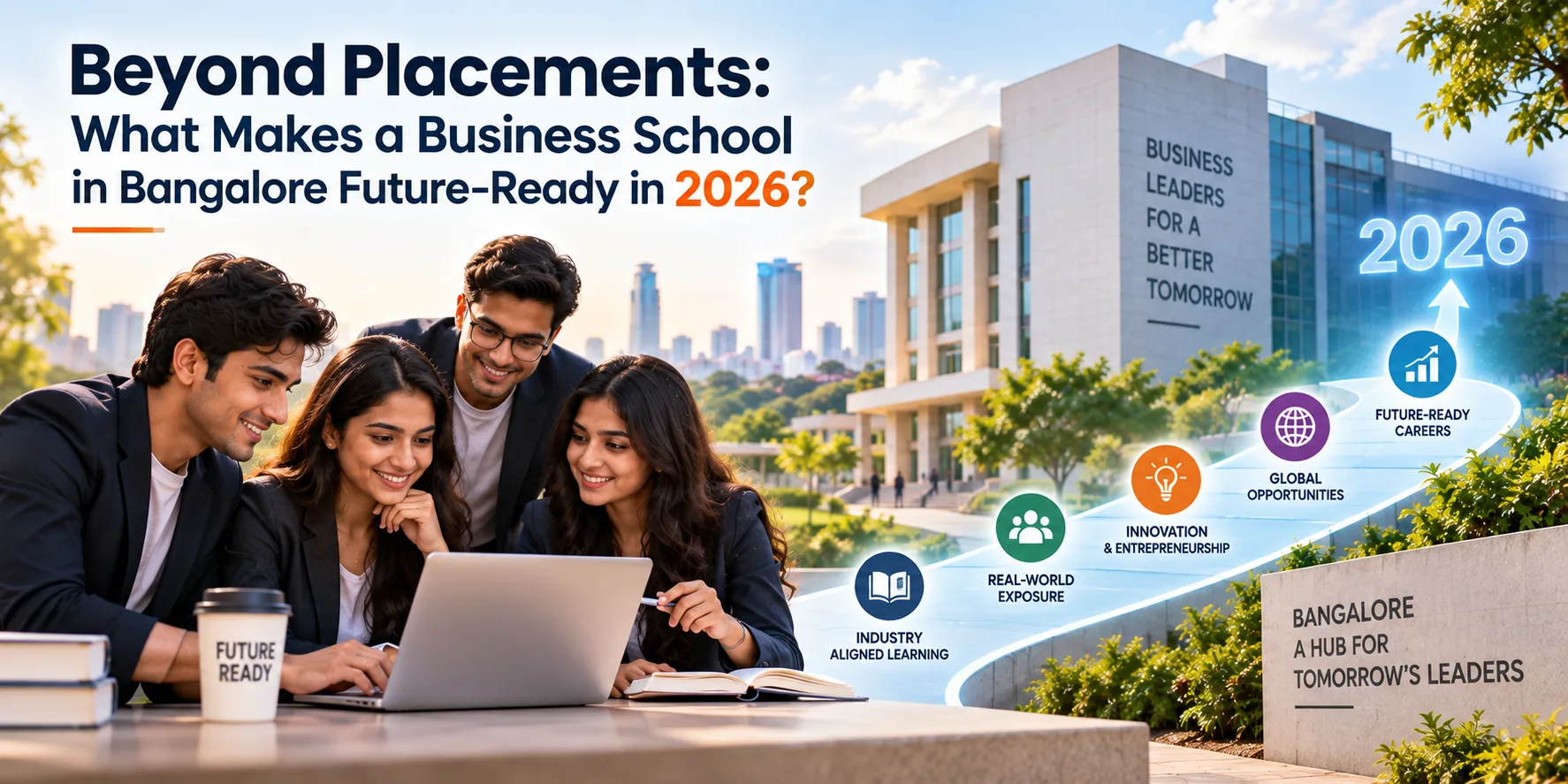
Choosing a management college is no longer just about finding a campus with impressive placement numbers. In 2026, students are looking for education that can prepare them for changing industries, new technologies, and evolving career expectations. This is why the best business schools in Bangalore are increasingly being evaluated on what they offer beyond a degree and a placement package.
Bangalore has long been one of India's major education and business destinations. With its strong startup ecosystem, technology companies, global organisations, and growing entrepreneurial culture, the city offers an environment where management education can connect closely with the real business world.
But what actually makes a business school future-ready?
The answer goes far beyond rankings.
The MBA Experience Is Changing
The traditional MBA model focused heavily on classroom teaching, examinations, textbooks, and recruitment at the end of the programme.
That approach is changing.
Companies today expect graduates to understand technology, communicate effectively, analyse information, solve practical problems, and adapt quickly. An MBA student may enter a workplace where artificial intelligence, automation, data analytics, digital marketing, remote collaboration, and new business models are already part of everyday operations.
As a result, management education needs to keep pace.
A future-ready business school should help students develop the ability to learn, apply, adapt, and lead rather than simply memorise concepts for examinations.
What Does a Future-Ready Business School Look Like?
Being future-ready does not necessarily mean having the most expensive campus or the longest list of facilities.
It means creating an environment where students are exposed to the realities of modern business.
Here are some of the most important factors students should consider when evaluating business schools in Bangalore.
1. Industry Exposure Should Start Inside the Classroom
One of the biggest differences between theoretical education and industry-oriented education is how students learn.
A strong management programme should connect classroom concepts with real business situations. Instead of only discussing marketing strategies, students can analyse actual campaigns. Instead of learning finance only through formulas, they can understand how financial decisions affect businesses.
Guest sessions, industry interactions, case studies, workshops, business simulations, and live projects can make this learning more practical.
This kind of exposure helps students understand that business decisions rarely have one perfect answer.
2. Technology and AI Skills Are Becoming Essential
Technology is changing almost every business function.
Marketing teams use automation and analytics. Finance professionals work with digital tools. Human resource departments use technology for recruitment and employee management. Operations increasingly depend on data and intelligent systems.
MBA education does not mean every student needs to become a technology expert.
However, management graduates should understand how technology influences business decisions.
A future-ready institute should therefore encourage students to develop digital awareness, data interpretation skills, technology adaptability, and an understanding of emerging business tools.
These skills can become valuable across industries, regardless of the student's chosen specialisation.
3. Practical Projects Can Matter More Than Another Textbook
Students often understand a concept much better when they have to use it.
Imagine being asked to create a marketing plan for a real business, study customer behaviour, evaluate a company's financial performance, develop a business strategy, or solve an operational problem.
The learning experience becomes completely different.
Projects encourage students to research, discuss ideas, make decisions, work with others, and defend their recommendations.
This is one reason students comparing the best MBA colleges in Bangalore should look carefully at the practical learning opportunities available rather than focusing only on rankings or advertisements.
4. Internships Should Be Treated as Career Learning
An internship should not simply be viewed as a certificate to add to a resume.
It can be one of the first opportunities for a student to experience professional life.
During an internship, students may discover how teams communicate, how deadlines work, how customers behave, how managers make decisions, and how workplace expectations differ from classroom assignments.
The best learning often happens when students encounter a problem they have never faced before and have to figure out how to approach it.
Therefore, when evaluating an MBA institute in Bangalore, students should ask:
- Are internships encouraged?
- Can students work on practical assignments?
- Is there industry interaction?
- Does the programme provide opportunities to apply classroom learning?
- Are students guided in developing professional skills?
These questions can reveal much more about the learning experience than a brochure alone.
5. Communication and Leadership Cannot Be Replaced by Technology
Technology may change how businesses operate, but people will continue to make decisions, manage teams, negotiate, present ideas, and build relationships.
This makes communication and leadership skills extremely important.
A management graduate should be comfortable presenting an idea, participating in discussions, writing professional communication, handling disagreements, and working with people from different backgrounds.
Future-ready education should therefore create opportunities for presentations, group discussions, leadership activities, teamwork, public speaking, and professional interaction.
These experiences may appear simple, but they can have a major impact on a student's confidence.
6. Career Preparation Should Begin Before the Final Semester
Career development should not start a few weeks before placement interviews.
Students need time to understand their strengths, identify suitable career paths, improve their resumes, develop interview skills, and build professional confidence.
A good business school can support this process through career counselling, skill-building sessions, mock interviews, industry interactions, resume development, and professional workshops.
The goal should not simply be to prepare students for one interview.
It should be to help them become employable professionals who can continue developing their careers after graduation.
7. Entrepreneurship Should Be Part of the Conversation
Not every management student wants to work for a large corporation.
Some may want to join a startup. Others may eventually build their own business. Some may work in family businesses or develop new ventures within existing organisations.
Bangalore's startup environment makes entrepreneurship particularly relevant to management education.
Exposure to business ideas, startup case studies, innovation activities, entrepreneurial thinking, and problem-solving can help students understand how businesses are created and scaled.
Even students who do not become entrepreneurs can benefit from entrepreneurial thinking because modern companies value employees who can identify opportunities and think creatively.
Why Bangalore Remains Attractive for Management Education
Bangalore offers something that textbooks cannot provide: proximity to a diverse business ecosystem.
The city is associated with technology, startups, consulting, finance, e-commerce, healthcare, manufacturing, and numerous other industries.
For students, this creates opportunities to observe how different sectors operate and understand the skills employers are looking for.
This is also why searches for MBA courses Bangalore continue to cover a wide range of interests. Students are no longer necessarily looking for one generic management experience. They are exploring programmes based on their career goals, interests, and preferred industries.
The city's professional environment can complement classroom learning when students actively take advantage of industry exposure, internships, networking events, projects, and other opportunities.
Don't Choose a Business School Only by Its Placement Package
Placement statistics naturally attract attention.
Students want to know what companies recruit from a campus and what career opportunities are available after graduation. These are legitimate considerations.
However, placement numbers should be only one part of the decision.
A student should also consider:
What will I learn?
How much practical exposure will I receive?
Will I develop professional confidence?
Can I interact with industry professionals?
Will I understand modern business technology?
What support will I receive when preparing for my career?
These questions help students evaluate the long-term value of their education rather than focusing on a single number.
AIMS IBS Business School and Industry-Oriented Learning
For students exploring management education in Bangalore, AIMS IBS Business School is one institution that places emphasis on connecting academic learning with practical business exposure.
Its approach includes areas such as industry interaction, professional skill development, business projects, internships, and career-oriented learning.
The important point for students is not simply the name of an institution. It is understanding whether its learning environment matches their personal career objectives.
Students should compare programmes carefully, explore the curriculum, understand the learning methodology, and evaluate the opportunities available before making a final decision.
How to Choose the Right Business School in 2026
There is no single business school that will be perfect for every student.
Someone interested in marketing may have different priorities from a student interested in finance. An aspiring entrepreneur may look for a different environment than someone targeting corporate management.
Before making a decision, students can follow a simple approach.
Start With Your Career Goal
Think about the type of career you want to explore.
You do not need to have your entire career planned. But having a general direction can help you identify suitable programmes and learning opportunities.
Look Beyond the Brochure
Visit the institution's official website, review the curriculum, understand the programme structure, and look for information about industry exposure and student activities.
If possible, speak with current students or alumni to understand their experience.
Evaluate Skills, Not Just Subjects
Ask yourself what skills you will have after completing the programme.
Can you analyse a business problem?
Can you present a solution?
Can you work with a team?
Can you interpret data?
Can you communicate professionally?
Can you adapt to new technology?
These skills can influence your career long after your degree is completed.
Consider the Overall Learning Environment
The campus environment, faculty interaction, peer group, projects, extracurricular activities, industry exposure, and career support can all contribute to the overall experience.
A good management education experience is not created by one factor.
It is the combination of many small learning opportunities.
The Future Belongs to Adaptable Graduates
Nobody can predict exactly what the business world will look like five or ten years from now.
New technologies will emerge. Some job roles will change. New industries will grow. Businesses will adopt different models.
That uncertainty makes adaptability one of the most valuable skills for management graduates.
A future-ready business school should therefore encourage students to remain curious.
Instead of asking only, “What job will I get after my MBA?”, students should also ask:
“What capabilities will help me build a successful career even when the business environment changes?”
That shift in thinking can make the college selection process much more meaningful.
Final Thoughts
The definition of a good business school is changing.
In 2026, students should look beyond impressive placement headlines and consider the complete learning experience. Industry exposure, practical projects, technology awareness, communication skills, leadership development, internships, entrepreneurship, and career preparation can all contribute to becoming a stronger management professional.
Bangalore provides an excellent environment for this kind of education because of its diverse business and startup ecosystem.
Whether you are comparing business schools in Bangalore, exploring an MBA programme, or planning your next academic step, the most important question is not simply which institution looks impressive today.
It is whether the learning environment can help you become ready for tomorrow.
Choose an education that builds skills, not just a qualification.