Shopping for a water softener used to mean a home visit from a salesperson and a pressure-heavy pitch for whatever unit carried the best commission. That's changed. Today, most homeowners Buy Water Softener Online directly, often at a meaningfully lower price than a dealer-installed system, without sacrificing quality as long as you know what to actually look for in a listing before you buy. This guide covers exactly that.
Why Buying Online Has Become the Standard Approach
The price gap between a dealer-installed softener and a direct-to-consumer online purchase is almost entirely labor and sales commission, not equipment quality. Buying online typically means:
- Lower prices, since you're not paying for a salesperson's home visit or a dealer's markup on top of the manufacturer's cost
- More transparent specifications, with grain capacity, resin type, and control valve details listed directly rather than filtered through a sales pitch
- The flexibility to install yourself or hire a local plumber, rather than being locked into whatever installation service the dealer bundles in
- Direct access to manufacturer support and documentation, which matters more than it sounds like it should when you're troubleshooting a setting six months after installation
The trade-off is that you're responsible for understanding your own sizing and specification needs, since there's no in-home sales visit walking you through it which is exactly why getting the fundamentals right before buying matters so much.
Residential Water Softener Basics: What You're Actually Buying
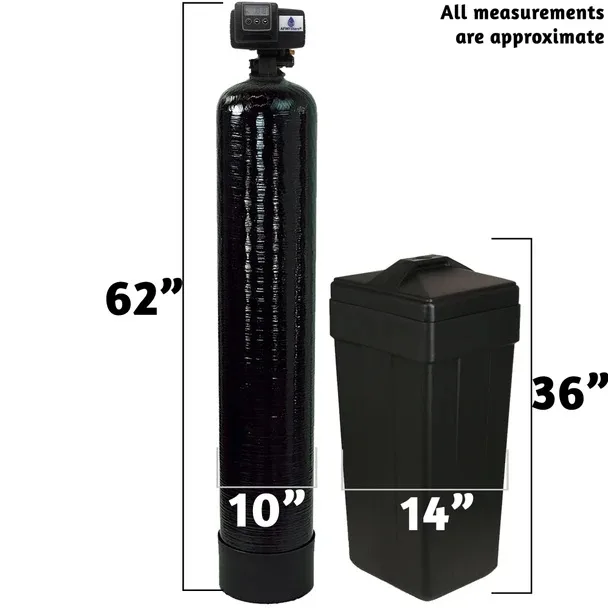
Before comparing specific listings, it helps to understand the core components that make up a residential water softener system, since these are what actually determine performance and price:
- Resin tank contains the ion-exchange resin beads that trap calcium and magnesium as water passes through
- Control valve the "brain" of the system, managing regeneration cycles; metered, on-demand control valves (which regenerate based on actual water usage rather than a fixed timer) are generally more efficient and are the standard on most quality modern systems
- Brine tank holds the salt solution used to regenerate (recharge) the resin bed during each cycle
- Resin type and percentage higher cross-link resin (commonly sold as 8% or 10%) generally offers longer resin life and better resistance to chlorine degradation than lower-grade resin
Sizing: The Single Most Important Spec to Get Right
Grain capacity the amount of hardness a system can remove before needing to regenerate is the specification most likely to be misunderstood when buying online, and getting it wrong leads directly to a system that either regenerates too often (wasting salt and water) or fails to keep up with demand.
Sizing depends on two numbers multiplied together:
- Household size more people means more daily water usage, which increases the total grains of hardness that need removing between regenerations
- Water hardness level, measured in grains per gallon (GPG) available from a home water test or your municipal utility's water quality report
As a general framework:
- 1–3 person households with moderate hardness typically do well with a 32,000-grain system
- 3–5 person households, or households with higher hardness levels, generally need a 40,000 to 48,000-grain system
- Larger households or notably hard water may benefit from a twin-tank system, providing continuous soft water even during regeneration cycles, since one tank can regenerate while the other stays in service
Buying oversized isn't necessarily wasteful, since a larger system regenerates less frequently and uses less salt and water over time relative to demand but undersizing is the mistake to actively avoid, since it results in inconsistent softening performance and more frequent regeneration cycles than necessary.
Whole House Water Conditioner System: What "Complete" Should Include
When comparing listings for a Whole House Water Conditioner System, look specifically for what's actually included, since pricing can vary significantly based on what's bundled versus sold separately:
- Both tanks (resin and brine), not just the control valve or resin tank alone
- A bypass valve, allowing the system to be temporarily bypassed for maintenance without shutting off water to the entire house
- Installation fittings and adapters matched to standard plumbing sizes
- Documentation and installation instructions, ideally detailed enough for a confident DIY installer to follow without guesswork
- Warranty coverage on both the control valve (commonly 5 years) and the tank (commonly 10 years) these are separate warranty terms worth confirming individually, since tank and valve failures are handled differently
Combo Water Softener and Filter: When Bundling Makes Sense
A Combo Water Softener And Filter system pairs a softener with an additional filtration stage commonly an upflow carbon filter in a single combined purchase. This is worth considering specifically when:
- Your water has both hardness and chlorine/taste issues, since municipal water frequently presents both problems together
- You want simplified installation, since a combo system is plumbed as one connected unit rather than two entirely separate systems
- The carbon component uses an upflow, non-backwashing design, which typically means no additional electricity or drain line requirement beyond what the softener itself needs
Price of Water Softener System: What Actually Drives the Range
The Price Of Water Softener System options varies substantially, generally landing somewhere between $500 and $2,000 for the equipment itself (before any installation labor), with a few factors accounting for most of the difference:
- Grain capacity higher-capacity systems cost more than smaller units sized for lighter demand
- Resin quality upgraded 10% cross-link resin typically costs more than standard 8% resin but offers longer service life
- Control valve type metered, on-demand valves generally cost more than simple timer-based valves but operate more efficiently, using less salt and water over time
- Single-tank vs. twin-tank configuration twin-tank systems, offering continuous soft water, cost more than single-tank equivalents
- Bundled components, like an added carbon filter or pH neutralizer in a combo system, which add to the base price but consolidate what would otherwise be a separate purchase
What to Verify Before Completing an Online Purchase
- Confirm grain capacity matches your specific household size and hardness level not just a generic "whole house" label
- Check what's included versus sold separately tanks, bypass valve, fittings, and documentation should be clearly itemized
- Look for genuine customer feedback on post-purchase support, since online buying means you're relying more heavily on manufacturer documentation and customer service than an in-person sales relationship
- Confirm warranty terms for both the valve and the tank separately, since these often carry different coverage lengths
Final Thoughts
You can confidently Buy Water Softener Online as long as you go in with the right numbers your household size, your water's hardness level, and a clear understanding of what's actually included in the listing price. Get the sizing and specifications right, and an online purchase typically delivers better value than a dealer-installed system without any real trade-off in quality or long-term support.