Introduction
As global sustainability initiatives continue to gain momentum, carbon credit exchanges have emerged as critical infrastructure for facilitating transparent and efficient carbon trading. Governments, enterprises, financial institutions, and environmental organizations are increasingly participating in carbon markets to offset emissions, meet regulatory requirements, and achieve ambitious net-zero goals. This growing demand has accelerated the need for secure, scalable, and technology-driven carbon credit exchanges.
Unlike traditional trading platforms, modern carbon credit exchanges must handle complex processes such as carbon credit verification, regulatory compliance, transaction management, registry integration, and secure settlements. They also need to provide a seamless user experience for multiple stakeholders while ensuring transparency throughout the carbon credit lifecycle.
Building such an exchange requires careful planning and the right technology stack. From designing an efficient trading engine to integrating with trusted carbon registries, every component contributes to creating a reliable marketplace that inspires confidence among buyers and sellers.
At Triple Minds, we've seen organizations increasingly invest in digital carbon exchanges that combine robust trading capabilities with advanced technologies like blockchain, AI, and real-time analytics. Developing an exchange with these capabilities not only improves operational efficiency but also prepares businesses for the rapidly evolving carbon economy.
In this guide, we'll walk through the fundamentals of carbon credit exchange development, explain how these exchanges operate, explore their essential features, and discuss the technologies and best practices required to build a future-ready trading platform.
What Is Carbon Credit Exchange Development?
Carbon credit exchange development is the process of designing, building, and deploying a digital platform that enables organizations to buy, sell, verify, transfer, and retire carbon credits in a secure and transparent environment. These exchanges act as centralized ecosystems where multiple stakeholders interact while ensuring every transaction follows established environmental and regulatory standards.
Businesses investing in carbon trading marketplace development often expand beyond simple listing platforms by incorporating sophisticated exchange capabilities such as automated order matching, real-time pricing, registry integrations, secure payment infrastructure, and compliance management. The objective is to create a marketplace where carbon credits can be traded efficiently while maintaining complete transparency throughout the transaction lifecycle.
Although the terms marketplace and exchange are sometimes used interchangeably, a carbon credit exchange generally provides more advanced trading functionality. In addition to listing verified carbon credits, exchanges support structured trading mechanisms, improve market liquidity, and enable participants to execute transactions more efficiently.
A typical carbon credit exchange serves multiple participants, including:
- Project Developers that generate verified carbon credits through environmental initiatives.
- Corporate Buyers seeking carbon offsets to meet sustainability targets.
- Carbon Credit Sellers offering verified credits for trading.
- Verification Agencies responsible for validating environmental projects.
- Carbon Registries that issue and maintain official ownership records.
- Marketplace Administrators who oversee operations, compliance, and platform governance.
By bringing these participants together within a unified digital ecosystem, carbon credit exchanges simplify trading while improving trust, efficiency, and regulatory compliance across the carbon market.
How Does a Carbon Credit Exchange Work?
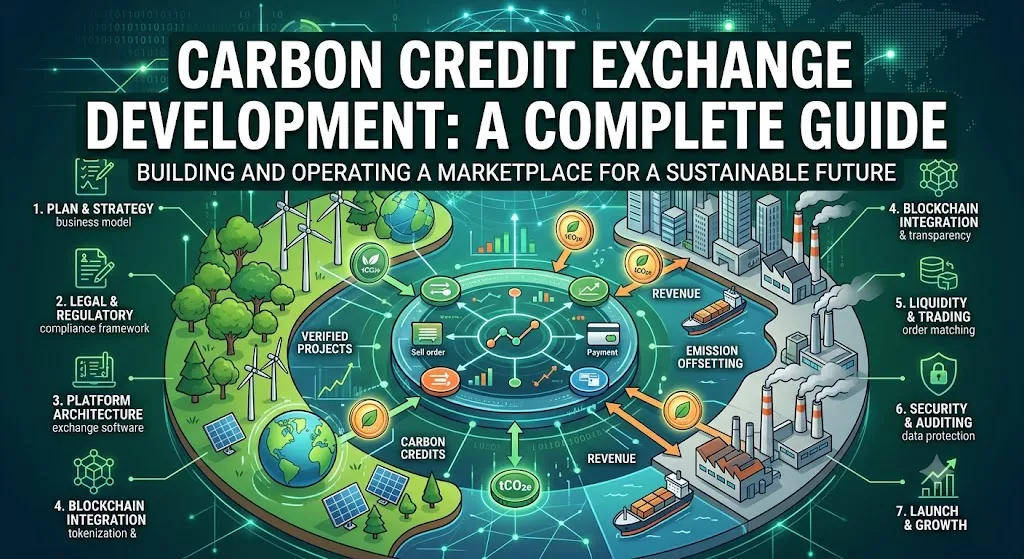
A carbon credit exchange follows a structured workflow that ensures every carbon credit traded on the platform is authentic, traceable, and securely transferred between participants. While individual platforms may differ in their implementation, the overall process follows several common stages. The journey begins with user onboarding. Organizations create accounts, complete identity verification, and undergo Know Your Customer (KYC) and Anti-Money Laundering (AML) checks before receiving access to the platform. This helps maintain marketplace integrity and prevents fraudulent activity.
Next, verified carbon credits are submitted for listing. Project developers provide supporting documentation, certification details, and registry references, allowing the exchange to validate the authenticity of each credit before it becomes available for trading. Once listed, buyers can browse available credits using advanced search and filtering tools. Depending on the platform's trading model, they may purchase credits at fixed prices, place bids, participate in auctions, or execute trades through an automated matching engine.
After a trade is completed, ownership of the carbon credits is securely transferred to the buyer. Many exchanges integrate directly with recognized carbon registries to synchronize ownership records and ensure every transaction is accurately reflected within the official registry. Finally, organizations can choose to retain purchased credits within their portfolio or permanently retire them to offset greenhouse gas emissions. Retirement removes the credits from circulation, preventing future resale and ensuring each credit is used only once.
Throughout this process, the exchange continuously generates transaction records, audit logs, and sustainability reports that support regulatory compliance, financial transparency, and corporate ESG reporting.
A well-designed carbon credit exchange automates much of this workflow, reducing manual effort while providing a secure, transparent, and efficient trading experience for every participant.
Essential Features of a Carbon Credit Exchange
Building a successful carbon credit exchange requires more than enabling buyers and sellers to trade carbon credits. The platform must provide a secure, transparent, and scalable ecosystem capable of supporting regulatory compliance, high transaction volumes, and seamless user experiences. The right feature set not only improves operational efficiency but also builds trust among participants and ensures the exchange can evolve alongside the rapidly growing carbon market.
Below are the core features every modern carbon credit exchange should include.
User Registration & KYC
Every carbon credit exchange begins with secure user onboarding. Since participants engage in financial transactions and environmental compliance activities, robust identity verification is essential to maintaining marketplace integrity.
The registration process should support multiple participant types, including corporate buyers, project developers, brokers, verification agencies, and administrators. Each role requires different permissions, making role-based access control (RBAC) an important part of the platform's security framework.
To comply with financial regulations and reduce fraudulent activities, exchanges should implement Know Your Customer (KYC) and Anti-Money Laundering (AML) procedures during onboarding. Additional security measures such as multi-factor authentication (MFA), encrypted credentials, and login monitoring further strengthen user protection.
Key capabilities include:
- Secure account registration
- Corporate and enterprise onboarding
- KYC and AML verification
- Multi-factor authentication (MFA)
- Role-based access control
- Organization profile management
- Login history and activity tracking
A secure onboarding process establishes trust while ensuring only verified participants can access the exchange.
Carbon Credit Listings
Carbon credit listings serve as the marketplace's inventory, allowing buyers to discover verified environmental projects and compare available credits before making purchasing decisions.
Every listing should present comprehensive project information, including certification standard, project location, project type, issuance date, available credit quantity, pricing, and retirement status. Providing detailed information enables buyers to evaluate the credibility and environmental impact of each carbon credit with confidence.
To improve usability, the exchange should also offer advanced search and filtering options that allow users to narrow results by registry, project category, geographical region, certification type, price range, or sustainability objective.
Essential listing capabilities include:
- Detailed project profiles
- Carbon credit availability
- Certification and registry information
- Supporting project documentation
- Advanced search functionality
- Dynamic filters
- Sorting by price, registry, or project type
- Saved searches and watchlists
Well-structured listings improve transparency and simplify the carbon credit selection process for marketplace participants.
Trading Engine & Order Matching
The trading engine is the core component of any carbon credit exchange. It manages buy and sell orders, executes transactions, and ensures fair price discovery across the marketplace.
Modern exchanges should support multiple trading mechanisms to accommodate different business requirements. While some participants prefer immediate purchases at fixed prices, others rely on auction-based trading or over-the-counter (OTC) negotiations for larger transaction volumes.
An intelligent order-matching system automatically pairs compatible buy and sell orders based on pricing rules and marketplace conditions, reducing manual intervention while increasing transaction efficiency.
Important trading capabilities include:
- Buy and sell order management
- Automated order matching
- Fixed-price transactions
- OTC trading
- Auction-based trading
- Real-time market pricing
- Trade confirmations
- Transaction history
- Order management dashboard
A reliable trading engine improves liquidity, accelerates transactions, and delivers a seamless trading experience for all marketplace participants.
Carbon Registry Integration
Trust and transparency are fundamental to every carbon credit exchange. Direct integration with recognized carbon registries helps verify the authenticity of carbon credits while preventing duplication and maintaining accurate ownership records.
Carbon registries issue verified carbon credits and maintain official records throughout their lifecycle. Integrating with these registries enables exchanges to automatically validate certification details, synchronize ownership changes, and update retirement statuses without relying on manual processes.
Common registry integrations include:
- Verra
- Gold Standard
- American Carbon Registry (ACR)
- Climate Action Reserve (CAR)
- Regional compliance registries
Registry integration enables exchanges to:
- Verify carbon credit authenticity
- Synchronize ownership records
- Prevent duplicate listings
- Track retirement status
- Improve marketplace transparency
- Simplify compliance reporting
By connecting directly with trusted registries, exchanges strengthen buyer confidence while ensuring the integrity of every transaction.
Wallet & Payment Infrastructure
An efficient payment system is essential for supporting secure and seamless carbon credit transactions. Buyers expect flexible payment options, while sellers require reliable settlement mechanisms that minimize delays and administrative complexity.
Digital wallets allow users to securely store purchased carbon credits, monitor portfolio balances, and review transaction histories from a centralized dashboard. For exchanges supporting blockchain-based assets, wallets may also manage tokenized carbon credits alongside traditional credits.
To serve a global audience, exchanges should support multiple payment methods, including bank transfers, credit cards, digital payment gateways, and cryptocurrencies where appropriate. Escrow services can further enhance trust by securely holding funds until transaction requirements are satisfied.
Key payment capabilities include:
- Secure digital wallets
- Multi-currency support
- Fiat payment processing
- Cryptocurrency payments
- Escrow services
- Automated settlements
- Invoice generation
- Transaction history
- Refund and dispute management
A flexible wallet and payment infrastructure simplifies global carbon trading while improving convenience for buyers and sellers alike.
Smart Contracts & Carbon Credit Tokenization
As carbon markets continue to embrace digital transformation, smart contracts and tokenization are becoming valuable additions to modern carbon credit exchanges. While traditional exchanges can operate without blockchain, these technologies enhance transparency, automate transactions, and improve operational efficiency.
Smart contracts are self-executing programs that automatically complete transactions once predefined conditions are met. They eliminate the need for manual intervention during settlement, reducing delays, operational costs, and the risk of human error.
Tokenization allows verified carbon credits to be represented as digital assets on a blockchain. These digital tokens can be securely transferred, traded, and retired while maintaining a transparent and immutable transaction history. Every ownership change is permanently recorded, making it easier to audit transactions and prevent duplicate use of carbon credits.
Key capabilities include:
- Smart contract-powered settlements
- Tokenized carbon credit management
- Automated ownership transfers
- Carbon credit retirement automation
- Blockchain transaction records
- Immutable audit trails
- Digital ownership certificates
By combining blockchain technology with exchange functionality, organizations can create more transparent, efficient, and trustworthy trading environments.
Security & Compliance
Security and regulatory compliance are fundamental to the success of any carbon credit exchange. Since these platforms manage sensitive business information, financial transactions, and verified environmental assets, they must implement enterprise-grade security measures while complying with evolving carbon market regulations.
A comprehensive security framework begins with strong authentication and encrypted communications. Sensitive information should be protected using encryption both during transmission and while stored within the platform. Multi-factor authentication (MFA), secure API authentication, and role-based access controls help minimize unauthorized access.
Beyond cybersecurity, exchanges must comply with financial regulations, environmental standards, and data privacy laws across multiple jurisdictions. Maintaining detailed audit logs and implementing continuous monitoring ensures marketplace activities remain transparent and traceable.
Essential security and compliance features include:
- End-to-end data encryption
- Multi-factor authentication
- Role-based access control
- Secure API authentication
- Audit trails and activity logs
- KYC and AML compliance
- GDPR and regional data privacy compliance
- Continuous threat monitoring
- Backup and disaster recovery
A strong security strategy protects marketplace participants while strengthening confidence in the exchange's reliability and integrity.
ESG Reporting & Analytics
Organizations purchasing carbon credits increasingly expect detailed reporting capabilities that demonstrate the environmental impact of their investments. Comprehensive ESG reporting tools help businesses measure sustainability performance while simplifying internal reporting and regulatory compliance.
An effective analytics dashboard provides real-time visibility into purchased, retired, and available carbon credits. Organizations can monitor emissions offset, evaluate project performance, and analyze transaction history through interactive reports and visualizations.
Advanced analytics also support strategic decision-making by identifying purchasing trends, measuring portfolio performance, and highlighting opportunities to improve carbon offset strategies.
Important reporting capabilities include:
- Carbon credit portfolio dashboard
- Emissions offset tracking
- Carbon footprint analytics
- ESG performance reporting
- Sustainability scorecards
- Interactive charts and visualizations
- Downloadable compliance reports
- Portfolio trend analysis
These reporting tools help organizations communicate measurable sustainability progress to executives, investors, regulators, and other stakeholders.
Admin Dashboard
A centralized administration dashboard enables exchange operators to efficiently manage users, monitor trading activity, oversee listings, and maintain platform performance from a single interface.
Administrators should have complete visibility into marketplace operations, including user registrations, transaction volumes, project approvals, marketplace fees, and compliance activities. Real-time monitoring tools help identify operational issues quickly while supporting informed business decisions.
Administrative controls should also simplify dispute resolution, content moderation, reporting, and overall marketplace governance.
Core administrative capabilities include:
- User and organization management
- Carbon credit listing approvals
- Marketplace monitoring
- Transaction oversight
- Fee and commission management
- Dispute resolution tools
- Operational reporting
- Content moderation
- Platform configuration management
A well-designed admin dashboard reduces operational complexity and enables marketplace operators to scale efficiently as trading activity grows.
API & Third-Party Integrations
A successful carbon credit exchange depends on seamless connectivity with external systems. APIs and third-party integrations allow the platform to exchange information with registries, payment providers, identity verification services, enterprise software, and analytics platforms.
Registry integrations ensure carbon credit authenticity, while payment gateways enable secure financial transactions. Identity verification providers streamline onboarding, and enterprise integrations help businesses synchronize carbon trading activities with their existing operational systems.
A modern exchange should support integration with:
- Carbon registries
- Payment gateways
- Identity verification providers
- ERP platforms
- CRM software
- Accounting systems
- ESG management platforms
- Notification services
- Business intelligence tools
An API-first architecture also makes it easier to expand platform capabilities as business requirements evolve. Organizations can introduce new services, connect additional partners, and support future technologies without rebuilding the core exchange infrastructure.
Technology Stack for Carbon Credit Exchange Development
Selecting the right technology stack is essential for building a carbon credit exchange that is secure, scalable, and capable of supporting future growth. The ideal architecture should handle increasing transaction volumes, integrate with external systems, and maintain high performance without compromising reliability.
On the frontend, frameworks such as React, Angular, or Vue.js enable developers to create responsive and intuitive user interfaces for buyers, sellers, and administrators. These frameworks support real-time updates, interactive dashboards, and seamless navigation across devices.
The backend serves as the foundation of the exchange, managing business logic, trading operations, user authentication, and integrations. Popular technologies like Node.js, Java Spring Boot, Python (Django/FastAPI), and .NET are commonly used to build secure, high-performance backend services.
For data storage, organizations typically combine relational databases such as PostgreSQL or MySQL with NoSQL solutions like MongoDB or Redis to support structured transaction data and high-speed caching.
Modern exchanges are usually deployed on cloud platforms such as AWS, Microsoft Azure, or Google Cloud to ensure scalability, high availability, and disaster recovery. Cloud-native architecture also simplifies monitoring, automated deployments, and infrastructure management.
Depending on business requirements, organizations may incorporate additional technologies, including:
- Blockchain for tokenized carbon credits and smart contracts
- Artificial Intelligence for fraud detection, recommendations, and predictive analytics
- REST and GraphQL APIs for third-party integrations
- Docker and Kubernetes for containerized deployment
- CI/CD pipelines for automated testing and deployment
- Security tools for encryption, monitoring, and identity management
Rather than choosing technologies based solely on popularity, organizations should select a stack that aligns with scalability requirements, regulatory obligations, integration needs, and long-term maintenance goals.
Challenges in Carbon Credit Exchange Development
Building a carbon credit exchange involves more than software development. Organizations must address technical, operational, and regulatory challenges while creating a platform that users trust for high-value transactions.
One of the most significant challenges is regulatory compliance. Carbon markets operate under different national and international frameworks, and exchanges must continuously adapt to evolving environmental standards, financial regulations, and data privacy requirements.
Another challenge is registry integration. Carbon exchanges often connect with multiple verification registries, each using different APIs, data formats, and operational processes. Maintaining accurate synchronization across these systems requires careful integration planning.
Liquidity is another important consideration. A technically advanced exchange still needs active buyers and sellers to create a healthy trading environment. Marketplace operators often need pricing strategies, partnerships, and marketing initiatives to encourage participation during the early stages.
Additional challenges include:
- Maintaining accurate carbon credit data
- Preventing fraudulent transactions
- Ensuring cybersecurity
- Managing cross-border transactions
- Supporting high transaction volumes
- Integrating legacy enterprise systems
- Scaling infrastructure as the marketplace grows
Addressing these challenges early helps organizations build a resilient exchange capable of supporting long-term growth.
Best Practices for Building a Carbon Credit Exchange
Developing a successful carbon credit exchange requires a strategic approach that balances technology, compliance, and user experience. Organizations that focus on long-term scalability from the beginning are better positioned to adapt as the carbon market evolves.
A practical starting point is building a Minimum Viable Product (MVP). Launching with essential trading features allows businesses to validate market demand, collect user feedback, and prioritize future enhancements without excessive upfront investment.
Compliance should also be integrated into every stage of development rather than treated as a post-launch requirement. Early implementation of KYC, AML, registry integrations, audit trails, and security controls reduces regulatory risks while improving marketplace credibility.
Organizations should also invest in modular system architecture. API-first design, cloud-native infrastructure, and microservices make it easier to introduce new capabilities, integrate external services, and scale individual platform components as demand increases.
Additional best practices include:
- Design for scalability from day one
- Prioritize security and compliance
- Build intuitive user experiences
- Integrate trusted carbon registries
- Monitor marketplace performance continuously
- Automate repetitive operational tasks
- Collect user feedback for continuous improvement
- Plan for future technology adoption
These practices help organizations create exchanges that remain reliable, adaptable, and competitive as carbon trading continues to grow.
Future Trends in Carbon Credit Exchanges
Carbon credit exchanges are evolving rapidly alongside advancements in digital technologies and global sustainability initiatives. Emerging innovations are expected to make future exchanges more intelligent, automated, and interconnected.
Artificial intelligence will continue to improve trading decisions through predictive pricing, personalized recommendations, automated fraud detection, and intelligent compliance monitoring. As AI models become more sophisticated, exchanges will be able to provide real-time market intelligence that helps participants respond quickly to changing market conditions.
Blockchain technology is also expected to play a larger role by improving transparency, enabling tokenized carbon credits, and simplifying cross-border transactions. Combined with smart contracts, blockchain can automate ownership transfers and settlement processes while reducing administrative overhead.
Other trends likely to shape future exchanges include:
- AI-assisted trading decisions
- Tokenized carbon credits
- Blockchain interoperability
- Automated compliance monitoring
- Real-time ESG analytics
- Global carbon market connectivity
- Digital identity verification
- Advanced sustainability reporting
Organizations that embrace these innovations will be better prepared to build exchanges capable of supporting the next generation of carbon trading.
Conclusion
Carbon credit exchanges are becoming a cornerstone of the global sustainability ecosystem, enabling organizations to trade verified carbon credits with greater transparency, efficiency, and confidence. However, building a successful exchange requires much more than creating a digital trading platform. It demands secure infrastructure, robust trading capabilities, seamless registry integrations, strong regulatory compliance, and a scalable architecture that can adapt to evolving market demands.
By investing in the right technology stack, implementing essential features, and following industry best practices, businesses can create exchanges that deliver long-term value to buyers, sellers, project developers, and other stakeholders. As technologies such as artificial intelligence, blockchain, and advanced analytics continue to reshape the carbon market, future-ready exchanges will be well positioned to support growing global demand for transparent carbon trading.
Whether you're launching a new carbon exchange or modernizing an existing trading platform, partnering with an experienced technology provider can accelerate development and reduce implementation risks. Triple Minds specializes in developing secure, scalable, and enterprise-grade carbon credit exchanges tailored to evolving market requirements, helping organizations build innovative platforms that support long-term sustainability and business success.