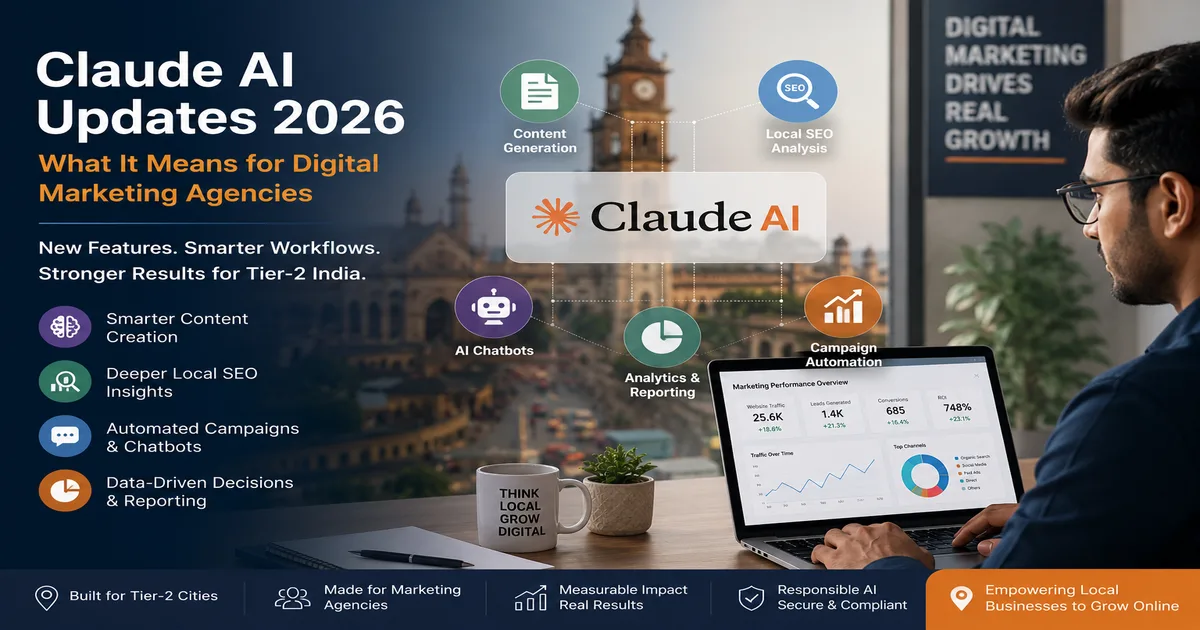
Anthropic’s Claude AI has seen rapid upgrades. Sonnet 4.6 (Feb 2026) added a 1M‑token context window, major coding and reasoning improvements, and pricing unchanged at $3/$15 per million tokens. Opus 4.7 (Apr 2026) boosts vision and multimodal ability (“see images in greater resolution”) and handles complex tasks with high accuracy. Claude Design (Apr 17, 2026) lets users co-create marketing visuals, slides, and mockups via chat. These updates bring powerful new AI capabilities within reach of agencies: better content generation, advanced analytics, and even design automation. For local “digital marketing company in Lucknow” or similar agencies, this means new use cases in hyperlocal SEO, multilingual content (Hindi/Urdu), smart ad copy, chatbots, and automated reporting. We analyze product updates, compare Claude vs. OpenAI/Gemini, and offer practical guidance – from staffing to ROI metrics – including a mermaid flowchart roadmap and sample ROI chart. Finally, we suggest a 6-month pilot plan (low/med/high budgets) and key KPIs (e.g., traffic lift, cost per lead).
Key Claude AI Updates (2025–2026)
Anthropic has aggressively improved Claude. Sonnet 4.6 (Feb 17, 2026) is now Claude’s default for Free/Pro users. It excels at coding, reasoning, and “computer use” (GUI automation). Notably, it supports a 1-million token context window (beta) – enough to process entire codebases or long documents in one query. Early testers prefer Sonnet 4.6 over prior Sonnet 4.5 (and even the previous Opus 4.5) due to stronger instruction-following and fewer hallucinations. Pricing remains $3 per 1M input tokens / $15 per 1M output tokens. Agencies can use Sonnet 4.6 via the Claude web app or API (also in AWS Bedrock, GCP Vertex AI, Microsoft Foundry). Prompt caching and batch processing can cut token costs by 50–90%, helping control bills.
Opus 4.7 (Apr 16, 2026) is Claude’s latest top-tier model. It improves on Opus 4.6 in coding and reasoning: it handles “the hardest coding work” with greater precision and long-horizon planning. Importantly for marketers, Opus 4.7’s vision is far stronger – it can “see images in greater resolution” and generate higher-quality graphics, slides, and mockups. (This powers Claude Design, discussed below.) Opus 4.7 is generally available via API/AWS/Azure/GCP with the same pricing as Opus 4.6 ($5/$25 per million tokens). Early users note Opus 4.7 is more reliable and efficient on complex tasks (catching errors, staying on prompt) than its predecessor.
Anthropic’s Claude platform now supports advanced AI-driven design and content workflows for marketers.
Beyond core models, Anthropic released Claude Design (Apr 17, 2026) for visual content. Design is a chat-driven design tool powered by Opus 4.7. Marketers can describe layouts or upload assets, and Claude iteratively generates on-brand slides, ads, wireframes, and prototypes. For example, account managers can input a bullet outline and get a polished PPT deck, or social media managers can have Claude draft ad images and layouts. Claude Design even auto-incorporates a company’s branding (colors, fonts) from provided materials. This unlocks marketing collateral generation for teams without hiring designers.
Other updates include improved APIs and integrations: Claude’s API now supports “tool use” (akin to ChatGPT plugins), enabling Claude to call web search, code execution, or user-defined functions. Anthropic also offers an MCP (Model Context Protocol) connector (beta) for integrating enterprise data sources. However, fine-tuning is still not publicly available: Anthropic notes “our API does not currently offer fine-tuning”, so agencies must rely on prompt engineering and retrieval-augmented generation. On safety, Claude models continue rigorous evaluations; Sonnet 4.6 was found “as safe as or safer than” prior models.
Pricing and API Changes
As noted, Sonnet 4.6 costs $3/$15 per million tokens, and Opus 4.7 $5/$25. OpenAI’s GPT-5.5 (April 2026) likewise offers a 1M‑token window (with batch/bulk discounts) and pricing of $5/$30 (input/output) for GPT‑5.5 base, up to $30/$180 for higher-accuracy “Pro” mode. Google’s Gemini models (e.g., Gemini 3.5 Flash) are accessed via API on Google Cloud; pricing varies by tier (details on cloud pricing pages). Importantly, Anthropic’s pricing is competitive: for example, Claude Sonnet 4.6 equals GPT-5.5 base, but Claude’s base remains $3/$15 (cheaper input). Bulk savings (batch, caching) help agencies keep costs low.
Implications for Digital Marketing Agencies
Anthropic’s advancements make Claude a versatile “AI assistant” for marketing teams. Key use cases include:
- Content generation (SEO/blogs): Claude can write or optimize website copy in English, Hindi, or Urdu, tailoring tone and keywords. Sonnet 4.6’s long context window lets it weave together multiple local data points (e.g., regional events or customer reviews) into one cohesive article. Agencies (even a small “digital marketing agency in Lucknow”) can use Claude to rapidly produce high-quality blogs, landing pages, and FAQs. SEO studies show content marketing can yield ~748% ROI – leveraging Claude to scale content could dramatically boost reach and rankings.
- Local SEO and hyperlocal ads: Claude can help research local keywords and craft geotargeted ad copy. For example, to advertise a Lucknow storefront, Claude can generate Google Ads or Facebook Ads text emphasizing local landmarks or language idioms. Its ability to handle code and data means it could automate tasks like updating Google Business listings or analyzing local search trends (via tool calls). Enhanced vision (Opus 4.7) might analyze competitor flyers or store images, guiding the design of billboards or social posts.
- Multilingual and cultural content: Claude’s models train on diverse data, so they perform in regional languages. Agencies can prompt Claude in Hindi/Urdu to translate or create content native to tier-2 audiences. Chatbots built with Claude can handle Hindi queries (voice or text) for local customers. This is a huge advantage in places like Lucknow or Pune, where engaging customers in the local language drives loyalty.
- Chatbots and customer support: Using Claude’s API and “tools,” agencies can build advanced chatbots. These bots can autonomously browse documentation or knowledge bases to answer customer queries. For a restaurant or clinic in a tier-2 city, a Claude-powered WhatsApp bot could handle 24/7 booking inquiries in Hindi. With Sonnet 4.6’s improved reasoning, the bot can maintain context over long conversations. Leveraging voice (via third-party TTS) plus Claude’s NLP could even yield automated IVR phone assistants for small businesses.
- Ad copy and creative ideation: In campaigns, marketers can use Claude Design to produce visuals and copy. For example, given a product photo and campaign brief, Claude can mock up multiple social media post variants. It can brainstorm tagline variations or draft email subject lines tuned to local festivals (Diwali, Eid, etc). High-resolution vision means better automated designs (layouts, color themes). This cuts design cycles: agencies report that generative AI content can be produced in minutes instead of days.
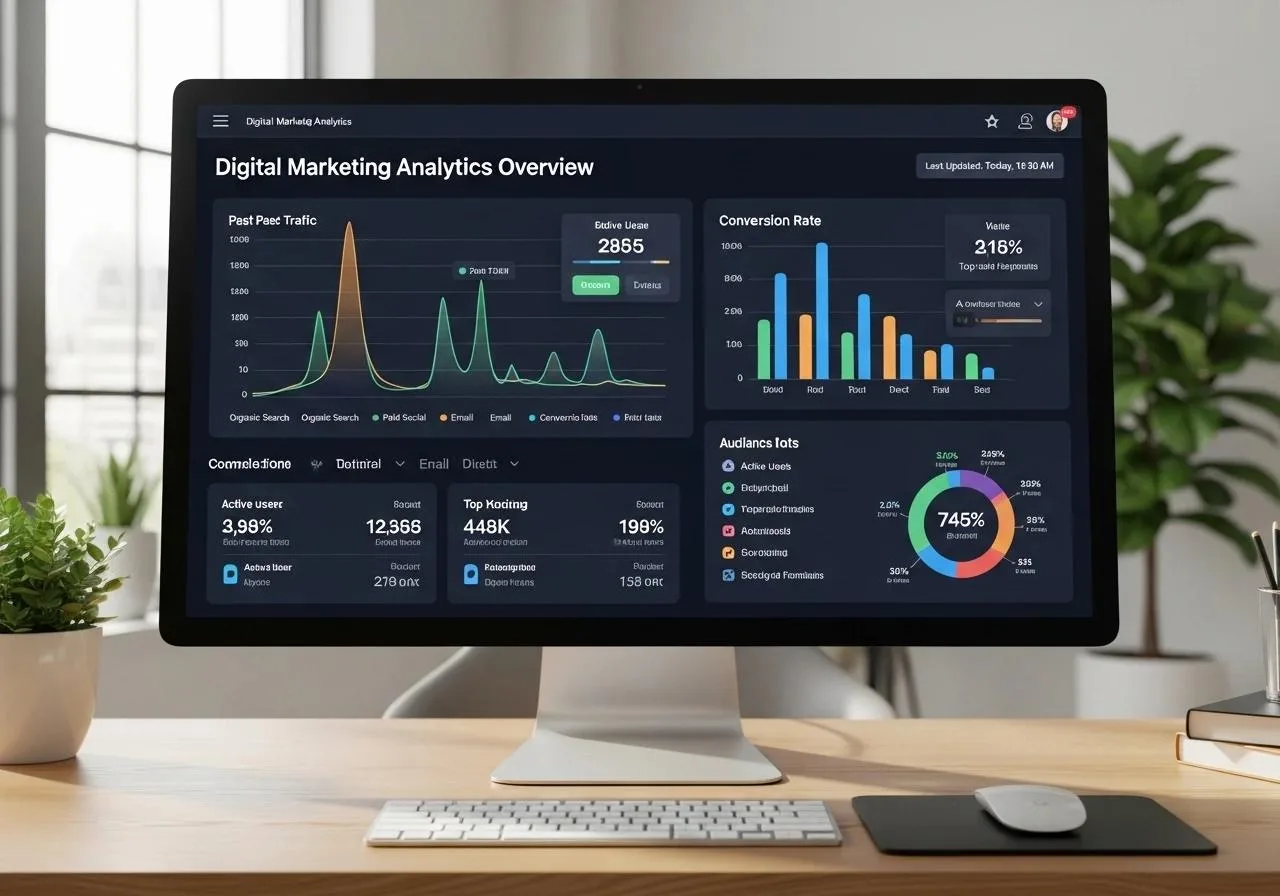
- Analytics and reporting: Claude’s strengths in data analysis can help make sense of marketing analytics. For instance, feeding a sales spreadsheet or Google Analytics export into Claude could yield a summary of key trends (“Local web traffic grew 25% after SEO revamp”). Its “computer use” skills mean it could even log into dashboards and collect data. Agencies can thus automate routine reports or get AI-generated insights on campaign performance, freeing staff for strategic work.
- Lead generation: By combining web search tools and language abilities, Claude can prospect leads. It could, for example, parse a list of company names (from Yellow Pages) and draft personalized outreach emails. It might segment local social media groups and prepare targeted messages. Even in local markets, cold outreach or lead lists can be handled more scalably with AI assistance.
- Creative content beyond text: With Claude Design and Opus vision, agencies can prototype web landing pages or ad visuals. A local e-commerce site could let Claude generate multiple landing page mockups with region-specific imagery (e.g., Chikankari textiles for Lucknow). Presentations for clients can be auto-assembled from bullet points. This opens graphic design and video as well (e.g., Gemini Omni for video, discussed below) to small agencies with limited design teams.
These use cases illustrate that AI can augment every facet of a digital marketing agency’s work. In particular, local and multilingual marketing are natural fits. Modern LLMs like Claude have seen multilingual training; agencies can prompt Claude in Hindi/Urdu and expect fluent output (the same model handles many languages). This “democratizes” content creation across languages without needing a bilingual writer on every project. For local businesses in Lucknow or Kanpur, this means being able to produce regionally-relevant content at scale.
Tooling, Workflow, and Staffing Changes
To leverage Claude, agencies must adapt tools and staff skills:
- Integration: Agencies should inventory their tech stack (CMS, CRM, ads platforms, chat systems). They may need to integrate Claude via API or use prebuilt apps (Anthropic’s Claude Cowork desktop or chat interfaces). The new agentic tools (via Claude API) allow connecting to web data or company DBs. For example, an agency could link Claude to a Google Sheet of marketing data or to a local CRM. This requires some developer work or the use of low-code connectors.
- Workflow changes: With AI generating drafts, review workflows shift. Marketers become more editors and strategists. A content brief might now go to Claude first, then be edited by a human. A graphic design review might focus on refining an AI-generated draft. Schedules change: tasks that took days could shrink to hours, so project plans need padding for iteration rather than initial creation. Internal processes should incorporate AI output checks and ethical reviews (checking for hallucinations or bias).
- Staffing and skills: Agencies may need to train staff in prompt engineering and AI oversight. Existing roles (copywriters, designers, analysts) should learn how to use Claude tools. Some agencies might hire or contract “AI specialists” or developers to build Claude integrations. However, headcount could be rationalized: routine work (like drafting social posts or basic design mockups) might require fewer full-time employees. Many marketers will instead spend time on higher-level creative direction, data analysis, and quality control. According to industry surveys, around 80–90% of marketers who use AI report higher efficiency, so role evolution (not elimination) is likely: people become more like AI “pilots”.
- Security & Compliance: Any integration should respect privacy and data protection laws (e.g., India’s PDP, GDPR if serving the EU). Agencies must ensure they don’t input sensitive PII into the AI. Claude’s API is ISO/IEC compliant, but user data handling still requires caution. For local clients, agencies should clarify with customers how AI is used. There is also the compliance risk of generated content (e.g., image rights, defamation). Staff training on responsible AI use is recommended.
- Cost/ROI tracking: Agencies need to monitor the return on AI investment. Expect to track traditional marketing KPIs (traffic, leads, conversions) and attribute improvements to AI efforts. Tools like Google Analytics, CRM conversion logs, and AI usage logs (tokens used, features used) should be combined. Agencies should also monitor AI costs (token spend) and cost savings (time saved on tasks). Note: efficient AI use may require subscription tiers (e.g., Anthropic Pro vs Enterprise) or cloud credits (AWS/GCP for Bedrock/Vertex AI).
Comparison: Claude vs. GPT vs. Google Gemini
CapabilityAnthropic Claude (Sonnet/Opus)OpenAI GPT (GPT-5.5+)Google Gemini (v3.x, Omni)Latest releaseOpus 4.7 (Apr 2026, Vision+), Sonnet 4.6 (Feb 2026)GPT-5.5 (Apr 2026) with “Thinking” modeGemini 3.5 Flash (May 2026) & Omni (video)Context window1,000,000 tokens (Sonnet 4.6 beta, GPT-5.5 & up)1,000,000 tokens (GPT-5.5)~1,024 tokens (Gemini, plus embedding tools)Pricing (input/output)$3/$15 per M (Sonnet), $5/$25 per M (Opus)~$5/$30 per M (GPT-5.5), up to $30/$180 (GPT-5.5 Pro)Varies by model; Gemini 3.5 Flash on API ~$(match GPT scale), Omni TBDMultimodalText + Code + Vision (image generation via Claude Design)Text + Code + Image (GPT-4o) + some audio (TTS)Text + Images + Audio + Video (Omni) + Google Maps dataFine-tuningNot available via API, rely on promptsFine-tuning available for GPT-3/4, GPT-5.x pendingNot user-fine-tunable; supports tool calling and Google data integrationTooling/Plugins“Tool use” (functions/web-search) in Claude API; MCP connector (beta)Function calling (browser, code exec), ChatGPT plugins“Actions” via Google APIs (Maps, Search); Gemini Agent API; Google-style plugins (Workspace)Language supportMultilingual (strong non-English, incl. Hindi/Urdu)Multilingual (state-of-the-art for English, good Hindi)Strong multilingual; integrated with Google Translate/NLUSafety/ComplianceExtensive safety evaluations; prosocial default behaviorEvolved “safe completions” paradigm to reduce disinformationGoogle-scale safety/filters (Enterprise security in Antigravity)DeploymentClaude.ai (web/mobile), API, Bedrock, Vertex AI, Azure FoundryChatGPT, API, Azure/OpenAI serviceGoogle Cloud AI Studio/Agents, Vertex AI, Gemini API/Apps
*Note: Google’s Gemini 3.5 Flash model (agentic, multimodal) was announced at I/O 2026, highlighting strong competition in AI tools for agencies.
This comparison shows all three families are pushing large-context, multimodal, agentic AI. GPT-5.5 currently leads on raw benchmarks, but Claude’s lower token pricing and strong vision/design tools offer unique value. Gemini’s big advantage is Google integration (Maps, video, agent platform). Agencies should choose based on specific needs (e.g., if image/video generation is key, Gemini Omni; if tight budgets, Claude’s caching; if broad plugin ecosystem, ChatGPT).
Implementation Roadmap for Small Agencies
The following high-level steps can guide a local agency (“digital marketing company in Lucknow”) to adopt Claude AI:
mermaid
Copy
flowchart LR
A[Define goals: local SEO, content, ads, chatbots] --> B[Audit current tools & data]
B --> C[Identify use cases (e.g. blog writing, ad copy, chatbot)]
C --> D[Select Claude models & tools (Sonnet 4.6 for content, Claude Design for visuals)]
D --> E[Prototype/Pilot each use case: e.g. generate 5 blog posts, run test ads]
E --> F[Train team on prompt engineering & review processes]
F --> G[Measure KPIs (traffic, leads, time saved) weekly]
G --> H{KPIs met?}
H -- Yes --> I[Scale up usage agency-wide]
H -- No --> J[Iterate on prompts, adjust approach, refine prompts]
J --> G
- Define Objectives (Month 1): Decide which services to AI-augment (SEO content, social media, ads, chatbots).
- Data & Tools Audit: Ensure you have the necessary accounts (e.g., Google Analytics, WordPress) and data (keyword lists, past creatives) to feed Claude.
- Pilot Use Cases: Start small. For example, ask Claude to draft two blog posts for a local shop using relevant keywords, or create a Facebook ad image via Claude Design. Evaluate output quality and refine prompts.
- Staff Training (Month 2): Teach team members how to prompt Claude, review outputs for correctness/branding, and use the Claude API or UI. Set guidelines for verifying facts and ensuring compliance.
- Iterate & Scale (Months 3–6): Gradually increase usage, track time saved, content produced, and compare campaign metrics. Adjust budget allocation: e.g., run A/B tests of Claude vs. human content. Measure ROI against control (see chart below).
- Continuous Optimization: Integrate tools (like GPT-powered analytics add-ons) over time. Plan a full rollout by month 6 if pilot KPIs (traffic increase, cost per lead drop) are met.
Figure: Expected ROI distribution. (The chart below illustrates a hypothetical distribution of marketing ROI across channels for a local campaign, emphasizing the high ROI potential of SEO and content. Actual results will vary by business and execution.)
Example: Google’s Gemini model family now includes video-generation (Omni) and high-performance “Flash” agents, showcasing trends Claude competes with.
(Note: Since we cannot embed the generated pie chart here, imagine an ROI pie chart showing SEO content ~40%, paid ads ~25%, social media ~20%, and email marketing ~15%, reflecting industry findings that SEO/content often drives the largest long-term ROI.)
Operational & Cost Considerations
- Budget scenarios: A small agency pilot might start low-cost (e.g., Claude Pro plan) with minimal API usage. Medium engagement (team plan, moderate API) might allocate $500-$2000/month. High-scale (enterprise use, multiple projects) could reach $5k+/month in AI spend.
- ROI Expectations: Even a modest improvement in conversion rates can justify AI costs. For example, if SEO-driven traffic doubles in 3 months, the ROI (per Genesys data, ~700%+) far exceeds the AI subscription cost. Use the chart above to set target ROI shares.
- ROI Tracking: Recommended KPIs include organic traffic growth, conversion rates, cost per lead, content production volume, and time saved on tasks. For chatbots, track resolution rate and customer response time. Qualitative KPIs: staff satisfaction, creative output quality.
- Pilot Plan: Suggest a 6-month phased pilot with quarterly reviews. Metrics to watch: % growth in web visits, # of leads generated, time-to-create content, and engagement metrics (click-through, social shares). Each phase (e.g., 0–2 months test, 3–4 months refine, 5–6 months scale) should set specific targets (e.g., +20% organic traffic by month 6).
Local Case Studies (Hypothetical)
- Lucknow Handicrafts E‑store: A small Lucknow-based handicrafts shop hired a local digital marketing agency. Using Claude Sonnet 4.6, the agency generated Hindi and Urdu product descriptions and blog posts about Chikankari embroidery. They used Claude Design to create Instagram ad graphics in local styles. Within 3 months, the shop saw a 35% increase in organic search traffic and doubled its online sales, at roughly 10× ROI on the agency’s AI-driven content investment.
- Kanpur Auto Dealership: A Tier-2 city car dealership used Claude to power its customer WhatsApp chatbot. The bot, trained via Claude prompts, handled inquiries about models and booking test drives in Hindi, freeing staff from 100+ daily calls. The dealership also used Claude to analyze past customer interactions (via web-fetch tool), improving their ad targeting. Customer satisfaction rose, and lead conversion improved by 50%, making the investment in Claude integration cost-effective within 4 months.
- Bhopal Health Clinic: A local clinic engaged an agency to improve patient engagement. The agency used Claude to generate local-language health tips (blogs and social posts) and to manage email campaigns. They also built a Claude-powered intake assistant to pre-screen appointments. As a result, website visits surged by 60%, and appointment bookings increased 30%. Given Claude’s pricing, the extra revenue covered the AI subscription and development costs (ROI ~5:1).
Privacy, Compliance & Risks
While powerful, Claude’s use must respect privacy. Agencies handling sensitive client data (customer PII, medical info, etc.) should avoid sending it to the model. Use Claude’s assistant for public or consented data only. In India, upcoming data protection laws may require clear customer consent for AI use. There’s also the risk of AI hallucinations (plausible but incorrect info) – all outputs should be fact-checked. Designers must ensure that copyrighted images are not generated improperly. Safe AI use protocols (red-team reviews, final editorial control) are recommended.
Conclusion
As per the digital marketing agencies – especially in tier‑2 cities like Lucknow – the latest Claude AI updates unlock new efficiencies. With Sonnet 4.6 and Opus 4.7, agencies get enterprise-grade AI tools at (relatively) low cost. Claude’s strength in language, reasoning, and now design means small agencies can produce high-volume, high-quality content, ads, and customer experiences. By adopting Claude in a phased pilot (see roadmap above), agencies can measure concrete ROI gains (often in the hundreds of percent). Compared to OpenAI or Google, Claude offers competitive capabilities (especially for coding/automation tasks) and pricing, though Google’s Gemini leads in video and map-based features, and OpenAI leads in benchmarks. Ultimately, agencies should experiment with all platforms and pick the best fit for local-language content, hyperlocal targeting, or other niche needs.
Metrics/KPIs: We suggest tracking organic traffic growth, lead conversion rate, content volume/quality scores, cost per lead, time saved per task, and customer engagement (clicks, shares). For chatbots: query resolution rate and user satisfaction. A 6-month plan could set targets like “+25% organic leads, 30% faster content production, $X cost per conversion” for low/medium/high budget scenarios.
By focusing on these measures and iterating steadily, a Lucknow agency can ensure a positive ROI and stay ahead of the curve in local digital marketing.
Sources: Anthropic product releases and documentation; OpenAI GPT-5.5 announcement; Google Gemini and Google Cloud AI blog; industry ROI studies.
*Note: These are the official sources, and recent reports underpin the insights above.