Accurate moisture measurement starts with a sensing element that can respond reliably to very small changes in water vapour. In industrial gas and compressed-air applications, moisture levels may be low enough that ordinary humidity instruments are not suitable for the required measurements. A properly engineered sensor can provide the sensitivity, stability, and repeatability needed for trace moisture monitoring. It can also serve as an important component within portable instruments, transmitters, and online measurement systems. Dew-Point provides aluminium oxide moisture sensing technology for industrial gases and dry compressed air, with configurations designed for both standard and hazardous environments.
How a Moisture Sensor Supports Industrial Measurement
A moisture sensor detects water vapour within a gas and converts the change into a measurable signal. That information can then be processed by a transmitter, hygrometer, display, or other measurement equipment.
This makes the sensing element particularly important in applications where moisture must be monitored at trace levels. If the sensor is unstable or poorly matched to the application, the resulting measurement may be difficult to interpret or compare over time.
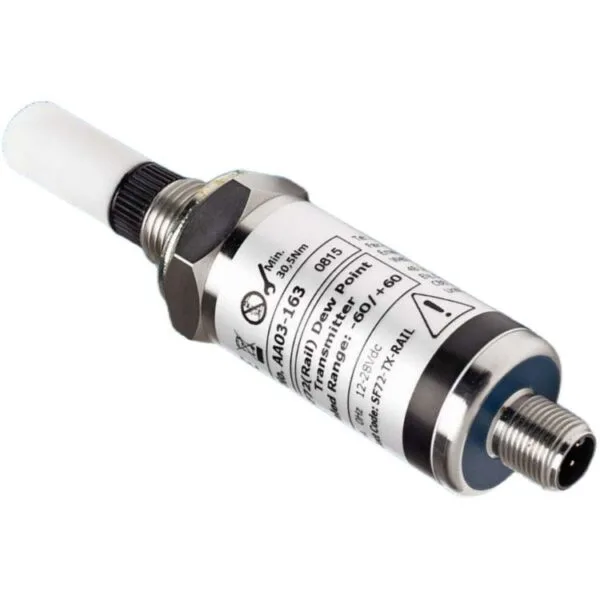
Dew-Point uses ultra-high-capacitance aluminium oxide technology for its moisture sensors. The company states that the technology is designed for sensitivity, response speed, accuracy, repeatability, and stability across dry compressed air and process-gas applications.
Aluminium Oxide Technology for Trace Moisture
Aluminium oxide sensing technology is suited to applications where moisture levels can be extremely low. Dew-Point's sensor range covers an overall dewpoint range from -110°C to +20°C, with equivalent moisture levels extending from very low trace concentrations upward.
A wide measurement range gives engineers more flexibility when selecting equipment for different processes. Some applications may require measurement of extremely dry gases, while others may operate closer to ambient or moderately dry conditions.
The sensor is also designed with low hysteresis and temperature stability, characteristics that can help maintain more consistent measurements when operating conditions change.
Why Sensor Stability Matters
Industrial measurement systems may operate for extended periods and under changing temperature, pressure, and flow conditions. A sensor that maintains stable characteristics can make measurement trends easier to understand and can reduce uncertainty when readings are compared over time.
Dew-Point specifies an accuracy of approximately ±2°C dewpoint for its sensor technology and provides calibration certificates traceable to National and International Humidity Standards through the National Physical Laboratory.
Traceable calibration is especially valuable where moisture readings are used for quality assurance, maintenance records, process verification, or other documented procedures.
Low Maintenance and Flow Independence
Practical industrial equipment should not require excessive maintenance simply to provide routine measurements. Dew-Point's sensor is designed for minimal maintenance and flow-independent operation, which can provide flexibility when integrating the sensing element into different measurement arrangements.
Flow conditions can still matter when designing a complete sampling system, but a flow-independent sensing element can simplify the requirements around the sensor itself.
Explore Dew-Point Sensor Solutions – https://dew-point.com/
Maintaining Good Sampling Conditions
The quality of a moisture reading depends not only on the sensor but also on how the gas reaches it. Poor sampling arrangements can introduce contamination, leaks, pressure changes, or other conditions that affect measurement reliability.
Dewpoint Sensor offers sensor holders and sample cells designed to optimize sampling conditions for its dewpoint transmitters and sensors. The sensor holder is manufactured from 316 stainless steel and is designed to allow sample gas to pass through without contamination while providing secure connections.
The sample cell also allows the sensor or transmitter to be removed for calibration without compromising the wider installation. This can be useful for facilities that need regular calibration while minimizing disruption to the measurement system.
Using Sensors With Transmitters
A sensor does not necessarily operate as a standalone instrument. In many industrial installations, it becomes part of a transmitter that converts the sensing information into a signal suitable for process monitoring.
Dew-Point's transmitter range includes AMT, AMT-Ex, and PDT models. The AMT and AMT-Ex use aluminium oxide sensing technology for continuous trace moisture measurement, while the transmitter output can be connected to compatible display or control equipment.
This type of configuration allows the sensing element to become part of a larger online measurement system rather than being limited to occasional manual testing.
Applications in Compressed Air and Process Gases
Moisture monitoring is relevant to many industrial environments where gas dryness influences equipment or process conditions. Compressed-air systems, natural gas, pharmaceuticals, aerospace, specialty gases, power generation, and semiconductor-related applications can all require trace moisture measurement.
Dew-Point's product information identifies applications including natural gas and LNG, food packaging, pharmaceutical production, breathing air, power generation, aerospace, and specialty gases.
The exact sensor configuration should be selected according to the gas composition, required measurement range, operating pressure, temperature, installation environment, and desired measurement method.
Sensors for Hazardous Environments
Some process areas require equipment that is suitable for potentially hazardous atmospheres. In these situations, safety certification is an important part of sensor selection.
Dew-Point's sensor technology can be used in intrinsically safe configurations when combined with the appropriate barrier or isolator. The company's specifications identify IECEx and ATEX certification for applicable sensor configurations.
For continuous hazardous-area monitoring, the AMT-Ex transmitter combines ultra-high-capacitance aluminium oxide sensing with ATEX and IECEx certification. It provides continuous trace moisture measurement and supports measurement ranges extending down to -120°C dewpoint. This gives engineers an option for integrating moisture measurement into processes where ordinary instrumentation may not be suitable.
Calibration for Long-Term Measurement Confidence
Even a stable sensing element needs appropriate calibration practices. Calibration provides a way to verify measurement performance and maintain confidence in the data produced by the system.
Dew-Point supplies its sensor with calibration documentation traceable to National and International Humidity Standards. Its transmitter systems can also incorporate AutoCal span correction, allowing users to perform span checks and corrections between laboratory calibrations.
Regular calibration can be particularly important when moisture measurements are used as part of quality-control programs or when historical readings need to be compared reliably.
Choosing a Sensor for the Application
Selecting the appropriate sensing solution requires consideration of more than just the dewpoint range. Engineers should also evaluate operating temperature, pressure, gas composition, sampling arrangement, hazardous-area requirements, accuracy, calibration requirements, and how the measurement will be displayed or transmitted.
For some applications, the sensor may be installed directly into an online transmitter. In others, it may form part of a portable hygrometer or a customized sampling system. Dew-Point's wider product portfolio includes sensors, portable instruments, transmitters, displays, and sample systems to accommodate different measurement requirements.
A complete system approach can help ensure that the sensor and supporting components work together under actual operating conditions.
Building a Reliable Moisture Monitoring System
A Dewpoint sensor provides the measurement foundation for many industrial moisture-monitoring systems. Its performance influences how accurately changes in water vapour can be detected and how confidently operators can use the resulting data.
Dew-Point's aluminium oxide technology combines a broad measurement range with stability, low hysteresis, flow independence, traceable calibration, and options for intrinsically safe applications.
When paired with an appropriate sample cell, transmitter, display, or portable instrument, the sensor can become part of a complete solution for monitoring dry compressed air and process gases.
Supporting Accurate Industrial Moisture Measurement
Reliable moisture data can help industrial teams understand changing gas conditions, verify process performance, and plan maintenance based on actual measurements. Achieving that reliability requires attention to the sensing element as well as sampling, calibration, installation, and system integration.
A Dewpoint sensor based on ultra-high-capacitance aluminium oxide technology can provide the sensitivity and stability required for demanding trace moisture applications. With configurations for general industrial and hazardous environments, Dew-Point offers a flexible foundation for moisture measurement across different processes.
For facilities where gas dryness is an important part of process control or equipment reliability, selecting a properly engineered sensing solution can make long-term moisture monitoring more dependable.