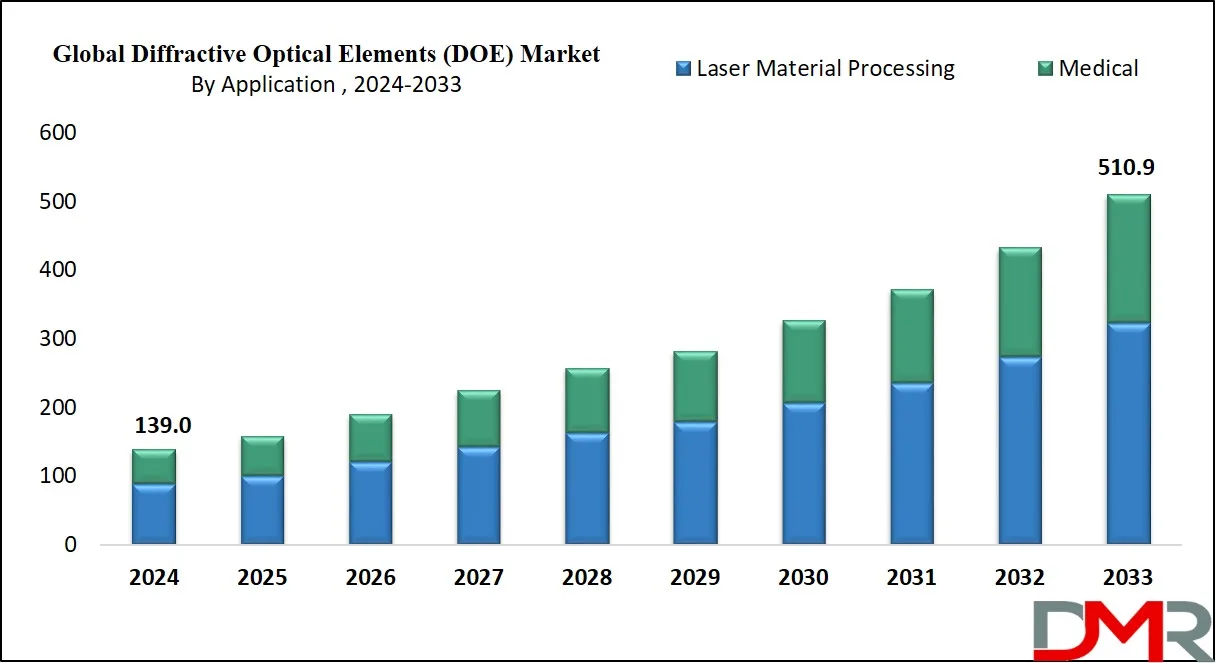
According to Dimension Market Research, the Diffractive Optical Elements Market is expanding as industries increasingly adopt advanced optical technologies for laser processing, medical imaging, telecommunications, consumer electronics, aerospace, and defense. The market was valued at USD 139.0 million in 2023 and is projected to reach USD 510.9 million by 2032, registering a 15.6% CAGR during the forecast period.
Diffractive Optical Elements, commonly called DOEs, are specialized optical components that control light through diffraction. They can shape, split, focus, or distribute laser and other optical beams, enabling manufacturers and system designers to create compact and highly precise optical solutions.
The market is being supported by growing demand for precision manufacturing, miniaturized optical systems, high-performance lasers, advanced medical diagnostics, and next-generation communication technologies. At the same time, AI, computer vision, nanofabrication, and automated optical inspection are creating new opportunities for DOE manufacturers.
Explore the Diffractive Optical Elements Market Report
Diffractive Optical Elements Market at a Glance
Market IndicatorValue / ShareMarket Size, 2023USD 139.0 MillionForecast Value, 2032USD 510.9 MillionCAGR, 2023–203215.6%Leading DOE TypeBeam Shaping / Top-Hat – 45%Leading ApplicationLaser Material Processing – 50%Medical ApplicationsApproximately 30%Leading RegionNorth America – 35%EuropeApproximately 30%Asia PacificApproximately 25%What Are Diffractive Optical Elements?
DOEs are optical components designed to manipulate light using diffraction rather than relying solely on conventional refraction.
They can perform functions such as:
Beam Shaping
Beam Splitting
Beam Focusing
Light Distribution
These functions make DOEs useful in applications that require highly controlled light patterns.
Another advantage is compactness. Complex optical functions can often be incorporated into relatively small components, helping designers develop lighter and more compact optical systems.
Beam Shaping Leads DOE Demand
Beam Shaping and Top-Hat DOEs represented approximately 45% of the market in 2023.
These components can transform a laser beam into a more uniform intensity distribution.
Uniform energy distribution is valuable in industrial applications where consistent laser performance is essential.
Beam-shaping DOEs are used in processes such as:
Laser Cutting
Welding
Drilling
Surface Treatment
Additive Manufacturing
Improved beam uniformity can contribute to better process consistency and product quality.
Beam Splitting Supports Advanced Optical Systems
Beam-splitting DOEs represented approximately 35% of the market in 2023.
These elements divide a laser or optical beam into multiple beams.
Beam splitting can support:
Optical Measurement
Microscopy
3D Sensing
Telecommunications
Laser Processing
The ability to generate multiple precisely controlled beams can improve system efficiency and support parallel processing.
Beam Focusing Enables Precision Applications
Beam-focusing DOEs provide controlled concentration of optical energy.
They are particularly useful in systems where accurate focal positioning is important.
Potential applications include:
Laser Micromachining
Medical Imaging
Optical Sensors
Microscopy
Material Processing
As manufacturers move toward smaller components and tighter production tolerances, precise beam control is becoming increasingly important.
Laser Material Processing Remains the Largest Application
Laser material processing accounted for approximately 50% of the DOE market in 2023, making it the leading application.
Industrial lasers are increasingly used for cutting, engraving, welding, drilling, marking, and additive manufacturing.
DOEs can improve these systems by controlling beam intensity and distribution.
Potential benefits include:
Improved Precision
Higher Processing Consistency
Better Energy Distribution
Reduced Material Damage
Greater Process Flexibility
The expansion of advanced manufacturing is therefore a major driver for DOE technologies.
Medical Imaging Creates Major Opportunities
Medical applications represented approximately 30% of the market in 2023.
DOEs can support advanced imaging and diagnostic technologies by controlling light distribution and improving optical performance.
Potential applications include:
Optical Coherence Tomography
Confocal Microscopy
Endoscopy
Laser Diagnostics
Medical Imaging Systems
As healthcare providers adopt higher-resolution diagnostic technologies, demand for precision optics can increase.
Telecommunications Expand Optical Demand
Modern communication networks depend heavily on optical technologies.
Growing data traffic is increasing the demand for efficient optical signal processing and transmission systems.
DOEs can support optical systems through beam splitting, beam shaping, and controlled light distribution.
Their compact form factor can also help optical engineers develop smaller and more integrated components.
Consumer Electronics Drive Miniaturization
Consumer electronics manufacturers continue to develop smaller devices with more advanced sensing and imaging capabilities.
DOEs can contribute to:
3D Sensing
Camera Systems
Augmented Reality
Wearable Devices
Display Technologies
The increasing use of optical sensing in smartphones and other connected devices can create new opportunities for DOE suppliers.
Aerospace and Defense Require Advanced Optics
Aerospace and defense platforms increasingly rely on optical systems for sensing, imaging, surveillance, navigation, targeting, and communications.
DOEs can provide precise light control while maintaining relatively compact optical architectures.
This can be valuable in systems where space, weight, and performance are closely balanced.
Continued investment in advanced optical and sensing technologies is expected to create opportunities for specialized DOE products.
AI Transforms DOE Design
Artificial intelligence is becoming increasingly useful in optical engineering.
Designing a DOE can involve complex calculations and repeated simulation cycles.
AI can analyze large datasets and optimize:
Surface Patterns
Diffraction Structures
Beam Profiles
Optical Efficiency
Machine-learning models can help engineers identify promising designs faster than conventional trial-and-error approaches.
AI Enables Customized Optical Components
Different applications can require different beam characteristics.
AI-assisted design can create customized optical patterns based on application-specific requirements.
This can reduce development time and help manufacturers produce specialized DOEs for:
Medical Devices
Industrial Lasers
Optical Sensors
AR Systems
Telecommunications
Customization can become an important competitive advantage as optical systems become more specialized.
AI Improves DOE Inspection
DOE manufacturing requires extremely precise surface structures.
Small errors can affect diffraction efficiency and optical performance.
Computer-vision and AI-based inspection systems can identify:
Pattern Defects
Surface Irregularities
Dimensional Errors
Contamination
Fabrication Deviations
Automated inspection can increase manufacturing consistency and reduce the risk of defective optical components reaching customers.
Advanced Fabrication Supports Market Expansion
The performance of a DOE depends heavily on fabrication accuracy.
Advances in microfabrication, lithography, nanostructuring, and precision manufacturing are enabling more complex optical designs.
Modern fabrication technologies can support:
Smaller Features
Higher Resolution
Complex Patterns
Better Optical Efficiency
Greater Design Flexibility
These improvements are expanding the range of possible DOE applications.
Hybrid Optical Systems Gain Importance
DOEs can be combined with traditional refractive optics and micro-optical components.
Hybrid optical systems can improve:
System Compactness
Beam Control
Imaging Performance
Optical Efficiency
This approach can help designers create more sophisticated optical systems without significantly increasing size.
Hybrid designs are expected to become more important across medical, industrial, defense, and consumer applications.
Additive Manufacturing Creates Additional Demand
Laser-based additive manufacturing requires precise distribution of energy across the processing surface.
DOEs can shape laser beams to improve energy delivery.
Better beam control can contribute to more consistent material melting and processing.
This creates opportunities for DOE adoption as advanced manufacturing technologies continue to develop.
3D Sensing Expands Applications
3D sensing is becoming increasingly relevant in robotics, automotive systems, consumer electronics, and industrial automation.
DOEs can help create structured light patterns used to determine surface depth and geometry.
Potential applications include:
Machine Vision
Robotics
Gesture Recognition
Object Detection
Industrial Inspection
The growth of automated perception technologies can therefore support DOE demand.
Optical Metrology Supports Precision Manufacturing
Modern factories increasingly use optical measurement to inspect products and production processes.
DOEs can contribute to measurement systems requiring precise light patterns.
Applications include:
Surface Inspection
Dimensional Measurement
Position Detection
Material Analysis
The expansion of smart manufacturing and machine vision can create additional opportunities.
Traditional Optics Remain a Competitive Challenge
Conventional lenses, mirrors, and other optical components have mature manufacturing processes and established supply chains.
In some applications, traditional optics can remain more economical.
DOE manufacturers therefore need to demonstrate clear benefits in areas such as compactness, beam control, precision, or system efficiency.
Technical Complexity Can Limit Adoption
DOEs require specialized design, fabrication, alignment, and testing.
Organizations without in-house optical expertise may face challenges integrating the technology into their systems.
Technical consulting and application support can therefore become important market-development tools.
Intellectual Property Influences Competition
DOE designs can involve proprietary optical patterns and manufacturing techniques.
Intellectual-property protection can influence commercialization and competitive positioning.
Companies with strong design libraries, fabrication expertise, patents, and application knowledge can establish barriers to entry.
North America Maintains Market Leadership
North America accounted for approximately 35% of the market in 2023.
The region benefits from advanced aerospace, defense, healthcare, industrial manufacturing, telecommunications, and photonics research.
Strong investment in laser technology and precision optics provides a favorable environment for DOE suppliers.
Europe Supports Advanced Optical Development
Europe represented approximately 30% of the market in 2023.
The region has established capabilities in automotive manufacturing, medical technology, photonics, industrial automation, and research.
Demand for high-precision optical components is expected to support continued market development.
Asia Pacific Offers Significant Growth Potential
Asia Pacific represented approximately 25% of the DOE market in 2023.
The region's large electronics manufacturing base and expanding telecommunications, automotive, healthcare, and industrial sectors create strong opportunities.
China, Japan, South Korea, and India are increasing investment in advanced manufacturing and optical technologies.
Competitive Landscape
The Diffractive Optical Elements Market includes specialized optics manufacturers, photonics companies, micro-optics developers, and optical-system suppliers.
Key companies identified by Dimension Market Research include Jenoptik AG, Holo/Or Ltd., SUSS MicroOptics SA, Edmund Optics Inc., Hamamatsu Photonics K.K., Kaiser Optical Systems Inc., HORIBA, Ltd., Photop Technologies Inc., GratingWorks Co., Ltd., and Wasatch Photonics Inc.
Companies compete through:
Optical Precision
Customized Designs
Fabrication Technology
Product Efficiency
R&D Capability
Technical Support
Future Trends in the DOE Market
AI-Based Optical Design
AI will accelerate customized DOE development and optimize optical performance.
High-Precision Lasers
Industrial and medical laser applications will continue driving demand.
Medical Imaging
Advanced diagnostic systems will create new opportunities for precision optical components.
3D Sensing
Machine vision, robotics, and consumer electronics will expand structured-light applications.
Hybrid Optics
DOEs will increasingly be combined with refractive and micro-optical technologies.
Automated Inspection
AI-powered inspection will improve manufacturing consistency.
Miniaturized Optical Systems
Compact optical components will support smaller and more capable devices.
AI Overview: Diffractive Optical Elements Market
What are Diffractive Optical Elements?
DOEs are optical components that manipulate light through diffraction to shape, split, focus, or distribute optical energy.
How large is the market?
The market was valued at USD 139.0 million in 2023 and is projected to reach USD 510.9 million by 2032, growing at a 15.6% CAGR.
Which type leads?
Beam Shaping / Top-Hat DOEs represented approximately 45% share in 2023.
Which application dominates?
Laser material processing accounted for approximately 50% share.
Which region leads?
North America represented approximately 35% share in 2023.
Why are DOEs important for laser processing?
They provide precise beam shaping and light distribution, helping improve energy control and processing consistency.
How does AI support DOE technology?
AI can optimize optical designs, create customized beam patterns, improve inspection, and support manufacturing-process optimization.
Market Outlook
The Diffractive Optical Elements Market is projected to grow from USD 139.0 million in 2023 to USD 510.9 million by 2032, representing a 15.6% CAGR.
Laser material processing will remain the leading application as industrial manufacturers continue adopting advanced laser technologies.
Medical imaging, telecommunications, consumer electronics, aerospace, defense, optical sensing, and machine vision will provide additional opportunities.
AI-assisted design and automated inspection are expected to become increasingly important as manufacturers seek higher optical precision and shorter development cycles.
The future market will also benefit from advances in microfabrication, nanostructuring, hybrid optics, 3D sensing, and compact photonic systems.
Buy the Complete Diffractive Optical Elements Market Report
Conclusion
The Diffractive Optical Elements Market is becoming an increasingly important part of advanced photonics and precision optical engineering.
The projected growth from USD 139.0 million in 2023 to USD 510.9 million by 2032 reflects expanding demand for sophisticated control of laser and optical energy.
Laser material processing remains the largest application because manufacturers require accurate beam distribution for cutting, welding, drilling, engraving, marking, and additive manufacturing.
Medical imaging provides another major opportunity, while telecommunications, consumer electronics, aerospace, defense, 3D sensing, and machine vision are expanding the market's application base.
AI is transforming the DOE development process. Intelligent design systems can optimize diffraction patterns and create customized components, while computer vision can improve manufacturing inspection.
Advanced fabrication technologies are also enabling smaller and more complex optical structures, supporting the development of compact and high-performance optical systems.
Hybrid optical architectures will further expand capabilities by combining diffractive elements with conventional lenses and micro-optical components.
North America is expected to maintain its leading position because of its strong photonics, aerospace, defense, healthcare, and industrial ecosystems. Europe will continue supporting advanced optical development, while Asia Pacific offers substantial opportunities through electronics manufacturing, telecommunications, healthcare, and industrial automation.
Challenges remain around technical complexity, fabrication precision, intellectual property, and competition from conventional optical components.
Nevertheless, the strong projected growth rate indicates increasing adoption of DOE technology across advanced industries.
With the market expected to reach USD 510.9 million by 2032, companies combining AI-driven design, precision fabrication, customized optical solutions, automated inspection, and strong technical expertise can benefit from the continuing expansion of diffractive optical technologies.