If you've searched "dubbing service in India," chances are you're either a producer trying to get a web series into three more languages before launch, or a creator wondering if dubbing your YouTube channel into Hindi is worth the money. Both of you are going to hit the same wall: most dubbing company websites tell you they're "the best" and ask you to fill out a quote form. Nobody tells you what dubbing is. How long it takes, or how to tell a good studio from a mediocre one.
This guide breaks down what professional dubbing services actually cost, how the process works, and how to pick a vendor you won't regret hiring.
What Is Dubbing? (And How It's Different from Voice-Over and Subtitling)
Dubbing means replacing the original spoken dialogue with a new recording in another language ideally so well-timed that it feels like the actor is speaking that language. But "dubbing" actually covers a few different things, and knowing which one you need saves you money and confusion later.
Lip-sync dubbing is what you see in a dubbed Bollywood film or a Turkish drama redone in Hindi the new dialogue is matched to the actor's mouth movements, syllable by syllable. It's the most labor-intensive and expensive form, because a translator has to rewrite lines to fit lip shapes, not just meaning.
Voice-over dubbing (sometimes called UN-style dubbing) layers translated narration over the original audio, which stays faintly audible underneath. You'll notice this in documentaries and news segments; no lip-sync needed, so it's faster and cheaper.
ADR (Automated Dialogue Replacement) happens in the same language as the original shoot it's used to fix bad on-set audio, not to translate anything. If your production house has ever re-recorded a line because a scooter honked mid-take, that was ADR.
For a YouTuber, dubbing usually means the voice-over kind of a single narrator track in Hindi or Tamil layered over your existing video. For a production house releasing a series on an OTT platform, it almost always means full lip-sync with a multi-character cast. That distinction changes your budget by a factor of five or more.
Why Dubbing Matters for Indian Content Right Now
Demand for dubbing service in India has grown fastest around OTT releases, and it's not hard to see why: India has 22 scheduled languages and dozens more spoken widely enough to matter commercially. A show that only exists in Hindi is invisible to a huge chunk of the Tamil, Telugu, Bengali, and Marathi-speaking audience and vice versa. That's why almost every major OTT release in the last few years, regardless of which language it was shot in, gets dubbed into four or five Indian languages within days of launch. The Korean and Turkish drama boom on Indian streaming platforms happened almost entirely because of aggressive Hindi and regional-language dubbing, not subtitles.
For creators, the shift is just as real but less obvious: YouTube now lets you upload multiple audio tracks on a single video, so a channel can serve an English track to international viewers and a Hindi or regional track to Indian viewers same video, no re-editing. Channels doing this consistently see meaningfully higher watch time from Tier 2 and Tier 3 Indian cities, where English comprehension is lower but content appetite is just as high.
The Dubbing Process, Step by Step
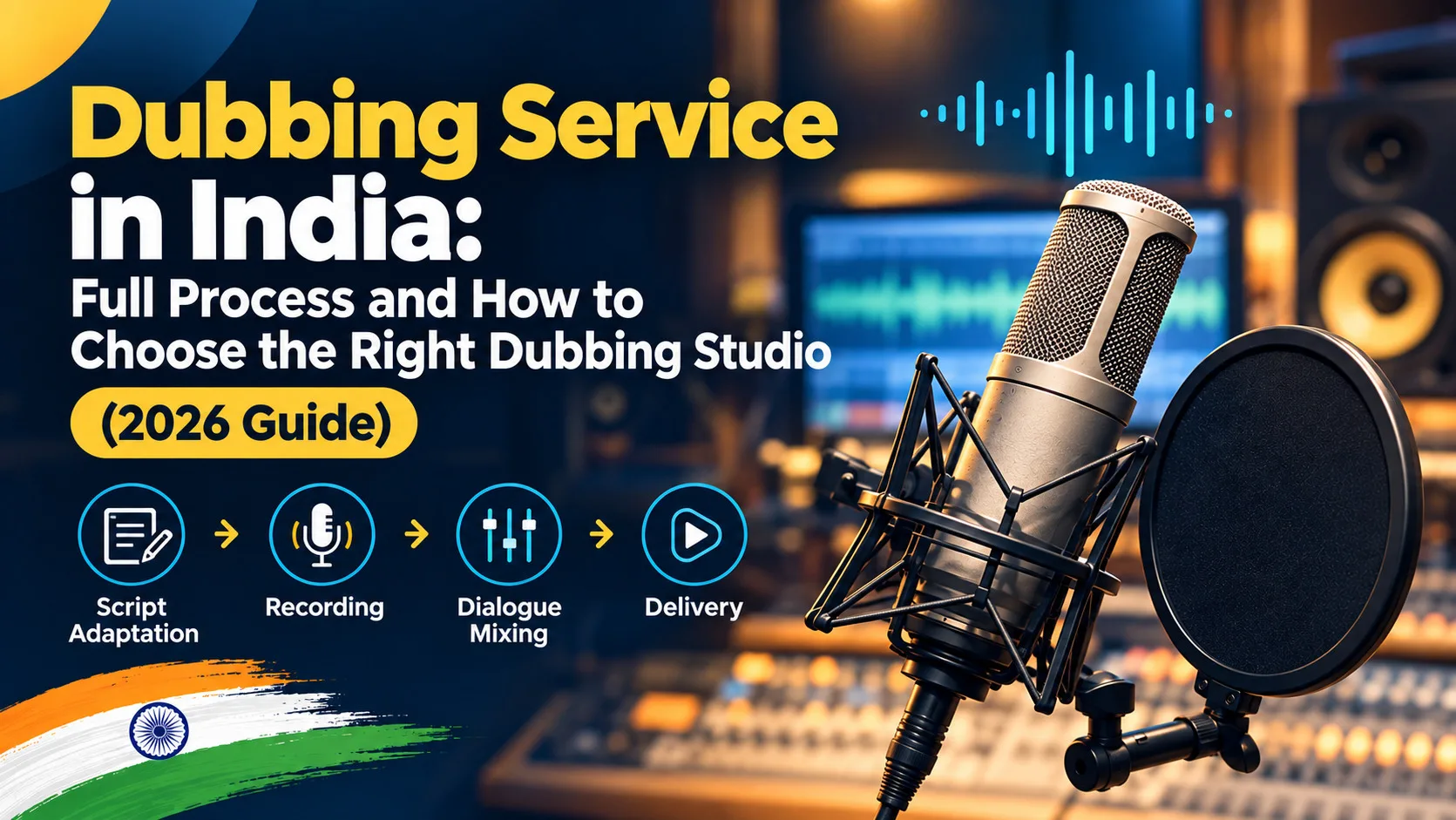
A proper dubbing studio in India moves the work through six stages, and knowing them helps you spot a rushed, corner-cutting vendor.
- Script translation and adaptation: not a literal translation. A good adapter rewrites lines so they fit the actor's mouth movements and still sound natural in the target language.
- Casting: matching voice artists to characters by tone, age, and accent, not just language fluency.
- Recording: studio sessions led by a dubbing director who watches the original performance and pushes the voice artist to match its energy, not just its words.
- Dialogue mixing: blending the new dialogue track with the original music and effects (M&E) track so it sounds like one cohesive mix, not a voice pasted over a video.
- Quality control: a linguistic check (did the translation actually land right?) and a technical check (sync accuracy, audio levels, format compliance).
- Delivery: final files in whatever spec the platform demands.
Realistic turnaround times: a 10-minute YouTube video with simple voice-over dubbing can be turned around in 2–4 days. A 90-minute film with full lip-sync dubbing into one language typically takes 3–4 weeks once you include casting, recording, and QC. A full OTT series dubbed into five languages simultaneously can take 6–10 weeks, mostly because of parallel scheduling across multiple language teams, not because any single language is slow.
Human Dubbing vs. AI Dubbing: Which Should You Use?
AI dubbing tools have gotten genuinely good over the past couple of years, and they're not something to dismiss reflexively. They're fast, cheap, and increasingly convincing for flat, informational content, e-learning modules, product explainers, internal training videos, and quick social clips where the goal is comprehension, not performance.
Where they still fall short is anything emotionally demanding: a dramatic film scene, a comedic beat that depends on timing, a brand voice you want to feel consistent and human across hundreds of videos. AI voices can sound right technically and still miss the moment, and audiences notice, even if they can't articulate why.
A growing number of studios now run a hybrid workflow: AI for a fast first-pass draft that a human director then polishes, which cuts costs without gutting quality. If you're a creator on a tight budget, an AI-assisted or fully AI dubbed track for informational content is a reasonable call. If you're dubbing a film or a series lead performance, don't skip the human studio.
How to Choose a Dubbing Company in India: A Checklist
Every dubbing company in India will tell you they offer "quality, speed, and native artists" which tells you nothing. Whether you're evaluating a large studio or a small one, ask these questions before you sign anything, and if you're visiting a dubbing studio in India in person, ask to sit in on part of a live session:
- Can I hear a sample in my exact target language and genre? A studio strong in corporate voice-over isn't automatically good at dramatic film dubbing.
- Are your artists in-house or pulled from a freelance network? Neither is automatically better, but you should know which one you're paying for.
- What does your QC process actually involve? "We check everything" isn't an answer. Ask if there's a separate linguistic reviewer and a separate technical reviewer.
- How many revision rounds are included? Get this in writing before you sign.
- Do you deliver to my platform's exact technical spec? Netflix, Prime Video, and YouTube each have different loudness, format, and metadata requirements; a vendor unfamiliar with yours will cost you a rejected delivery and a delay.
- How do you handle data security for unreleased content? Any studio working with pre-release films or series should have an NDA process as standard, not an afterthought.
Red flags: no sample reels offered upfront, vague or verbal-only pricing, no written turnaround commitment, or a quote that's dramatically cheaper than everyone else's for full-cast lip-sync work; that gap usually shows up in the final quality.
Rights, Licensing & Compliance for Dubbed Content
This part gets skipped constantly, and it shouldn't. When you hire a voice artist, you need clarity on usage rights is this a one-time-use license, or perpetual rights for re-release, syndication, and future seasons? For OTT and theatrical releases, platforms often have their own contractual and technical delivery requirements. A dubbing company in India that regularly works with these platforms should already understand them, not learn on your project.
For creators, it's simpler but not nonexistent: if you're using YouTube's multi-language audio track feature, make sure whoever dubs your content understands the platform's technical requirements for uploading a secondary audio track, so you're not stuck re-uploading later.
Dubbing for YouTubers and Influencers: What's Different
Creator dubbing usually means one or two voices, not a full cast, and turnaround expectations measured in days, not weeks. If you're building a channel that regularly reaches Hindi-speaking or regional audiences, it's worth finding one voice artist and sticking with them. A consistent "channel voice" across languages builds the same kind of recall as your on-camera personality does. Keep your scripts adaptation-friendly: idioms, wordplay, and cultural references that work in English often need to be rewritten, not translated, to land the same way in Hindi or Tamil.
Dubbing for Films, Web Series & OTT Platforms: What's Different
Professional dubbing services look very different at this scale. At production-house level, the challenge isn't a single video; it's consistency across an entire season and across every language you're releasing in simultaneously. That means locking character voices early so season 2 doesn't sound different from season 1, and coordinating multiple language teams on parallel timelines so a five-language launch doesn't slip because one language team fell behind. This is where working with a vendor that has an established partner network rather than one in-house team stretched across five languages usually pays off.
Ready to Get Your Content Dubbed?
Whether you're a production house dubbing a full series into five languages or a creator dubbing your channel into Hindi for the first time, choosing the right dubbing service in India comes down to the questions in the checklist above, not the promises on a homepage.
Top 5 Dubbing Studios in India
If you're not sure where to start your search, here are five established names worth researching further vet each one against the checklist above before committing:
- Sukudo Studios: A Delhi-based, TPN-certified studio built around an in-house (not freelance-network) model, covering 90+ languages. Known especially for high-volume short-drama and micro-drama dubbing, alongside work for OTT platforms and YouTube creators.
- Prime Focus Technologies: Part of the Prime Focus Group (alongside VFX studio DNEG), PFT is one of the largest full-stack media localization providers globally, with dubbing studios across India and clients including major OTT platforms and studios. It's less a boutique dubbing house and more an enterprise-scale localization operation, a fit for large productions with complex, multi-language rollout needs.
- Sound & Vision India: A long-standing, Mumbai-based dubbing studio associated with large-scale entertainment and film localization projects.
- DUBnSUB: Headquartered in Gurugram with branch offices in Germany, the USA, France, and Myanmar, DUBnSUB offers dubbing, voice-over, and subtitling in 100+ languages and is a specialized division of Lingual Consultancy.
- Lingual Consultancy: The parent company behind DUBnSUB, offering a broader range of language services (translation, interpretation, localization) in addition to dubbing a reasonable option if you need dubbing bundled with other language services under one vendor.
About the Author
Pratham Singh is a former localization manager with 7 years of experience in the dubbing and localization industry. He now writes SEO-focused content on dubbing, voice-over, and media localization, drawing on hands-on experience managing vendor relationships, production timelines, and quality control for multilingual content.