Empty Fruit Bunches (EFB) are one of the major biomass residues produced by the palm oil industry. Every palm oil mill generates a large quantity of EFB during the processing of fresh fruit bunches. While EFB can be used in several ways, its high moisture, long fibers, irregular structure, and low bulk density can make direct handling and transportation inconvenient.
A complete EFB pelleting line offers a practical solution by converting loose EFB into compact biomass fuel pellets. Instead of relying on a single pellet machine, the complete production system integrates raw material receiving, cleaning, shredding, drying, grinding, conditioning, pelletizing, cooling, screening, and packing.
For palm oil mills, biomass fuel producers, and renewable energy investors, an EFB pellet production line can turn an abundant agricultural residue into a standardized fuel product while improving the overall utilization of palm biomass.
What Is an EFB Pelleting Line?
An EFB pelleting line is an integrated production system designed to process Empty Fruit Bunches into biomass pellets.
The line combines multiple machines that perform different functions throughout the production process. Each piece of equipment is selected and configured according to the characteristics of the raw material and the required production capacity.
A typical EFB pellet production process is:
EFB Receiving → Cleaning → Shredding → Drying → Grinding → Conditioning → Pelletizing → Cooling → Screening → Packing
The exact process may vary depending on the moisture content, fiber length, contamination level, pellet specifications, production capacity, and final application.
The advantage of a complete production line is that each stage is coordinated instead of operating as an isolated machine.
Why Build an EFB Pellet Production Line?
Loose EFB has several disadvantages as a commercial fuel.
It is bulky and takes up considerable storage space. Its irregular shape makes automatic feeding more difficult, while its moisture content can make direct combustion or transportation less convenient.
Pelletizing changes the physical characteristics of the material.
EFB pellets are compact, uniform, and easier to handle. They can be conveyed mechanically, stored in organized facilities, and supplied to suitable biomass boilers or industrial heating systems.
A complete pelleting line can therefore provide several benefits:
- Better utilization of palm oil waste
- Higher bulk density
- Easier transportation
- More convenient storage
- More consistent fuel handling
- Automated production
- Reduced manual material handling
- Potentially higher commercial value
For palm oil mills with a stable EFB supply, these advantages can make pellet production an attractive biomass utilization strategy.
EFB Raw Material Characteristics
The design of an EFB pelleting line should begin with a detailed analysis of the raw material.
High Moisture Content
Fresh EFB may contain considerable moisture after palm oil processing.
Excessive moisture can negatively affect grinding, feeding, and pellet formation. It can also increase the thermal energy required for processing.
Therefore, many commercial EFB pellet plants require a dedicated drying system.
Long Fibers
EFB contains long and tough fibers.
If these fibers enter the pellet mill without adequate preparation, they may cause feeding problems or unstable operation.
Primary shredding and subsequent grinding help create a more suitable particle structure.
Low Bulk Density
Loose EFB has a low bulk density compared with finished biomass pellets.
This makes transportation and storage less efficient.
Pelletizing compresses the biomass into a denser product that is easier to handle.
Variable Material Quality
EFB characteristics can change according to palm fruit varieties, processing conditions, collection methods, storage duration, and moisture.
For this reason, the final production line should be designed around actual material testing whenever possible.
Main Equipment in an EFB Pelleting Line
A complete EFB pellet plant may contain the following equipment:
- EFB receiving hopper
- Feeding conveyor
- Cleaning system
- Magnetic separator
- EFB shredder
- Rotary drum dryer
- Hot air furnace
- Cyclone and dust collection system
- Hammer mill
- Conditioner or mixer
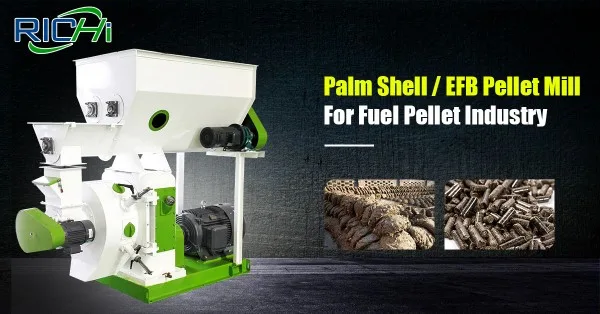
- Biomass pellet mill
- Pellet cooler
- Vibrating screen
- Finished pellet conveyor
- Automatic packing machine
- Electrical control system
Not every project requires exactly the same configuration.
A small project may use a relatively simple process, while a large commercial plant may require multiple shredders, dryers, grinders, pellet mills, and packaging systems.
Step 1 EFB Receiving
The production process starts with receiving EFB from the palm oil mill.
A receiving hopper can temporarily hold incoming biomass and provide controlled feeding into the production line.
Conveyors are then used to transfer the material to the cleaning and shredding section.
Because EFB is bulky, transportation distance should be considered when planning the plant location.
If possible, locating the pellet plant close to the palm oil processing facility can reduce internal transportation requirements.
Step 2 EFB Cleaning
EFB may contain unwanted materials such as stones, soil, metal fragments, and other foreign objects.
A cleaning system removes these contaminants before the biomass enters the size-reduction equipment.
Magnetic separators are particularly useful for removing ferrous metal.
Effective cleaning helps protect shredders, hammer mills, and pellet mills from unnecessary wear and damage.
Step 3 EFB Shredding
The next stage is primary size reduction.
An EFB shredder cuts long fibers into smaller pieces. This makes the material easier to convey and prepares it for drying.
Shredding also reduces the risk of long fibers interfering with downstream grinding and feeding systems.
The shredder should be selected according to the expected material throughput and fiber characteristics.
Step 4 EFB Drying
Drying is often one of the most important stages in an EFB pellet plant.
The objective is to reduce excessive moisture and create material conditions suitable for grinding and pelletizing.
An industrial rotary dryer machine is commonly considered for continuous industrial biomass processing.
A complete drying section may include:
- Rotary drum dryer
- Hot air furnace
- Exhaust fan
- Cyclone
- Air ducts
- Temperature monitoring
- Dust collection
The dryer should be sized according to actual incoming moisture and production capacity.
Rather than using a fixed drying parameter for every project, the appropriate operating conditions should be established through material testing and commissioning.
Step 5 EFB Grinding
After drying, the shredded biomass is further reduced in size.
A hammer mill can grind EFB into smaller particles suitable for pelletizing.
Grinding improves material uniformity and can help the pellet mill maintain more stable compression.
The grinding size should be selected according to the characteristics of the EFB and the desired pellet specifications.
Excessively coarse material can reduce pellet quality, while unnecessarily fine grinding may increase energy consumption.
Step 6 Pelletizing
Pelletizing is the central stage of the production line.
The prepared EFB is fed into the pellet mill, where mechanical pressure compresses the biomass through a die.
The basic process is:
Feeding → Compression → Extrusion → Cutting
Rollers press the biomass against the die surface, forcing the material through the die holes.
The extruded biomass is then cut into pellets of the required length.
For commercial EFB pellet production, the pellet mill must be capable of stable continuous operation.
Wear-resistant dies and rollers are especially important because biomass processing places significant mechanical demands on the compression system.
(Learn more: https://richipelletizer.com/efb-pellet-machine/)
Selecting the Right Pellet Mill
The pellet mill should not be selected according to capacity alone.
Several factors need to be considered.
Raw Material Characteristics
EFB fiber length, moisture, particle size, and contamination all influence pellet mill performance.
Production Capacity
The required output determines whether one pellet mill or multiple pellet mills should be installed.
Pellet Diameter
The target market determines the die specification.
Common biomass pellet diameters include 6 mm, 8 mm, 10 mm, and 12 mm, although customized specifications may also be possible.
Operating Schedule
Plants designed for long continuous operating hours require reliable mechanical components and convenient maintenance access.
Step 7 Pellet Cooling
Fresh pellets leaving the pellet mill are relatively hot.
They need to be cooled before screening and packing.
A counterflow pellet cooler can continuously reduce pellet temperature and stabilize the finished product.
Cooling also makes pellets easier to handle and transport.
The cooler must be properly matched with the pelletizing capacity to prevent bottlenecks.
Step 8 Pellet Screening
After cooling, the pellets pass through a screening system.
The screen removes fines, broken pellets, and other particles that do not meet the finished product requirements.
The main output consists of qualified pellets.
Fine particles can often be returned to the pelletizing process, helping improve material utilization.
For commercial fuel production, effective screening can improve the consistency of the final product.
Step 9 EFB Pellet Packing
The final stage is packaging.
Depending on the market, EFB pellets can be packed into small bags, large bags, or loaded in bulk.
An automatic packing system can perform weighing, filling, and sealing operations while reducing manual labor.
Finished pellets should be stored in a dry environment and protected against rain and excessive humidity.
EFB Pelleting Line Layout
A well-designed plant layout can improve material flow and reduce unnecessary handling.
A typical arrangement can be divided into five major zones.
Raw Material Zone
This includes EFB receiving, storage, feeding, and initial cleaning.
Preparation Zone
This area contains shredders, dryers, and grinding equipment.
Pelletizing Zone
The prepared biomass is conditioned and compressed into pellets.
Finishing Zone
Cooling and screening are carried out here.
Packaging and Storage Zone
Qualified pellets are packed and transferred to finished product storage.
The layout should also provide sufficient space for equipment maintenance, spare parts, electrical systems, truck movement, and worker access.
How Production Capacity Affects Line Design
Production capacity is one of the most important factors in EFB pellet plant design.
A small plant may require only one processing train, while a large commercial facility may use several parallel production lines.
For example, increasing pellet output may require:
- Larger EFB receiving capacity
- Higher shredding capacity
- Greater drying capacity
- More grinding capacity
- Additional pellet mills
- Larger cooling equipment
- Higher screening capacity
- Faster packing systems
The equipment should be balanced.
There is little benefit in installing a high-capacity pellet mill if the dryer or grinder cannot supply enough prepared material.
Multiple Pellet Mills for Large Projects
Large EFB pellet plants may use multiple pellet mills rather than relying on a single large machine.
This configuration can provide several advantages.
First, production can be adjusted according to available EFB supply.
Second, maintenance can be performed on one machine while other units continue operating.
Third, multiple machines can provide additional flexibility when production requirements change.
The final configuration should be determined through detailed engineering analysis.
EFB Drying System Selection
The drying section can have a major influence on plant performance.
The dryer must remove enough moisture to prepare EFB for pelletizing without consuming excessive thermal energy.
Important design factors include:
- Initial moisture
- Final moisture requirement
- Material throughput
- Heat source
- Ambient conditions
- Dryer type
- Exhaust system
A rotary drum dryer is commonly used for large biomass projects because it is suitable for continuous processing.
The heat source can be selected based on available fuels and local operating costs.
Energy Consumption in an EFB Pellet Plant
Energy consumption comes from several stages rather than the pellet mill alone.
Major energy-consuming equipment may include:
- Shredder
- Dryer
- Furnace
- Hammer mill
- Pellet mill
- Fans
- Conveyors
- Cooler
- Packing equipment
The drying stage can be particularly significant when processing wet EFB.
Therefore, improving raw material preparation and optimizing the heat source can contribute significantly to overall plant efficiency.
Dust Collection and Environmental Control
Dust can be produced during shredding, grinding, conveying, and screening.
A properly designed dust collection system can capture airborne particles and improve the production environment.
The system may include:
- Cyclones
- Bag filters
- Exhaust fans
- Dust pipelines
- Collection hoods
The dust-control system should be integrated into the plant design from the beginning.
Local environmental, occupational safety, and emissions requirements should also be considered during project planning.
Automation of the EFB Pelleting Line
Automation can coordinate different sections of the production line.
A centralized PLC control system can monitor:
- Material feeding
- Conveyor operation
- Dryer temperature
- Fan status
- Grinder operation
- Pellet mill load
- Cooler operation
- Screening
- Packing
Automatic alarms and safety interlocks can help protect both operators and machinery.
For large plants, centralized monitoring can also make production management more efficient.
EFB Pellet Quality Management
Consistent pellet quality depends on the entire production process.
Important parameters include raw material condition, particle size, moisture, compression conditions, pellet durability, and pellet dimensions.
Quality control can begin with raw material inspection and continue through every stage.
The production team should monitor:
- EFB moisture
- Contamination
- Particle size
- Pellet appearance
- Pellet durability
- Pellet size
- Fine content
The exact quality requirements should be established according to the intended fuel application and customer specifications.
Applications of EFB Pellets
EFB pellets can be used as renewable solid fuel in suitable systems.
Potential applications include:
Palm Oil Mill Boilers
Palm oil mills can potentially use pellets as a standardized biomass fuel within their own energy systems, subject to equipment compatibility.
Industrial Boilers
Industrial facilities requiring solid fuel for heat or steam generation may use suitable EFB pellets.
Biomass Power Plants
EFB pellets can be considered as a feedstock for biomass energy projects where fuel specifications and combustion technology are compatible.
Agricultural Processing
Food and agricultural processing facilities may also use biomass pellets for thermal energy production.
The actual suitability of EFB pellets should always be evaluated through fuel analysis and combustion testing.
EFB Pellet Plant Investment Cost Factors
The investment cost of an EFB pelleting line depends on the project configuration.
Major factors include:
- Production capacity
- EFB moisture
- Dryer requirements
- Shredding system
- Grinding capacity
- Pellet mill configuration
- Cooling system
- Screening system
- Packing method
- Automation level
- Dust collection
- Storage facilities
- Factory construction
- Installation
- Transportation
A quotation based only on the pellet mill price may not represent the real investment required for a complete commercial plant.
A complete technical proposal should consider all major processing sections.
How to Reduce EFB Pellet Production Costs
Cost optimization does not necessarily mean purchasing the cheapest equipment.
Instead, the entire process should be optimized.
Reduce Unnecessary Transportation
Locating the pellet plant near the EFB source can reduce internal logistics costs.
Optimize the Dryer
Correct dryer sizing prevents excessive thermal energy consumption.
Balance Equipment Capacity
All major machines should be properly matched to avoid bottlenecks.
Use Appropriate Automation
Automation can reduce labor requirements and improve production consistency.
Maintain Equipment Regularly
Preventive maintenance helps avoid unexpected downtime and expensive repairs.
Optimize Storage
Proper storage can reduce moisture absorption and product losses.
Building an EFB Pellet Plant Near a Palm Oil Mill
One of the most practical approaches is to integrate the EFB pelleting line directly with an existing palm oil mill.
This arrangement offers a number of potential advantages.
The raw material is already generated on site or nearby, reducing the need to purchase biomass from external suppliers.
Existing infrastructure may also provide electricity, transportation access, workers, and other supporting facilities.
The EFB can move from the palm oil processing operation to the pellet plant with relatively short transportation distances.
This creates a more integrated palm biomass utilization system.
What Information Is Needed for EFB Plant Design?
Before designing an EFB pellet plant, engineers normally need several key parameters.
Raw Material
Information about EFB moisture, fiber characteristics, contamination, and daily availability is required.
Capacity
The target pellet production rate should be clearly defined.
Pellet Specification
The desired pellet diameter, packaging, and quality requirements should be established.
End Application
Engineers need to know whether the pellets will be used internally or sold to external fuel customers.
Site Conditions
Available land, building height, electricity supply, road access, and storage facilities should be evaluated.
Energy Source
The available heat source for drying should be considered.
These details help create a realistic and efficient process design.
Customized EFB Pelleting Solutions
Every palm oil mill has different EFB characteristics and production requirements.
A standardized production line may therefore not be suitable for every customer.
A customized EFB pelleting line can be designed according to:
- EFB supply
- Moisture content
- Required capacity
- Pellet diameter
- Factory space
- Heat source
- Automation requirements
- Packaging method
- Final application
RICHI Pelletizer can provide complete turnkey engineering services covering process design, equipment selection, manufacturing, transportation, installation, commissioning, operator training, and after-sales technical support.
This approach allows the complete production system to be designed as one coordinated project.
Conclusion
EFB is an abundant palm oil processing residue with significant biomass utilization potential. However, its high moisture, long fibers, irregular shape, and low bulk density make direct handling difficult.
A complete EFB pelleting line addresses these challenges through a series of coordinated processing stages. Shredding reduces fiber length, drying controls moisture, grinding prepares particle size, pelletizing densifies the biomass, and cooling, screening, and packing prepare the final product for storage and transportation.
For palm oil mills and biomass fuel investors, the most important consideration is not simply the selection of a pellet mill. The entire production system must be matched to the available EFB and the intended production target.
With appropriate engineering, equipment configuration, and process control, an EFB pellet plant can provide an effective pathway for converting palm oil residues into a convenient renewable fuel while improving the economic value of biomass resources.