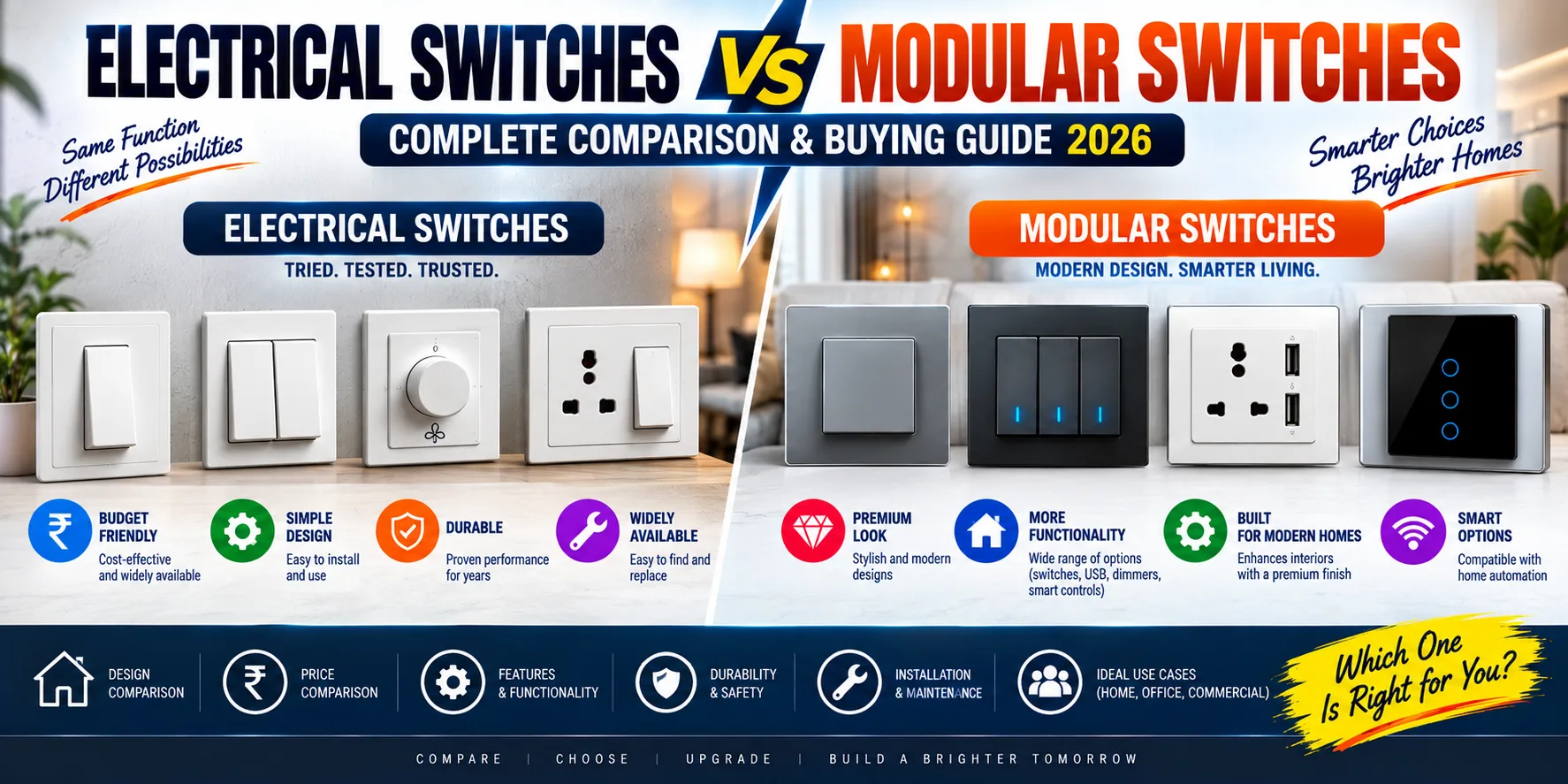
Choosing the right electrical switches for a home, office, commercial building, or renovation project may seem like a small decision, but switches play an important role in everyday electrical safety, convenience, appearance, and functionality.
When homeowners and project managers compare electrical switches vs modular switches, they often assume these are two completely different categories. In reality, “electrical switch” is a broad term that includes many types of switching devices, while “modular switch” generally refers to a modern modular electrical system in which individual switch and accessory modules are fitted into a compatible plate and mounting frame.
The popularity of modular switches in India has increased because of their contemporary appearance, flexible configurations, replaceable modules, and compatibility with modern interior designs. Traditional electrical switches, however, continue to be used in many homes, commercial properties, industrial environments, and replacement projects.
So, how do electrical switches and modular switches differ? What should homeowners consider when selecting switches? Are modular switches necessarily better? What about electrical switches for home, sockets, smart controls, installation, safety, maintenance, and cost?
This comprehensive guide explores the differences, similarities, applications, advantages, limitations, and buying considerations to help you understand the two categories before making a purchasing decision.
What Are Electrical Switches?
An electrical switch is a device used to control the flow of electrical current through a circuit.
In simple terms, a switch allows a user to open or close an electrical circuit.
When the switch is turned on, the circuit is completed and electrical current can flow to the connected load. When it is turned off, the circuit is interrupted.
Electrical switches can be found in:
- Homes
- Offices
- Shops
- Hotels
- Schools
- Hospitals
- Factories
- Warehouses
- Industrial facilities
- Commercial buildings
Common types include:
- One-way switches
- Two-way switches
- Intermediate switches
- Double-pole switches
- Push-button switches
- Rocker switches
- Toggle switches
- Rotary switches
- Selector switches
- Emergency switches
- Specialized control switches
Therefore, electrical switches represent a broad category rather than one specific physical design.
What Are Modular Switches?
Modular switches are electrical switches designed as individual modules that can be installed within a modular mounting system.
Instead of using a single fixed switch plate with permanently integrated components, a modular system generally allows different electrical modules to be arranged within a compatible frame and plate.
A modular setup can include:
- Switch modules
- Socket modules
- Fan regulators
- Dimmer modules
- USB charging modules
- Data outlets
- TV outlets
- Telephone modules
- Smart-control modules
- Indicator modules
- Bell-push modules
This modular approach provides flexibility when designing a switchboard.
For example, a homeowner could configure one plate with several switches, a socket, and a charging module depending on the requirements of the room.
Electrical Switches vs Modular Switches: The Basic Difference
The easiest way to understand the difference is to consider the terminology.
Electrical switch describes the function and category.
Modular switch describes a particular design and installation system.
In other words, a modular switch is an electrical switch, but not every electrical switch is modular.
This distinction is important when researching products.
A traditional electrical switch may have a fixed design, while a modular switch generally forms part of a configurable modular plate system.
Quick Comparison: Electrical Switches vs Modular Switches
Meaning:
Electrical Switches — Broad category of switching devices
Modular Switches — Switches designed for modular mounting systems
Design:
Electrical Switches — Traditional or specialized designs
Modular Switches — Modern modular configuration
Configuration:
Electrical Switches — May be fixed
Modular Switches — Highly configurable
Appearance:
Electrical Switches — Depends on product type
Modular Switches — Generally contemporary
Replaceability:
Electrical Switches — Depends on design
Modular Switches — Individual modules can often be replaced
Switchboard Flexibility:
Electrical Switches — Varies
Modular Switches — Generally high
Sockets:
Electrical Switches — Separate depending on system
Modular Switches — Can be integrated into modular plates
Smart Integration:
Electrical Switches — Available in selected products
Modular Switches — Available in selected modular systems
Interior Design:
Electrical Switches — Depends on style
Modular Switches — Often designed for modern interiors
Maintenance:
Electrical Switches — Depends on construction
Modular Switches — Individual modules can simplify replacement
Application:
Electrical Switches — Residential, commercial and industrial
Modular Switches — Residential, commercial and modern electrical installations
Installation:
Electrical Switches — Product-specific
Modular Switches — Requires compatible modules, frames and plates
Types of Electrical Switches
Understanding the different types of electrical switches is useful before comparing them with modular products.
One-Way Switch
A one-way switch controls a circuit from one location.
It is commonly used for:
- Bedrooms
- Bathrooms
- Small rooms
- Individual lights
Two-Way Switch
A two-way switching arrangement allows the same light or load to be controlled from two locations.
It is useful for:
- Staircases
- Long corridors
- Bedrooms
- Large rooms
Intermediate Switch
An intermediate switch can be used in circuits where a light needs to be controlled from multiple locations.
Double-Pole Switch
A double-pole switch can control two poles of a circuit and may be used for applications requiring isolation of both conductors, depending on the electrical design.
Push-Button Switch
Push-button switches operate through pressing rather than a conventional rocker mechanism.
They can be used for:
- Doorbells
- Control applications
- Certain lighting systems
Rocker Switch
Rocker switches use a rocking mechanism and are common in residential electrical applications.
Toggle Switch
Toggle switches use a lever-style mechanism and are widely used across electrical and electronic applications.
Types of Modular Switches
The modular category offers many configurations.
Modular One-Way Switch
This is one of the most common modules for controlling individual lights or loads.
Modular Two-Way Switch
Useful when a circuit needs to be controlled from two locations.
Modular Intermediate Switch
Used in suitable multi-location switching arrangements.
Modular Bell Push
A momentary push-button module can be used for doorbells and similar applications.
Modular Fan Regulator
A fan regulator can be integrated into the same switchboard.
Modular Dimmer
Dimmer modules allow compatible lighting loads to be adjusted.
Modular Socket
Sockets can be combined with switches within a modular plate.
USB Charging Module
Some modern modular systems include USB charging outlets.
Data and Connectivity Modules
Depending on the product ecosystem, modular plates can accommodate data, television, telephone, or other communication modules.
Design Difference Between Electrical and Modular Switches
One of the most noticeable differences is appearance.
Traditional electrical switches may use a more conventional switchboard design.
Modular switches generally use:
- Separate modules
- Uniform plates
- Standardized mounting frames
- Contemporary finishes
- Multiple configuration options
This allows manufacturers to create switch ranges that coordinate with modern interior designs.
For homeowners who pay attention to wall aesthetics, modular systems can provide greater flexibility.
Why Modular Switches Are Popular in India
The demand for modular switches in India is connected to changing residential construction and interior-design preferences.
Modern homes increasingly include:
- More electrical appliances
- USB charging requirements
- Internet connectivity
- Entertainment equipment
- Smart-home devices
- Decorative lighting
- Multiple lighting circuits
- Air-conditioning
- Ceiling fans
- Kitchen appliances
A modular system can allow multiple functions to be organized within a single coordinated switchboard.
This can make modular systems particularly attractive during new-home construction and renovation projects.
Electrical Switches for Home: What Should You Consider?
When selecting electrical switches for home, the first consideration should be safety and compatibility rather than appearance alone.
Consider:
Electrical Rating
Choose switches suitable for the intended electrical load and installation.
Build Quality
Look for appropriate construction and reliable operation.
Installation
Installation should follow applicable electrical practices.
Compatibility
Ensure the switch fits the existing wiring and mounting arrangement.
Environment
Bathrooms, kitchens, outdoor areas, and industrial environments may require different considerations.
Design
Choose a finish that works with the interior.
Manufacturer Support
Warranty and after-sales support can be useful for long-term installations.
Modular Switches for Home
Modular switches for home are often selected because homeowners can combine different functions within the same plate.
For example, a bedroom switchboard could include:
- Two lighting switches
- One fan switch
- One fan regulator
- One charging socket
- One power socket
A kitchen could require:
- Multiple appliance switches
- High-load sockets where appropriate
- Exhaust-fan control
- Lighting controls
A living room may include:
- Ceiling-light switch
- Decorative-light switch
- Fan control
- Television outlet
- Data outlet
- Charging socket
The exact configuration should be determined by the electrical design and appliance requirements.
Modular Switches and Sockets
The combination of modular switches and sockets is one of the major advantages of a modular electrical system.
A single plate can accommodate different modules.
For example:
Switch + Switch + Socket + USB Module
or:
Switch + Fan Regulator + Socket + Data Module
This allows a switchboard to be customized according to the room.
Traditional electrical systems may also provide multiple functions, but the modular format generally emphasizes interchangeable module-based configurations.
Aesthetic Benefits of Modular Switches
Modern interiors often use coordinated electrical accessories.
Modular systems can provide:
- Clean lines
- Consistent appearance
- Multiple plate finishes
- Different colors
- Contemporary profiles
- Flexible arrangements
This makes them popular in:
- Modern apartments
- Villas
- Offices
- Hotels
- Retail stores
- Restaurants
- Premium commercial projects
However, aesthetics should never override electrical safety and technical suitability.
Maintenance and Replacement
Maintenance is another important area when comparing electrical switches vs modular switches.
In a modular system, individual modules can often be replaced without replacing the entire plate assembly, provided the system is designed for such replacement and the correct compatible component is available.
This can simplify future modifications.
For example, a homeowner may later replace a standard charging module with another compatible module.
Traditional switches can also be replaced, but the process depends on the particular switchboard design.
Installation Considerations
Electrical installation should be performed by a qualified professional where required.
Switch selection must take into account:
- Circuit design
- Load
- Voltage
- Current rating
- Wiring
- Earthing
- Protection devices
- Box depth
- Mounting arrangement
- Environmental conditions
A visually attractive switch is not suitable if it is incompatible with the electrical installation.
For new construction, switchboard planning should ideally happen during the electrical-design stage.
Safety Considerations
Safety is more important than brand, finish, or appearance.
When buying electrical switches, consider products that are designed and tested according to applicable standards.
Look for appropriate:
- Electrical ratings
- Insulation
- Mechanical durability
- Terminal quality
- Heat resistance
- Certification or compliance information
- Manufacturer documentation
Never overload sockets or switches.
High-power appliances may require dedicated circuits and appropriately rated electrical equipment.
Electrical Switches vs Modular Switches: Durability
Durability depends on product quality, materials, design, installation, operating conditions, and usage.
It would be inaccurate to say that every modular switch is automatically more durable than every traditional switch.
Instead, compare:
- Material quality
- Contact mechanism
- Number of operations
- Rated load
- Heat resistance
- Construction
- Manufacturer specifications
- Warranty
A high-quality traditional switch may outperform a low-quality modular product, while a well-designed modular system can provide excellent long-term performance.
Electrical Switches vs Modular Switches: Flexibility
Flexibility is one area where modular systems can be particularly useful.
A modular plate can accommodate different components.
For example:
2 switches + 1 regulator + 1 socket
can be arranged in one configuration.
Another room could use:
4 switches + 1 USB module + 1 socket.
This allows electrical points to be customized according to room requirements.
Traditional systems may have fewer configuration options depending on their design.
Smart Switches and Modern Homes
Technology has introduced another category: smart switches.
Smart electrical controls can provide features such as:
- Smartphone control
- Scheduling
- Remote operation
- Voice integration
- Automation
- Energy monitoring in selected systems
Some smart switches are designed as modular components.
However, smart compatibility should be checked carefully.
Consider:
- Wi-Fi requirements
- Neutral-wire requirements
- Load compatibility
- App support
- Smart-home ecosystem
- Installation requirements
- Security and firmware support
Smart features should complement, not replace, fundamental electrical safety.
Cost Comparison
Cost is another factor when choosing between traditional electrical switches and modular systems.
The overall price can include:
Switches + Sockets + Plates + Frames + Regulators + Specialized Modules + Installation
A basic traditional setup may have a different initial cost from a modular setup.
However, the total project cost depends on the number and type of electrical points.
For modular systems, premium finishes, smart modules, USB charging modules, dimmers, and specialized sockets can increase the total cost.
Therefore, compare complete switchboard configurations rather than comparing the price of one switch alone.
Best Electrical Switches: What Does “Best” Mean?
Searches for best electrical switches often produce a large number of product choices.
But “best” depends on the application.
A suitable switch for a bedroom may not be the right product for an industrial environment.
When evaluating products, consider:
- Electrical rating
- Safety
- Material
- Construction
- Switching mechanism
- Compatibility
- Warranty
- Availability
- Design
- Installation requirements
A good buying decision should be based on application-specific requirements.
Best Modular Switches: Selection Criteria
Similarly, choosing the best modular switches requires more than selecting a popular design.
Evaluate:
1. Safety
Check relevant product specifications and compliance information.
2. Mechanical Performance
The switch should operate smoothly and reliably.
3. Material
Consider the quality of the plastic, frame, terminals, and other components.
4. Configuration
Ensure the system supports the modules you need.
5. Availability
Replacement modules should ideally be easy to obtain.
6. Design
Select a finish suitable for your interiors.
7. Warranty
Manufacturer warranty can provide additional confidence.
Comparing Switches for Different Rooms
Different rooms have different electrical requirements.
Bedroom
Typical requirements may include:
- Ceiling light
- Bedside light
- Fan
- Fan regulator
- Charging socket
Living Room
Potential requirements include:
- Main lighting
- Decorative lighting
- Fan
- Television
- Internet/data
- Charging points
Kitchen
Kitchens often require several dedicated electrical points for appliances.
These should be planned according to appliance loads and electrical design.
Bathroom
Bathroom electrical installations require particular attention to location, protection, and applicable safety requirements because of the presence of water and moisture.
Office
Offices may require:
- Lighting controls
- Fans or HVAC controls
- Power outlets
- Data outlets
- USB charging
- Specialized equipment connections
Traditional Electrical Switches vs Modular Switches
The following comparison summarizes the major differences.
Basic Function:
Traditional Electrical Switches — Electrical circuit control
Modular Switches — Electrical circuit control
Design:
Traditional Electrical Switches — Traditional
Modular Switches — Modern/modular
Configuration:
Traditional Electrical Switches — Product-dependent
Modular Switches — Highly configurable
Module Replacement:
Traditional Electrical Switches — Depends on design
Modular Switches — Often individually replaceable
Plate Design:
Traditional Electrical Switches — Conventional options
Modular Switches — Multiple coordinated options
Socket Integration:
Traditional Electrical Switches — Depends on system
Modular Switches — Easy within modular systems
Smart Modules:
Traditional Electrical Switches — Available in selected products
Modular Switches — Available in selected ecosystems
Interior Appeal:
Traditional Electrical Switches — Varies
Modular Switches — Often suited to modern interiors
Customization:
Traditional Electrical Switches — Moderate
Modular Switches — High
Cost:
Traditional Electrical Switches — Wide range
Modular Switches — Wide range
Applications:
Traditional Electrical Switches — Residential and commercial
Modular Switches — Residential, commercial and modern installations
Advantages of Electrical Switches
Traditional electrical switches have several practical advantages.
Simple Design
Many traditional switches are straightforward and familiar.
Wide Availability
Basic electrical switches are commonly available in local markets.
Variety
There are numerous types for different applications.
Cost Options
Consumers can find products across a broad price range.
Suitable for Many Applications
Electrical switches are used in residential, commercial, and industrial environments.
Advantages of Modular Switches
Modular systems provide several benefits.
Flexible Configuration
Multiple electrical functions can be arranged within one plate.
Modern Appearance
Modular plates can complement contemporary interiors.
Replaceable Components
Individual modules can often be changed.
Expandability
Additional compatible modules may be added when the system allows it.
Integrated Accessories
Sockets, regulators, USB modules, and other accessories can be combined.
Organized Installation
A coordinated modular system can create a cleaner switchboard layout.
Potential Limitations of Modular Switches
Modular systems also have considerations.
Higher Cost for Premium Configurations
Premium plates and specialized modules can increase project costs.
Compatibility Requirements
Modules, frames, and plates need to be compatible.
More Components
A modular switchboard involves multiple components that need to work together.
Replacement Availability
A specialized module may need to come from the same ecosystem or compatible manufacturer.
Common Buying Mistakes
Choosing Only by Appearance
A beautiful switch is not necessarily the correct switch for the application.
Ignoring Electrical Ratings
Always select equipment appropriate for the intended circuit.
Mixing Incompatible Modules
Modular systems require compatible frames, plates, and modules.
Buying Only Based on Price
Very low-cost products may not provide the quality or specifications required.
Ignoring Future Requirements
During new-home construction, consider future needs such as charging points, data connectivity, smart controls, and additional appliances.
How to Plan Switchboards for a New Home
Before purchasing modular switches for home, create an electrical-point plan.
List every room and identify:
- Lighting points
- Fan points
- Appliance points
- Charging points
- Data points
- TV points
- Special equipment
- Outdoor requirements
Then determine the appropriate switchboard configuration.
For example:
Bedroom:
3 switches + 1 fan regulator + 2 sockets + 1 charging module
Living Room:
4 switches + 1 regulator + 2 sockets + TV/data modules
The actual configuration should be finalized with the electrical contractor or designer based on the wiring plan.
How to Choose Between Electrical Switches and Modular Switches
Use the following decision framework.
Choose a Modular System When:
- You want a modern switchboard appearance.
- You need multiple functions in one plate.
- You want configurable modules.
- You may need specialized accessories.
- You are building or renovating a modern home.
- You want coordinated switches and sockets.
Consider Traditional Electrical Switches When:
- You need a straightforward replacement.
- Existing infrastructure uses a conventional switch system.
- You need a specific specialized switch.
- A simple and familiar design is preferred.
- The application does not require modular flexibility.
The right choice ultimately depends on the project.
Future Trends in Electrical and Modular Switches
The electrical-accessory market continues to evolve.
Smart Home Integration
Connected switches are becoming increasingly relevant to modern home automation.
USB and Charging Integration
As homes use more mobile devices, charging modules can become useful components.
Improved Design
Manufacturers continue to develop thinner profiles, new finishes, and different plate designs.
Energy Management
Smart controls may increasingly integrate energy-monitoring capabilities.
Touch and Sensor Controls
Touch-sensitive controls and occupancy-related automation may become more common in selected applications.
Sustainable Materials
Manufacturers may increasingly explore materials and production methods with sustainability considerations.
Frequently Asked Questions
What is the difference between electrical switches and modular switches?
Electrical switch is a broad category covering devices that control electrical circuits. Modular switches are electrical switches designed as individual modules within a compatible modular frame and plate system.
Are modular switches better than traditional electrical switches?
The answer depends on the application. Modular switches offer configuration and design flexibility, while traditional switches can provide simple and practical solutions. Safety, compatibility, quality, and intended use should guide the decision.
Are modular switches suitable for homes?
Yes. Modular switches for home are widely used for lighting, fans, sockets, charging modules, and other electrical functions, provided the selected products are appropriate for the installation.
What are modular switches and sockets?
Modular switches and sockets are individual electrical modules installed within a compatible modular frame and plate. They allow different electrical functions to be combined in one switchboard.
Are modular switches more expensive?
They can be, particularly when premium plates or specialized modules are selected. However, modular systems are available across different price ranges.
Can modular switches be replaced individually?
Many modular systems allow individual modules to be replaced, but the replacement must be compatible with the frame and plate system.
What should I consider when buying electrical switches for home?
Consider safety, electrical rating, compatibility, construction quality, intended application, design, warranty, and manufacturer support.
What are the best modular switches?
There is no single best modular switch for every application. Compare safety, ratings, materials, mechanical performance, configuration options, availability, warranty, and suitability for the installation.
Can modular switches support smart-home systems?
Some modular switch ecosystems offer smart modules or compatible smart controls. Requirements vary by product, so compatibility should be verified before installation.
Can I mix different modular switch brands?
Compatibility depends on the physical dimensions, mounting system, frame, plate, and module design. Do not assume modules from different brands are interchangeable.
Conclusion
The comparison of electrical switches vs modular switches becomes much easier once the terminology is understood.
Electrical switches represent a broad category of devices used to control electrical circuits. Modular switches are a specific type of electrical switch designed to work within a modular system containing interchangeable or configurable components.
For modern homes and commercial interiors, modular switches in India have become popular because they offer flexibility, coordinated aesthetics, and the ability to combine switches, sockets, regulators, charging modules, and other accessories within a single switchboard.
Traditional electrical switches, however, continue to have important applications. Their simplicity, broad availability, variety, and suitability for straightforward installations make them relevant for many projects.
When selecting electrical switches for home, do not focus only on appearance or price. Consider electrical ratings, safety, compatibility, construction quality, installation requirements, manufacturer support, and the intended use of each electrical point.
Similarly, when selecting modular switches and sockets, evaluate the complete system—including modules, frames, plates, sockets, regulators, and specialized accessories.
The concept of best electrical switches or best modular switches should therefore be approached according to the specific application rather than as a universal ranking. A switch that is appropriate for a bedroom may not be suitable for a high-load appliance or commercial installation.
For a new home or renovation, planning ahead is especially important. Consider current electrical requirements as well as future needs such as additional charging points, data connectivity, smart-home controls, and new appliances.
Ultimately, the best switchboard is one that combines appropriate electrical performance, safety, compatibility, durability, usability, and design. By understanding the differences between traditional electrical switches and modular systems, homeowners, architects, contractors, and businesses can make more informed decisions when planning their electrical installations in 2026.