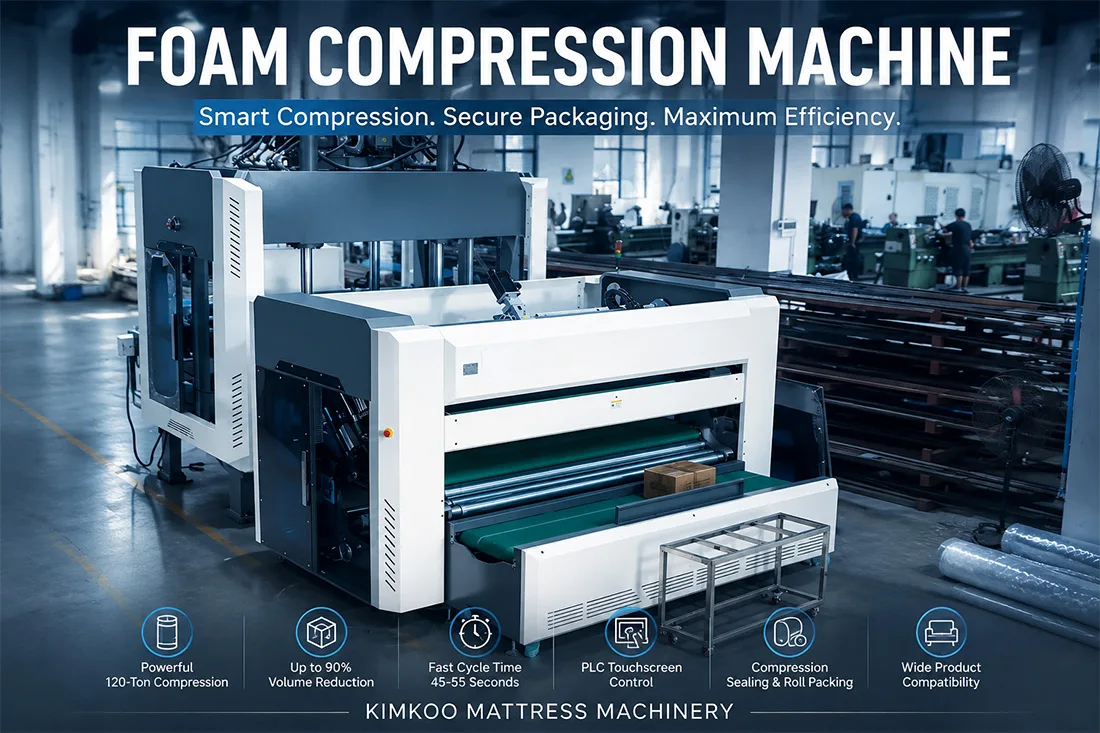
Foam blocks are widely used in mattress, furniture, sofa, and cushioning production, but their large volume can create serious challenges during storage and transportation. Even when foam products are lightweight, they can occupy a significant amount of warehouse and shipping space. A foam compression machine provides a practical solution by compressing bulky foam products into a much smaller package before transportation.
However, choosing the right machine requires more than looking at its compression force. Manufacturers should consider foam characteristics, product dimensions, compression height, packaging method, production speed, and the required final package size.
What Is a Foam Block Compression Machine?
A foam block compression machine uses mechanical or hydraulic pressure to reduce the volume of foam products before packaging. In a compression roll-packing system, the process normally combines compression, heat sealing, and rolling.
The foam block is first placed inside a suitable PE or PVC bag. The machine then applies controlled pressure to flatten the product. After compression, the bag is heat-sealed to help prevent rapid rebound. The compressed product can then be rolled into a compact cylindrical package.
What Should You Check Before Buying?
Compression Force
Compression force is one of the most important specifications. Different foam materials have different densities and recovery characteristics, so the required pressure can vary significantly.
For larger and denser foam blocks, a machine with sufficient hydraulic capacity is important. KIMKOO's JK-C3R provides up to 120 tons of hydraulic pressure and uses four hydraulic cylinders to distribute pressure across the compression area.
However, maximum pressure should not be the only selection criterion. The actual foam material and required compression ratio should always be tested before finalizing machine specifications.
Maximum Product Height
The maximum compression height determines how large a foam block the machine can process.
The JK-C3R supports foam products with heights from 50 to 1000 mm. This range allows manufacturers to process different foam blocks and other bulky resilient products without requiring separate machines for every product thickness.
Compression Plate Dimensions
The compression plate must be large enough for the products being processed. The JK-C3R uses a 2100 × 2300 mm compression plate and supports foam block and sofa products within its specified working dimensions.
For factories producing non-standard foam sizes, customized press plate dimensions and lifting strokes can also be considered.
How Does the Compression Process Work?
The operator first places the foam block into a correctly sized PE or PVC packaging bag. The bagged product is then positioned on the machine's working area.
The hydraulic compression system moves the press plate downward and applies controlled pressure to reduce the product's height. Once the desired compression position is reached, the packaging film is heat-sealed.
The compressed product is then transferred into the roll-packing stage, where it is formed into a compact cylindrical package. The target roll diameter can be adjusted according to the product and transportation requirements.
Can One Machine Handle Different Foam Products?
Yes, but the actual range depends on the machine configuration and the characteristics of the products.
Compression roll-packing equipment can be used for foam blocks, foam sheets, foam layers, foam sofas, mattresses, and other resilient products. A flexible machine with adjustable parameters is particularly useful for manufacturers producing several product sizes.
For example, KIMKOO's system can also compress multiple foam sheets or cut layers in one cycle when their dimensions and material properties are suitable.
Will Compression Affect Foam Quality?
Foam naturally tends to recover after compression, but the recovery rate depends on the material. Foam density, cellular structure, compression ratio, compression time, temperature, and storage conditions can all influence the final result.
Manufacturers should therefore test their own foam before setting production parameters. The objective is to achieve sufficient volume reduction while maintaining the required recovery and product quality.
A properly selected compression system should provide controlled and repeatable pressure rather than simply applying the maximum possible force.
How Fast Can Foam Blocks Be Packed?
Production speed is particularly important for factories handling large quantities of foam.
The JK-C3R has a typical cycle time of approximately 45–55 seconds per unit, covering compression, sealing, and roll packing. The actual cycle time can vary according to product dimensions, material characteristics, and operating conditions.
Reducing the packaging cycle can help manufacturers improve throughput while reducing the amount of manual handling required between different packaging stages.
Why Use Roll Packing After Compression?
Compression reduces the height and volume of the foam, while roll packing turns the compressed product into a compact cylindrical package.
This makes the finished package easier to handle and can improve the utilization of warehouse and transportation space. The rolled product can also be inserted into a carton when boxed shipping is required.
For manufacturers shipping foam products over long distances, this combination can help increase the number of products loaded per shipment and reduce transportation costs.
About KIMKOO Mattress Machinery
KIMKOO Mattress Machinery is an experienced mattress machine manufacturer with more than 18 years of experience in machinery design and manufacturing.
KIMKOO develops equipment for mattress production, foam processing, sofa packaging, and compression roll-packing applications. Its JK-C3R Sofa & Foam Compression Roll Packing Machine combines hydraulic compression, heat sealing, and automatic roll packing in one system.
The machine provides up to 120 tons of hydraulic pressure, supports compression heights up to 1000 mm, and uses a touchscreen PLC control system with SIEMENS components. Its intelligent roll-packing system allows operators to set the required package diameter according to different product requirements.
Learn more about KIMKOO:
What Information Should You Give the Machine Manufacturer?
Before requesting a quotation, foam manufacturers should provide several key details:
- Foam material and density
- Product length, width, and height
- Daily or hourly production volume
- Desired compression ratio
- Target roll diameter
- Packaging bag material
- Whether the finished package will be boxed
- Available factory power supply
Providing these details allows the machine manufacturer to recommend a more suitable configuration instead of selecting equipment based only on general specifications.
Conclusion
A foam block compression machine can significantly improve the way bulky foam products are packaged, stored, and transported. The right solution should provide sufficient compression force, an appropriate working range, reliable sealing, consistent roll packing, and enough flexibility for the factory's actual products.
For manufacturers considering compression equipment, product testing and detailed specification matching are essential steps before purchase. A machine selected around the actual foam material and production requirements can provide better packaging consistency and long-term logistics benefits.