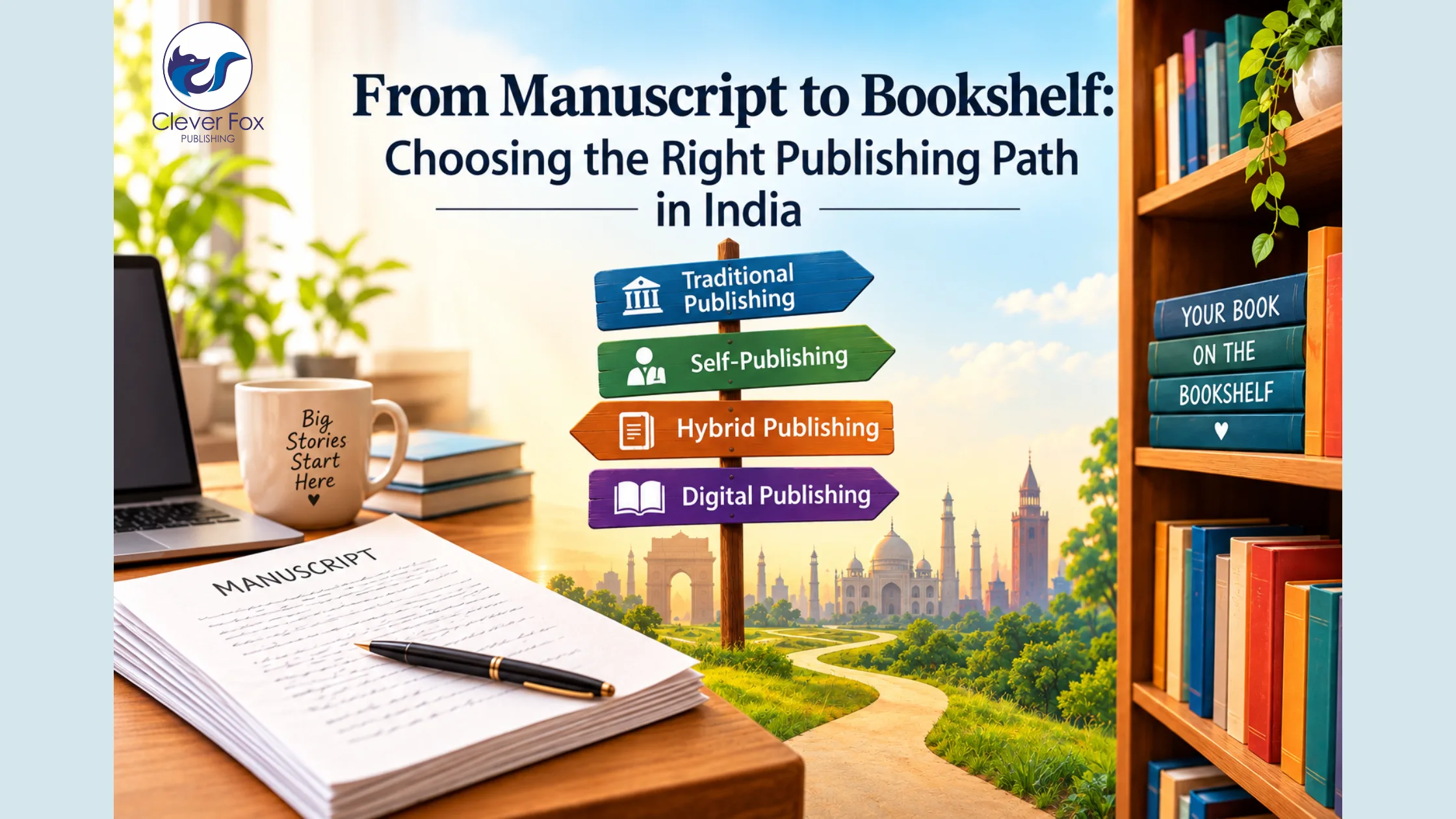
Finishing a manuscript is a major milestone for any writer. But once the final chapter is complete, another important question begins: What should happen next?
For many aspiring authors, publishing can initially seem complicated. Should you approach a traditional publisher? Should you publish independently? Would working with a publishing company make the process easier? Understanding these choices before committing time or money can help an author build a much clearer publishing plan.
Today, writers have more options than ever, and self-publishing in India has made it possible for authors to take a more active role in turning their manuscripts into professionally published books.
Your Manuscript Is Only the Beginning
A completed manuscript is the foundation of a book, but it is not necessarily the finished product.
Before publication, a manuscript may require developmental editing, proofreading, formatting, cover design, ISBN registration, printing, distribution, and promotional planning. Each of these stages contributes to how readers experience the finished book.
This is where authors need to decide how involved they want to be.
Some writers prefer a completely independent approach, managing individual services themselves. Others want a professional team to coordinate multiple stages of publication. There is no universal answer; the right choice depends on the author’s experience, goals, budget, and preferred level of control.
What Makes Self-Publishing Attractive?
The biggest appeal of self-publishing is control.
Instead of waiting for a publishing house to decide whether a manuscript fits its catalogue, authors can take responsibility for the publishing process and make decisions about their work.
This can be particularly valuable for:
- First-time authors
- Business and professional writers
- Poetry and short-story writers
- Regional-language authors
- Niche non-fiction writers
- Entrepreneurs and subject-matter experts
- Authors building a personal brand
An author can decide how the book should be positioned, what audience it should target, and how it should be promoted.
However, control also comes with responsibility. Authors who choose a completely independent route need to coordinate editing, design, publishing platforms, printing, distribution, and marketing themselves or through individual service providers.
When Professional Support Makes Sense
Not every writer wants to become an editor, designer, publishing coordinator, and marketing manager after completing a manuscript.
For such authors, working with a publishing service provider can simplify the process. Instead of coordinating several freelancers independently, an author can work with a team that understands the different stages involved in bringing a book to market.
Professional support can be especially useful for first-time authors who are unfamiliar with publishing terminology, production requirements, distribution channels, and promotional strategies.
The objective is not to take the author’s creative role away. Rather, the publishing team can handle technical and professional aspects while the author remains involved in important decisions.
Understanding Hybrid Publishing
One model that has gained attention among independent writers is hybrid publishing.
Hybrid publishing generally combines author investment with professional publishing services. Depending on the provider and agreement, authors may receive support for areas such as editing, cover design, formatting, printing, distribution, and marketing.
The important point is that the term “hybrid” can mean different things across companies. Authors should therefore examine the actual services, rights, royalty terms, costs, and distribution commitments rather than selecting a company simply because it uses the label.
A well-structured publishing arrangement should clearly explain what the author is receiving and what responsibilities remain with the author.
What Should Authors Look for in a Publishing Company?
Searching for the top self-publishing companies in India can produce a long list of options. Instead of choosing purely on the basis of advertisements or package prices, authors should compare the actual publishing ecosystem offered by each company.
Editorial Quality
A book should be professionally reviewed before publication. Editing and proofreading can improve readability, consistency, grammar, structure, and overall presentation.
Cover and Interior Design
Readers often make their first impression from a book’s cover. Interior formatting is equally important because poor typography or inconsistent layouts can affect the reading experience.
Distribution
Authors should understand where their books will be available. Online marketplaces, bookstores, libraries, and international distribution networks can each serve different purposes.
Royalty and Rights
The publishing agreement should clearly explain copyright ownership, royalty calculations, payment schedules, and the author’s rights.
Marketing Assistance
Publishing a book does not automatically create an audience. Authors should consider whether a company offers promotional support such as social media campaigns, advertising, public relations, reviews, author branding, or digital outreach.
Communication
A clear workflow and regular project updates can make a major difference, especially for first-time authors. A publishing partner should make the process understandable rather than overwhelming.
Publishing Is Also About Building an Author Brand
A modern book can represent much more than a single product.
For entrepreneurs, consultants, educators, doctors, coaches, and business professionals, a published book can support professional credibility. For fiction writers and poets, it can become the foundation for building a readership.
This is why authors should think beyond publication day.
An author website, social media presence, reader engagement, interviews, reviews, book events, and promotional campaigns can contribute to a long-term author platform.
The book should therefore be considered both a creative work and a communication asset.
Why Distribution and Marketing Need Different Strategies
Distribution answers one question: Where can readers buy the book?
Marketing answers another: Why should readers notice it?
A book can be available on major online platforms and still struggle to reach its intended audience if there is no visibility strategy behind it.
Authors should identify their ideal readers before selecting promotional channels. A children’s book may benefit from parent-focused communities and visual content, while a business book could be promoted through professional networks, interviews, LinkedIn content, and industry-focused campaigns.
This audience-first approach is often more useful than simply promoting a book everywhere.
Choosing a Publishing Partner Carefully
Authors considering Clever Fox Publishing or other publishing companies should evaluate the complete service offering rather than focusing on a single feature.
Look at the publishing process from manuscript preparation through post-publication promotion. Ask questions about timelines, production, distribution, royalties, marketing deliverables, author support, and rights.
A good publishing relationship should provide clarity at every stage. Authors should know what is included, what is optional, and what they are responsible for before beginning the project.
The Future of Independent Authors in India
The publishing environment continues to become more accessible. Digital platforms, online retail, print technology, social media, and professional publishing services have reduced several barriers that once made publishing difficult for new writers.
But accessibility does not remove the need for quality.
A successful publishing journey still depends on a strong manuscript, professional presentation, appropriate distribution, realistic marketing, and consistent effort after launch.
For authors, this creates an encouraging opportunity: publishing is no longer simply about waiting for someone to approve a manuscript. Writers can research their options, understand the process, choose the right level of support, and participate actively in building their publishing journey.
Final Thoughts
The most important publishing decision is not necessarily choosing between one company and another. It is understanding what you want from your book.
Do you want complete independence? Professional assistance? Wider distribution? A stronger author brand? A combination of these?
Once those goals are clear, comparing publishing models becomes much easier.
For today’s Indian author, the journey from manuscript to reader can be more flexible than ever. Whether you choose independent publishing or a professionally supported model, careful planning can turn a completed manuscript into a book that is not only published, but prepared to find the readers it was written for.