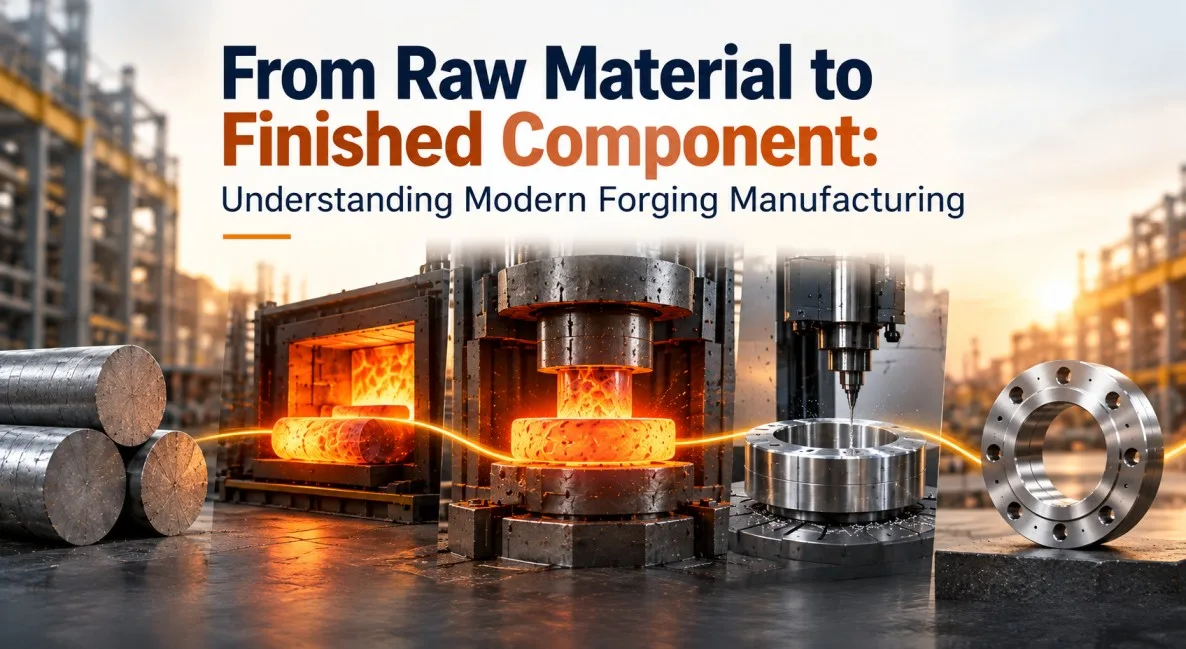
A forged component may look like a simple piece of metal once it reaches the end of the manufacturing line.
But behind that finished component is a carefully controlled process involving material selection, heating, forging, heat treatment, machining, inspection, and quality control.
For industries such as oil & gas, power generation, mining, construction, aerospace, and heavy engineering, the manufacturing process can have a direct impact on component performance and reliability.
Understanding how a forged component moves from raw material to finished product provides useful insight into why process control matters in modern manufacturing.
1. It Starts with the Right Raw Material
The first step in forging is selecting suitable raw material.
Depending on the application, manufacturers may work with:
- Carbon steel
- Alloy steel
- Stainless steel
- Duplex steel
- Aluminium alloys
- Titanium alloys
- Other engineering materials
The material must meet the required chemical composition and mechanical-property specifications.
Raw material inspection may include reviewing material certificates, verifying chemical composition, checking dimensions, and confirming traceability.
Starting with the right material provides the foundation for the entire manufacturing process.
2. Controlled Heating
Before forging, the material is heated to a suitable temperature range.
The heating process needs to be carefully controlled because temperature can influence how the material behaves during deformation.
Too little heat can make forging difficult, while excessive or poorly controlled heating can affect material properties and surface quality.
Modern forging facilities therefore use controlled heating systems and process monitoring to maintain appropriate conditions.
3. The Forging Process
This is where the material is transformed into the required shape.
The heated work piece is subjected to controlled compressive forces using forging equipment such as presses or hammers.
Depending on the component, manufacturers may use processes including:
- Open-die forging
- Closed-die forging
- Ring rolling
- Upset forging
- Other specialized forging processes
During deformation, the material flows into the required geometry.
Properly controlled forging can help develop favorable grain flow and produce components with the mechanical properties required for demanding applications.
4. Heat Treatment
Forging creates the basic component, but additional processing may be required to achieve the desired mechanical properties.
Heat-treatment processes can include:
- Annealing
- Normalizing
- Quenching
- Tempering
- Stress relieving
The appropriate process depends on the material and the final application.
Heat treatment can help achieve the required balance of strength, hardness, toughness, and dimensional stability.
5. Machining for Final Dimensions
After forging and heat treatment, many components undergo machining.
Machining removes controlled amounts of material to achieve the required:
- Dimensions
- Tolerances
- Surface finish
- Geometrical accuracy
Modern CNC machining equipment can provide the precision required for complex industrial components.
One advantage of forging is that the component can be produced relatively close to its required shape, potentially reducing the amount of material that needs to be removed during machining.
6. Inspection and Testing
A component is not ready for delivery simply because it has reached the required dimensions.
Quality inspection is an essential part of modern forging manufacturing.
Depending on customer and application requirements, testing may include:
Dimensional Inspection
Confirms that the component meets drawing dimensions and specified tolerances.
Mechanical Testing
Tests properties such as tensile strength, yield strength, elongation, impact toughness, and hardness where applicable.
Non-Destructive Testing
Methods such as Ultrasonic Testing (UT) and Magnetic Particle Inspection (MPI) can help identify internal or surface discontinuities without damaging the component.
Visual Inspection
Checks the component's surface condition and overall workmanship.
7. Traceability and Documentation
For many industrial applications, knowing where a component came from is just as important as knowing its final dimensions.
Manufacturers may maintain records covering:
- Raw material heat number
- Material certificates
- Forging process
- Heat treatment
- Inspection results
- Machining
- Final inspection
Traceability helps manufacturers and customers maintain confidence in product quality and provides important documentation throughout the component's lifecycle.
Why Process Control Matters
Every stage of forging manufacturing is connected.
Material selection → Heating → Forging → Heat treatment → Machining → Inspection
A problem at one stage can affect the performance of the final component.
This is why experienced forging manufacturers focus on controlling the entire manufacturing chain rather than treating each operation as an isolated activity.
For OEMs and procurement teams, evaluating a supplier's complete capabilities can therefore be more valuable than looking at forging capacity alone.
Modern Forging Is More Than Traditional Metalworking
Today's forging plants are increasingly incorporating automation, digital monitoring, advanced inspection, and data-driven manufacturing.
Technology can help manufacturers improve:
- Process consistency
- Production efficiency
- Quality monitoring
- Equipment reliability
- Material utilization
- Traceability
However, technology works best when combined with experienced engineers and skilled manufacturing teams.
The future of forging is therefore likely to be defined by the combination of advanced technology and manufacturing expertise.
CHW Forge: From Forging to Finished Components
With forging roots dating back to 1956, CHW Forge has developed capabilities to manufacture engineered forged components for demanding industries.
Its applications span sectors such as heavy industrial equipment, mining, oil & gas, power generation, construction, infrastructure, aerospace, and engineering.
The company's capabilities include forged and rolled components such as rings and gear rings, flanges, shafts, discs, hubs, hollow forgings, sleeves, and shells.
For global OEMs, an integrated manufacturing approach covering forging, heat treatment, machining, inspection, and traceability can be an important consideration when selecting a long-term manufacturing partner.
What OEMs Should Look for in a Forging Manufacturer
When sourcing forged components, procurement and engineering teams should evaluate more than the quoted price.
Important factors include:
- Raw material quality
- Forging capacity
- Manufacturing technology
- Heat-treatment capabilities
- Machining facilities
- Inspection and testing
- Material traceability
- Engineering expertise
- Production capacity
- Delivery reliability
A supplier capable of managing multiple stages of production can provide greater control over quality and manufacturing consistency.
Final Thoughts
Modern forging manufacturing is a carefully controlled journey that begins long before the finished component reaches the customer.
From selecting the right raw material to controlling forging temperatures, optimizing grain flow, applying appropriate heat treatment, achieving precise dimensions, and completing rigorous inspection, every stage contributes to the final product.
For heavy industries, where component reliability can directly influence equipment performance, understanding this process is important for both engineers and procurement teams.
The finished component may be the visible result, but its performance is built step by step—from raw material to final inspection.