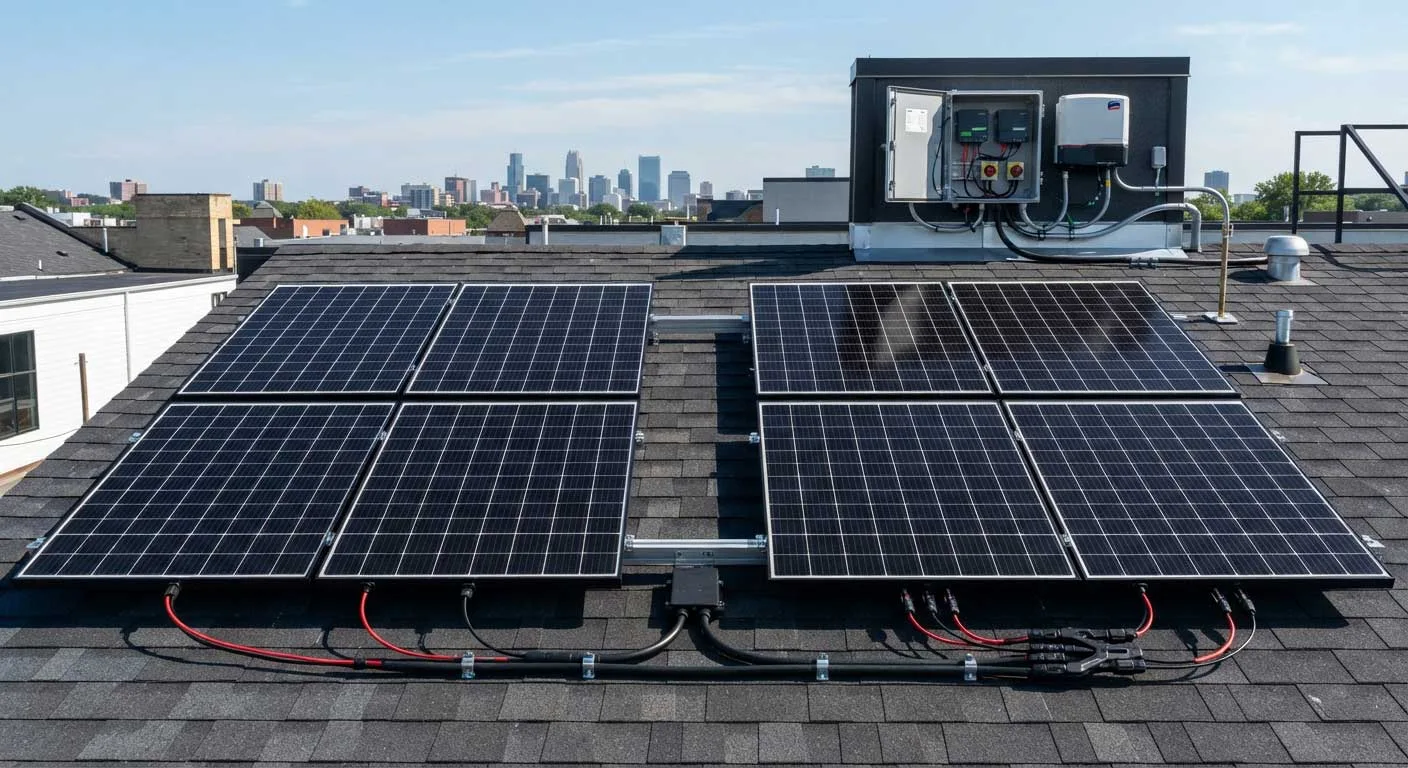
If you are connecting two or more solar panels, the choice between series and parallel wiring changes how voltage and current behave in your system. In simple terms, solar panel series vs parallel comes down to one basic difference: series wiring increases voltage, while parallel wiring increases current.
That sounds simple. In practice, though, your charge controller, cable length, shading, battery voltage, and inverter all matter. Choosing the wrong configuration can leave you with unnecessary voltage drop, excessive current, or an array that does not match your controller.

Solar Panels in Series: Higher Voltage
When solar panels are connected in series, the positive terminal of one panel connects to the negative terminal of the next.
The voltage adds together, while the current stays approximately at the level of one panel.
For example, suppose you have two panels rated at 20V and 5A:
- Series voltage: 20V + 20V = 40V
- Series current: approximately 5A
- Total power: about 200W
This is one reason series wiring is popular with MPPT charge controllers. Higher array voltage can be useful for longer cable runs because the same amount of power can be transmitted at lower current, helping reduce voltage drop.
But there is a catch: shading.
If one panel in a series string is heavily shaded, its reduced performance can affect the output of the string. Modern solar modules use bypass diodes to reduce the impact, but bypass diodes do not make shading irrelevant.
So, if part of your RV roof is regularly shaded by an air conditioner, antenna, or nearby structure, don't automatically assume that series is the best choice.
Solar Panels in Parallel: Higher Current
Parallel wiring works differently. You connect the positive terminals together and the negative terminals together.
The voltage remains approximately the same as one panel, while the current increases.
Using the same two 20V, 5A panels:
- Parallel voltage: approximately 20V
- Parallel current: 5A + 5A = 10A
- Total power: about 200W
This can make parallel wiring attractive for certain low-voltage battery systems and installations where partial shading is a concern.
There is another consideration, however: cable size.
More current means greater potential voltage drop and may require larger conductors. You also need to make sure your connectors, fuses, combiner equipment, and charge controller are rated for the resulting current.
Solar Panel Series vs Parallel: What Changes?
This is the easiest way to remember it:
Series = voltage goes up.
Parallel = current goes up.
The total rated wattage of identical panels is theoretically the same in either configuration. What changes is how that power is distributed between voltage and current.
That difference becomes important when selecting your charge controller and planning the wiring.
Wiring MethodVoltageCurrentTypical AdvantageSeriesIncreasesStays similarHigher voltage, lower currentParallelStays similarIncreasesBetter separation between stringsSeries-ParallelIncreasesIncreasesBalances voltage and currentWhich Is Better for an RV Solar System?
There is no universal winner.
For an RV, series wiring can be useful when you have an MPPT controller, longer cable runs, or a need to raise the PV voltage. Parallel wiring can make sense when partial shading is common or when the system design calls for keeping the PV voltage closer to the panel's nominal voltage.
For larger RV solar systems, a series-parallel solar panel connection can be a practical middle ground.
For example, four identical panels can be arranged as 2S2P: two panels connected in series to form one string, then two identical strings connected in parallel. This raises both the array voltage and current without creating one extremely long series string.
Don't Choose Wiring Before Checking the Controller
This is where many solar installations go wrong.
Before deciding between solar panel series vs parallel, check the solar panel's:
- Voc
- Vmp
- Isc
- Imp
- Maximum system voltage
Then compare those values with the charge controller or inverter's maximum PV voltage and current limits.
For series connections, pay particular attention to total Voc because the panel voltages add. Cold temperatures can also increase open-circuit voltage, so simply adding the values from a warm-weather specification sheet is not enough for a final system design.
For parallel connections, check the combined current and the controller's input-current limit.
The Bottom Line
There is no single answer to solar panel series vs parallel. Choose series when higher voltage and lower current fit your controller and wiring requirements; choose parallel when maintaining voltage while increasing current better suits the system. For many larger installations, a series-parallel configuration provides a useful balance.
At Bright Solar, we recommend starting with the complete system—not just the panels. Your panel specifications, controller, battery voltage, cable distance, shading conditions, and installation environment should all be considered before deciding how to wire the array.