
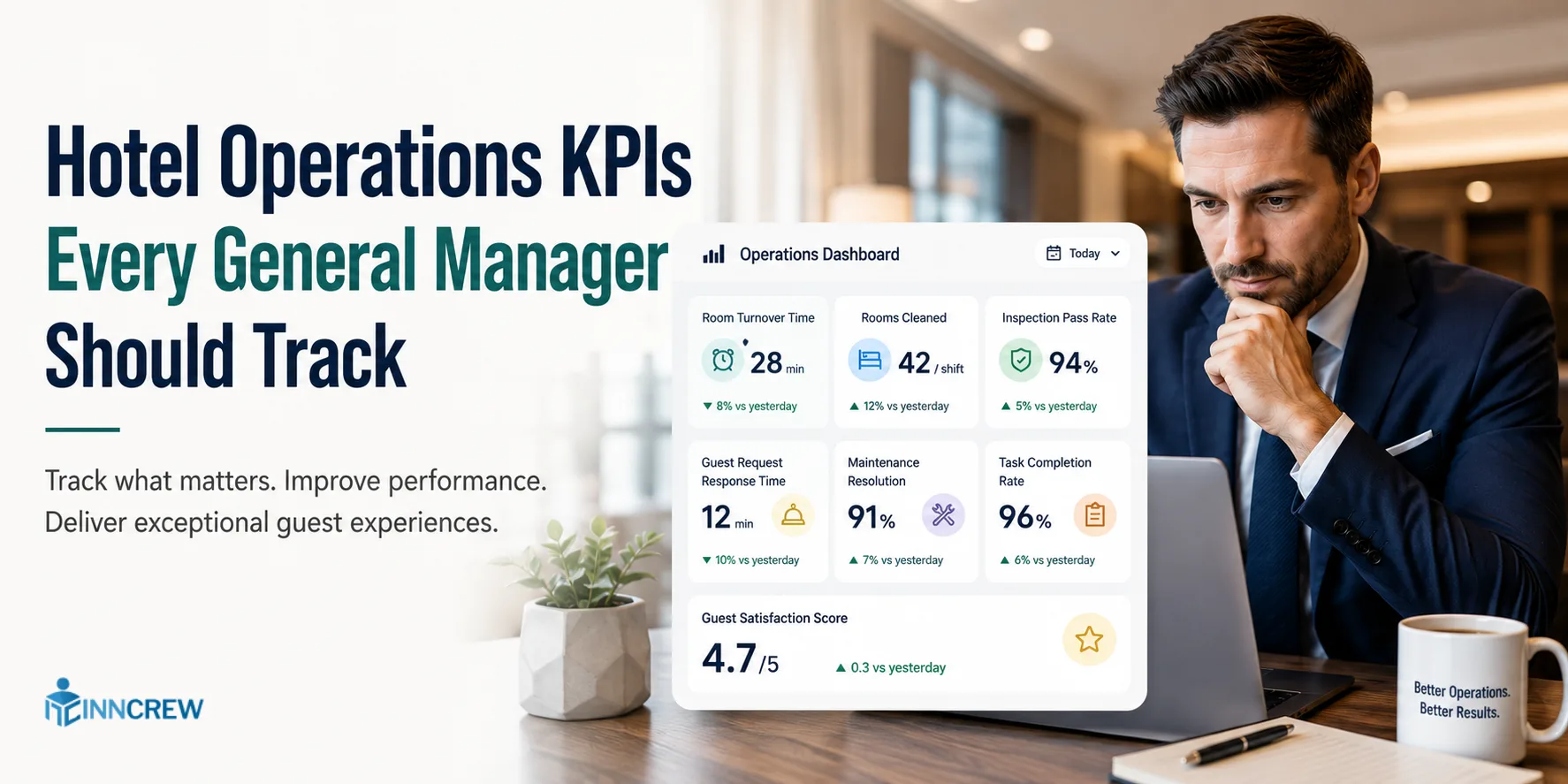
Walk into the office of any experienced hotel general manager, and you’ll usually find some version of the same thing: a dashboard, a spreadsheet, or a notebook covered in numbers they check every single day. The best GMs aren’t guessing how their property is performing. They’re tracking it. And the specific hotel operations KPIs they choose to track say a lot about how well that property actually runs behind the scenes. If you’re a GM, owner, or operations manager trying to get a clearer picture of what’s really happening across your hotel beyond occupancy and ADR, which most people already track, this guide walks through the operational metrics that genuinely move the needle. These are the numbers that tell you whether your team is coordinated, whether guests are getting what they expect, and where the hidden inefficiencies in your property actually live.
Why Operational KPIs Matter More Than Most GMs Realise
Every hotel tracks revenue metrics. Occupancy, ADR, RevPAR, these numbers are non-negotiable, and every GM in the USA knows them cold.
But revenue metrics tell you the outcome. They don’t tell you why. A hotel can have strong occupancy and still be bleeding money through inefficient operations, high staff turnover, and guest experiences that are quietly mediocre rather than memorable. The revenue numbers might look fine this month, but the underlying operational health of the property is what determines whether those numbers hold up over the next twelve months.
Hotel operational efficiency metrics are the early warning system. They show you problems while they’re still small and fixable — long before they show up as a drop in occupancy, a string of negative reviews, or a spike in staff turnover that suddenly leaves you short-staffed during peak season.
The GMs who track these numbers consistently aren’t doing it because someone told them to. They’re doing it because the numbers genuinely change the decisions they make.
Housekeeping KPIs - The Foundation of Daily Operations
Housekeeping is where a huge proportion of operational cost and guest experience risk lives, and it’s an area where hotel housekeeping KPIs give GMs genuinely actionable insight.
Average Room Turnover TimeThis is the time between a room being marked as checked out and the room being marked as clean and ready for the next guest. It’s one of the most important hotel KPI metrics because it directly affects both guest experience and revenue.
A property that takes 25 minutes to turn a room is functioning completely differently from a hotel, which requires 45 minutes for each turnover, and this difference adds up when multiplied throughout dozens of turnovers on any given day. Monitoring this performance metric based on different room types, floors, and specific staff members provides information that cannot be seen without the numbers. Some room types may require more time due to the space arrangement. Some floors may take longer due to the distance traveled to pick up supplies.
Rooms Cleaned Per Housekeeper Per ShiftThis metric tells you about workload distribution and productivity, but it needs to be read carefully alongside quality metrics. A housekeeper cleaning significantly more rooms than colleagues might be highly efficient, or might be cutting corners. The number alone doesn’t tell the full story, which is why it should always be paired with quality inspection data.
Inspection Pass RateWhat percentage of rooms pass quality inspection on the first check, without requiring rework? This is one of the clearest hotel guest experience KPIs because it directly correlates with the consistency of guests experience. A property with a 95% first-pass inspection rate is delivering a fundamentally more reliable guest experience than one running at 75% — even if both properties have similar average turnover times.
Same-Day Maintenance Resolution RateWhat percentage of problems identified by the housekeepers can be addressed on the very same day? This figure indicates the extent to which your maintenance and housekeeping teams are aligned. A low figure is indicative of miscommunication between the two rather than a lack of workforce on the side of the maintenance team.
Front Desk and Guest Service KPIs
Average Check-In and Checkout TimeHow long does the actual check-in or checkout process take from the moment a guest reaches the desk? Long processing times create queues, frustration, and a first or last impression that colours how guests remember their entire stay — regardless of how good the room itself was.
Guest Request Response TimeIf a guest phones in requesting additional towels, asks for a late checkout, or notifies the hotel about a problem in their room, how quickly will their request be attended to? This one measure alone is a strong predictor of guest satisfaction, since it indicates how well guests feel listened to and valued during their stay at the hotel.
First-Contact Resolution RateWhat percentage of guest requests and issues are resolved without the guest needing to follow up or escalate? A low first-contact resolution rate often indicates that staff don’t have the information or authority they need at the point of contact, a system problem more than a people problem in most cases.
Maintenance KPIs - The Metrics Most Hotels Ignore Until Something Breaks
Maintenance is one of the most under-measured areas of hotel operations, largely because issues only become visible when they cause a problem. But proactive GMs track maintenance metrics precisely to avoid that scenario.
- Preventive vs Reactive Maintenance Ratio
How much of the maintenance work is scheduled and preventive rather than emergency and reactive? Ideally, most of the maintenance work for your property should be done on a planned basis. High levels of reactivity are the number one indicator of future equipment breakdowns, costly repairs, and more problems impacting guests.
- Average Maintenance Resolution Time
From the initial reporting of the issue until it is fully solved, what time period does that entail for each type of problem? Problems in plumbing, heating, and air conditioning, electrical issues, and repairs all generally take very disparate amounts of time to solve.
- Repeat Maintenance Requests
How many times is the same problem reported for the same equipment or room? If it happens a lot, then this means that the problem is not being solved but rather covered up temporarily to make it stop bothering your guests and create more work for you later.
- Equipment Downtime
In relation to key equipment like elevators, HVAC equipment, pool equipment, and generators, what is the total downtime that has been recorded in a specific period? The reason this measure is important is because of operational considerations as well as compliance issues.
Staff Productivity and Coordination KPIs
Task Completion Rate Within SLAWhat percentage of tasks — across all departments — are completed within the time frame they were supposed to be? This is a broad but powerful metric because it reflects the overall operational tempo of the property. A declining completion rate often precedes more visible problems like guest complaints or rising overtime costs.
- Shift Handover Accuracy
How much information is accurately transferred between outgoing and incoming shifts? This is notoriously hard to measure in manual environments — which is itself telling. In digitally coordinated properties, this becomes measurable because the operational record persists regardless of who’s on shift, and hotel staff productivity improves measurably when teams aren’t starting each shift by reconstructing what happened on the last one.
- Staff Utilisation Rate
Is there any correlation between staffing and workload demands? Measuring it through occupancy, check-in, and check-out trends will show whether or not staffing is in tune with reality, as most hotels find out that they have more employees during lean times and fewer during busy times based on assumptions.
- Overtime as a Percentage of Total Labour Hours
High levels of overtime are seldom just a workforce shortage issue; often, they indicate a problem with efficiency and coordination. If tasks require more time than they should, owing to miscommunication, lack of clarity regarding priority, or lack of proper information, the outcome will be overtime. It is quite common to see a direct link between these two aspects.
Guest Experience KPIs Beyond the Standard Survey Score
Most hotels track overall guest satisfaction scores and online review ratings — and these matter enormously. But there are operational-level guest experience metrics that give GMs much earlier signals.
- Complaint Categories and Frequency
Rather than just tracking the overall number of complaints, breaking them down by category — room cleanliness, maintenance issues, service speed, noise, temperature — reveals exactly where operational attention needs to go. A spike in temperature-related complaints on a specific floor points to an HVAC issue long before it shows up as a broader satisfaction problem.
- Time-to-Resolution for Guest Complaints
When a complaint is logged, how quickly is it resolved — and does the guest receive a follow-up? Properties that resolve complaints quickly and follow up appropriately often see those same guests leave positive reviews despite the initial issue, because the recovery experience matters as much as the original problem.
- Repeat Guest Rate
What percentage of guests have stayed at the property before? While influenced by many factors, repeat guest rate is ultimately a reflection of whether the operational experience was good enough that guests chose to come back, making it one of the most honest long-term hotel guest experience KPIs available.
How to Actually Track These KPIs Without Drowning in Spreadsheets
Here’s the practical challenge that almost every GM runs into: these metrics are genuinely valuable, but collecting them manually is enormously time-consuming — and often doesn’t happen consistently, which means the data that does get collected is patchy and unreliable.
This is where hotel operations reporting software changes the equation entirely. When housekeeping status updates, maintenance requests, task assignments, and completion records are logged digitally as part of the normal daily workflow — not as a separate reporting exercise — the KPI data is generated automatically as a byproduct of doing the work.
Whereas in the case of utilization of a hotel operations management system that is linked, the GM does not have to require his department managers to provide weekly report compilations. These figures are already available because everything happens in real-time. Room turnovers are measured through the automated computation of room statuses. The resolution time taken for issues to be sorted is measured from the instant they are logged until they are sorted.
This shift — from manual reporting to automatically generated operational data — is one of the most significant changes happening in hotel management across the USA right now. It doesn’t just save time. It means the data is actually accurate, complete, and available in real time rather than reconstructed after the fact from memory and notes.
Building Your KPI Dashboard - Where to Start
If you’re not currently tracking operational KPIs in a structured way, here’s a practical starting point. Don’t try to track everything at once — start with the metrics that connect most directly to guest experience and cost.
Begin with average room turnover time and inspection pass rate — these two numbers alone reveal an enormous amount about housekeeping operations. Add guest request response time and first-contact resolution rate to understand the front-of-house experience. Track the preventive versus reactive maintenance ratio to get visibility into whether your maintenance approach is sustainable. And monitor overtime as a percentage of labour hours as a simple proxy for overall operational efficiency.
Once these baseline metrics are established and being tracked consistently, expand into the more granular metrics — repeat maintenance requests, shift handover accuracy, complaint categorisation — as your team becomes comfortable with data-driven operations.
What Good Looks Like - Benchmarks Worth Aiming For
Although benchmarks will vary depending on the type of hotel and the location, the following are some benchmarks achieved by well-managed hotels within the US:
Under 30 minutes room turnover time for regular rooms. Above 90% first inspection pass rate. Under 10 minutes is the guest’s request response time for non-emergency requests. Over 85% same day resolution rate for maintenance issues not related to emergencies. Minimum 70% of all maintenance is preventive maintenance. In the long run, less than 5% of all person-hours are used during regular operations.
These aren’t arbitrary numbers — they represent the kind of operational consistency that translates directly into guest satisfaction, staff retention, and ultimately, financial performance.
The Bigger Picture - KPIs Are a Conversation Starter, Not a Verdict
It is important to state that the benefit of monitoring such metrics does not lie in using them as a scorecard where people will be penalized for failing to perform. The benefit lies precisely in opening up the dialogue. If, say, the GM notices that room turnover times have increased on a certain floor, this is the basis for starting a conversation rather than making accusations.
The hotels getting the most value from operational KPIs are using them as a shared language between management and staff — a way to identify problems early, celebrate genuine improvements, and make resourcing decisions based on evidence rather than assumptions.
If your property doesn’t currently have visibility into these numbers, that’s the place to start — not with a complex analytics project, but with a system that captures the operational data as a natural byproduct of daily work.
InnCrew is a mobile-first hotel operations platform that gives GMs exactly this kind of real-time visibility, automatically tracking room turnover times, maintenance resolution, task completion, and staff coordination across every department, without adding reporting work to anyone’s plate. With hotel staff coordination software built for how hotel teams actually work, the KPIs that matter most are there, ready when you need them.
FAQ
Q1. What are the most important hotel operations KPIs to track?
Key hotel operations KPIs include room turnover time, inspection pass rate, guest response time, maintenance resolution time, task completion rate, and staff productivity.
Q2. How is hotel room turnover time calculated?
It is measured from guest checkout until the room is cleaned, inspected, and marked ready for the next guest.
Q3. What is a good inspection pass rate for hotel housekeeping?
A pass rate above 90% is generally considered strong and indicates consistent housekeeping quality.
Q4. How can hotels track maintenance KPIs effectively?
Hotels can use digital maintenance tools to log, assign, track, and resolve issues while monitoring response and completion times.
Q5. What is the difference between hotel KPIs and hotel operations KPIs?
Hotel KPIs often focus on revenue metrics, while hotel operations KPIs measure daily performance such as housekeeping, maintenance, and staff efficiency.
Q6. How does hotel operations software help with KPI tracking?
It automatically records operational data and provides real-time dashboards, reducing manual reporting and improving accuracy.
Q7. What is a good response time for guest requests in hotels?
For most requests, a response within 10 minutes is considered excellent and helps improve guest satisfaction.
Q8. What hotel operations software is best for tracking KPIs in the USA?
The best solutions are mobile-first and cloud-based, offering real-time visibility into housekeeping, maintenance, staff tasks, and operational performance.