Agricultural residues such as wheat straw, corn stalks, rice straw, barley straw, cotton stalks, and other fibrous materials are produced in large quantities every year. Although these materials are widely available, their low bulk density, irregular shape, high fiber content, and seasonal availability can make transportation, storage, and direct utilization difficult.
Pelletizing provides a practical way to solve these problems. By crushing, conditioning, and mechanically compressing loose agricultural residues, manufacturers can produce compact cylindrical pellets that are easier to handle, store, transport, and use.
At the center of this process is the straw pellet press, which applies controlled mechanical pressure to transform prepared straw material into dense pellets. Depending on the production objective, the finished pellets can be used as biomass fuel, animal bedding, or as a component of certain feed and agricultural applications.
For commercial production, however, choosing the press alone is not enough. The raw material condition, moisture content, particle size, required capacity, pellet diameter, cooling system, screening equipment, and final application all influence the design of a successful pellet production system.
What Is a Straw Pellet Press?
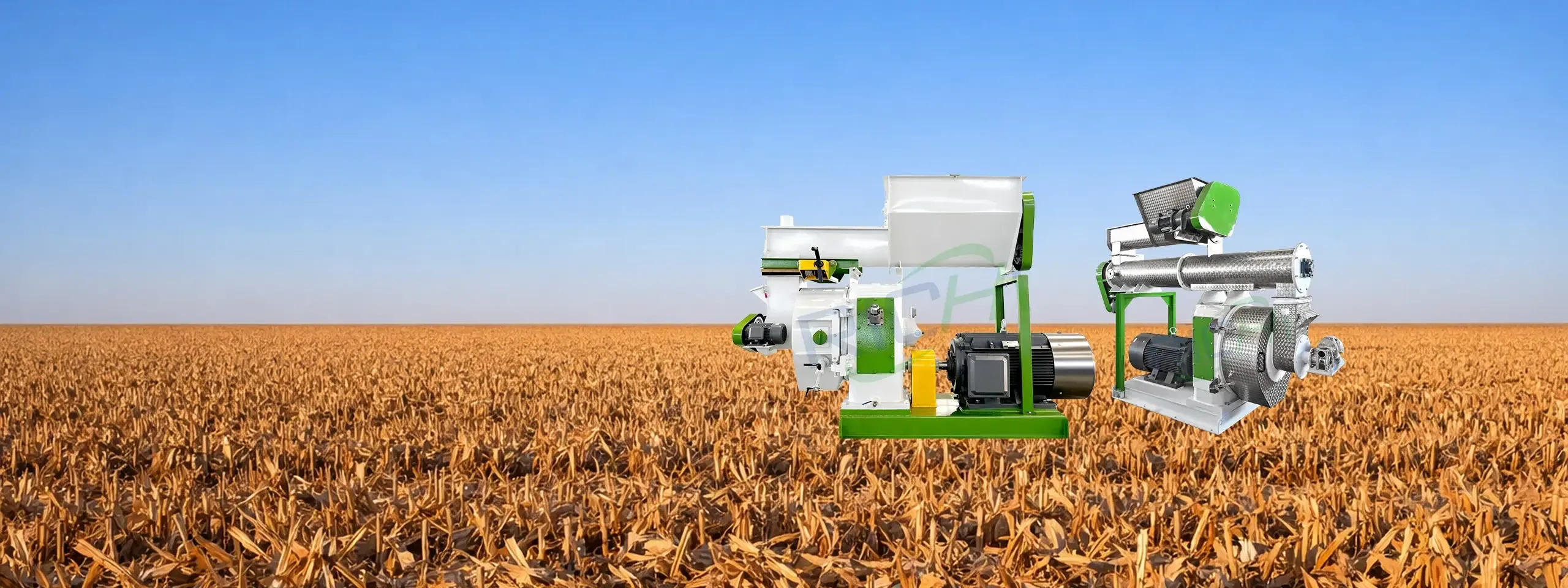
A straw pellet press is industrial equipment used to compress processed agricultural straw into cylindrical pellets. Unlike loose straw, which has a very low bulk density, compressed pellets have a much more concentrated structure.
The basic process involves several mechanical stages:
- Prepared straw enters the feeding system.
- The material is evenly distributed into the pelleting chamber.
- Press rollers compress the material against a ring die.
- The compressed material is forced through die holes.
- Continuous strands emerge from the die.
- Cutting knives divide the strands into pellets of the required length.
Modern ring die equipment uses continuous compression between rollers and the die. The size of the die holes determines the pellet diameter, while the cutting system influences pellet length.
This makes the pellet press the core forming machine in a commercial straw pellet production line.
(Learn more: https://richipelletizer.com/straw-pellet-machine-for-sale/)
Why Agricultural Straw Needs Compression
Raw straw is difficult to handle efficiently because of its physical characteristics.
A truck loaded with loose straw contains a large amount of air relative to the actual dry matter. Storage also requires considerable floor or warehouse space. Long fibers can become tangled, making automated feeding more difficult.
Pelletizing changes the physical form of the material.
Higher Bulk Density
Compression reduces the amount of empty space between individual straw fibers. This creates a much denser finished product.
Higher-density pellets are easier to stack and handle and can make transportation more practical.
More Uniform Shape
Loose straw varies considerably in length and shape. Pellets have a standardized cylindrical form, making them more suitable for automated conveying, weighing, packaging, and storage.
Easier Handling
Pellets can be transferred using conveyors, elevators, hoppers, and automatic packing systems. This is particularly useful for commercial production facilities.
Better Storage Management
Properly cooled and screened pellets can be stored in bags, bulk warehouses, or silos depending on the project design.
For fuel applications, the pelletized form can also provide a more standardized fuel product than loose agricultural residues.
What Types of Straw Can Be Pelletized?
The appropriate raw materials depend on the target product and equipment configuration. Common agricultural residues include:
- Wheat straw
- Corn stalks
- Rice straw
- Barley straw
- Oat straw
- Sorghum straw
- Cotton stalks
- Rapeseed straw
- Paddy straw
- Other crop residues
Some equipment configurations can also process other fibrous biomass materials such as grass, hay, and certain forage residues.
However, different materials should not automatically be processed using exactly the same settings.
Straw can vary significantly in:
- Moisture content
- Fiber length
- Ash content
- Bulk density
- Silica content
- Natural lignin content
- Particle size
- Seasonal condition
Therefore, a commercial project should be designed according to the actual raw material rather than selecting a machine only according to a nominal capacity.
The Complete Straw Pelletizing Process
A pellet press is only one part of the complete production process.
A typical commercial straw pellet line may include:
Raw Straw → Bale Breaking → Crushing → Drying → Storage or Buffering → Pellet Pressing → Cooling → Screening → Packaging
Not every project requires every machine. The exact configuration depends on the condition of the incoming straw and the final product requirements.
1. Bale Breaking
Straw is often collected and stored in large square or round bales.
These bales cannot normally be fed directly into the pellet press. A bale breaker separates the compressed material and provides a more continuous feed to the following processing equipment.
This is particularly important for large-scale projects where manual feeding would reduce production efficiency.
2. Crushing
Long straw fibers need to be reduced to a more suitable particle size before pelleting.
A biomass hammer mill or straw crusher cuts and breaks the material into smaller particles. Proper particle size helps improve material distribution inside the pelleting chamber.
The crusher should be selected according to:
- Straw type
- Initial fiber length
- Required output
- Final pellet diameter
- Moisture content
- Screen size
Poor crushing can create long fibers that interfere with feeding and pellet formation.
3. Drying
Moisture is one of the most important variables in pellet production.
If the raw material contains excessive moisture, it may be difficult to achieve stable compression and consistent pellet quality. If the material is excessively dry, pellet formation can also become unstable.
A rotary drum dryer can be integrated into the production line when drying is required.
The objective is not simply to make the straw as dry as possible. Instead, the moisture level should be controlled according to the raw material and pelletizing process.
4. Feeding
Prepared straw is transported to a buffer hopper before entering the pellet press.
Because processed straw is light and fibrous, it may have poor flow characteristics. Bridging or hanging inside the hopper can interrupt production.
For this reason, industrial equipment can use anti-bridging and forced-feeding systems to deliver material continuously into the pelleting chamber.
5. Compression and Pellet Formation
This is the main function of the straw pellet press.
Inside a ring die pellet press, the material enters the space between the rotating ring die and pressing rollers.
The rollers continuously compress the straw against the die surface. Pressure forces the material into the die holes, where it becomes a compact cylindrical strand.
As the strand exits the die, cutting knives divide it into individual pellets.
This continuous compression and extrusion process allows industrial pellet presses to operate at substantially higher throughput than many small batch-type systems.
How the Ring Die System Works
The ring die is one of the most important components of a commercial straw pellet press.
It contains numerous precisely manufactured holes. As the material is compressed between the rollers and die, it is forced through these holes.
The relationship between the roller system, die hole diameter, compression ratio, material characteristics, and operating conditions determines whether the machine can maintain stable production.
For example, a machine designed for a particular straw formulation may require a different die configuration when processing another material.
This is why simply changing the raw material without evaluating the die and operating parameters can lead to:
- Lower production capacity
- Higher energy consumption
- Poor pellet formation
- Increased fines
- Die blockage
- Excessive wear
A suitable die should therefore be selected according to the raw material and target pellet specifications.
Choosing the Right Pellet Diameter
Pellet diameter is another important design factor.
Depending on the equipment configuration, straw pellets can commonly be produced in different diameters. RICHI equipment specifications, for example, list pellet diameters in the approximately 4–12 mm range for several straw pellet machine configurations.
The appropriate diameter depends on the application.
Fuel Pellets
Fuel producers may select a diameter based on their combustion equipment, customer requirements, transportation system, and packaging specifications.
Animal Feed
For feed applications, pellet diameter is normally determined by the animal species, age, feeding method, and formulation.
Feed pellet production may also require conditioning and additional processing equipment that is not necessarily needed for simple biomass fuel pellet production.
Bedding or Agricultural Applications
For bedding and other agricultural uses, pellet size and density should be selected according to the intended handling and application conditions.
Factors That Affect Pellet Quality
A high-quality pellet is not determined by the pellet press alone.
Several factors work together.
Raw Material Quality
Clean straw with limited soil, stones, metal, and other contaminants is easier to process.
Foreign materials can increase equipment wear and may damage crushers, feeders, dies, or rollers.
Moisture
Moisture directly influences compression and pellet stability.
An appropriate moisture range should be established through raw material testing and production trials rather than applying one number to every straw type.
Particle Size
The crushed material should be sufficiently uniform to promote stable feeding and compression.
Excessively long fibers can create feeding problems, while excessively fine grinding may increase energy consumption.
Compression Ratio
The compression ratio of the die should correspond to the material characteristics.
Fibrous agricultural residues can behave differently from sawdust or other woody biomass. The die therefore needs to be selected according to the specific feedstock.
Feeding Stability
Even if the pellet press itself is properly configured, irregular feeding can result in fluctuating production.
A stable forced-feeding system helps maintain a more consistent material supply.
Cooling
Fresh pellets leave the pressing process at an elevated temperature. Cooling helps stabilize the pellets before screening and packaging.
A counterflow or similar pellet cooler can be integrated into larger production lines.
Why Cooling Is Important
Pellets should not normally be packed immediately after leaving the press.
Fresh pellets contain heat generated during compression and friction. If they are packaged while still too hot, condensation and moisture-related problems may occur inside the packaging.
A pellet cooler reduces the product temperature and helps stabilize the finished pellets.
After cooling, the product can enter a screening system.
Screening and Recycling
Not every pellet leaving the press will have exactly the same dimensions.
Screening separates:
- Finished pellets
- Fine particles
- Oversized material
- Broken pellets
The acceptable pellets proceed to packaging or bulk storage.
Fine material can often be returned to the production process, depending on the line design and product requirements.
This recycling loop helps reduce material loss and improve overall production efficiency.
Straw Pellet Press Capacity
Capacity is one of the first specifications customers consider when purchasing pellet equipment.
However, the stated machine capacity should not be treated as a universal production guarantee.
Actual throughput can be affected by:
- Straw variety
- Moisture
- Particle size
- Bulk density
- Die compression ratio
- Pellet diameter
- Feeding stability
- Motor power
- Operator settings
- Equipment configuration
Current RICHI specifications show straw ring die pellet machines covering a broad capacity range, from small commercial units to equipment designed for several tons per hour.
For example, one published RICHI model range lists capacities from approximately 0.7 to 40 t/h depending on the machine model and configuration.
This illustrates why capacity should be selected based on the complete project rather than the press alone.
How to Select a Straw Pellet Press
Before purchasing a pellet press, a project owner should define several basic requirements.
1. Determine the Raw Material
Start with the actual material available locally.
For example:
- Wheat straw
- Corn stalk
- Rice straw
- Barley straw
- Cotton stalk
- Mixed agricultural residues
If several materials will be processed, their properties should be evaluated separately.
2. Define the Required Capacity
Determine the desired hourly production.
For example, a small farm may require less than 1 t/h, while a commercial biomass fuel project may require several tons per hour.
The complete line should be designed around the required production rather than selecting the largest available machine.
3. Define the Pellet Size
Determine whether the finished product needs to be 4 mm, 6 mm, 8 mm, 10 mm, 12 mm, or another specification.
The die should then be selected accordingly.
4. Identify the End Application
Fuel, feed, bedding, and other pellet products can have different processing requirements.
This affects whether the project needs:
- Steam conditioning
- Additional mixing
- Cooling
- Screening
- Coating
- Special packaging
- Dust collection
5. Consider Future Expansion
If production is expected to increase, the layout should leave sufficient space for additional equipment.
A modular plant design can make future expansion easier.
(more helpful hints at :RICHI Pelletizer)
Straw Pellet Press vs Flat Die Pellet Mill
Both ring die and flat die pellet mills can be used for biomass pellet production, but they are generally suited to different project scales and operating requirements.
A flat die pellet mill is often associated with simpler structures and smaller-scale applications.
A ring die pellet press is commonly used in continuous commercial production because of its high-throughput design.
For larger straw pellet plants, ring die equipment can be integrated with automatic feeding, drying, cooling, screening, conveying, and packaging systems.
The correct choice should therefore be based on the required output, operating schedule, investment scale, raw material, and automation requirements.
Important Components of an Industrial Pellet Press
A commercial machine normally consists of several interconnected systems.
Feeding System
Provides stable material delivery to the pelleting chamber.
Ring Die
Determines the pellet diameter and strongly influences compression performance.
Press Rollers
Apply pressure to compact the material and force it through the die holes.
Main Drive
Transfers motor power to the pelleting mechanism.
Transmission System
Ensures stable power transfer during continuous operation.
Lubrication System
Reduces friction and wear in important moving components.
Cutting System
Controls the approximate length of the finished pellets.
Safety Protection
Overload protection can help reduce the risk of major mechanical damage when abnormal material enters the machine.
Industrial pellet machines can also be configured with automatic lubrication and other auxiliary systems to reduce routine maintenance work.
Maintenance of a Straw Pellet Press
Regular maintenance is essential for stable pellet production.
Operators should regularly inspect:
- Ring die condition
- Roller surfaces
- Roller bearings
- Main shaft
- Gearbox
- Lubrication system
- Feeding system
- Cutting knives
- Safety devices
- Electrical components
The die and rollers are particularly important because they are continuously exposed to compression and abrasion.
Straw may also contain abrasive mineral particles and silica depending on the crop and harvesting conditions. Therefore, wear inspection should be included in the routine maintenance schedule.
Common Problems During Straw Pelletizing
The Machine Blocks Frequently
Possible causes include excessive moisture, poor feeding, unsuitable particle size, foreign materials, or an inappropriate die configuration.
Pellets Break Easily
Possible causes include incorrect moisture, unsuitable compression conditions, insufficient cooling, or unstable raw material preparation.
Production Is Lower Than Expected
The cause may not be the pellet press itself.
Low output can result from:
- Insufficient feeding
- Incorrect die selection
- High moisture
- Poor crushing
- Material bridging
- Excessive downtime
- Improper operating conditions
The complete production process should therefore be checked before replacing the main machine.
Energy Consumption Is Too High
Grinding, drying, and pelletizing can all consume substantial energy.
Optimizing particle size, moisture, feeding stability, die selection, and equipment matching can help improve overall energy efficiency.
Building a Complete Straw Pellet Production Line
For commercial production, a complete line is often more practical than purchasing only a pellet press.
A typical configuration may include:
Straw Bale → Bale Breaker → Crusher → Dryer → Conveyor → Buffer Hopper → Straw Pellet Press → Cooler → Vibrating Screen → Packing Machine
Additional equipment may include:
- Magnetic separator
- Dust collector
- Storage silo
- Bucket elevator
- Belt conveyor
- Automatic weighing system
- Control cabinet
- Finished pellet warehouse
The exact configuration depends on the raw material and final product.
For example, if the incoming straw already has suitable moisture, a dryer may not be necessary. If the material is delivered in loose form instead of bales, the bale-breaking stage can also be modified.
Why Complete System Design Matters
A pellet press can only perform properly when the upstream and downstream equipment can keep up with it.
If the crusher is too small, the pellet press may run without enough prepared material.
If the dryer cannot supply sufficiently conditioned material, pellet quality may fluctuate.
If the cooler is undersized, the packaging stage may be interrupted.
If the screening system is too small, finished pellets can accumulate and cause bottlenecks.
Therefore, commercial pellet production should be designed as an integrated system.
Investing in Straw Pellet Production
The investment required for an industrial straw pellet plant depends on much more than the price of the pellet press.
Important cost factors include:
- Raw material preparation equipment
- Crushing system
- Drying system
- Pellet press
- Cooling system
- Screening system
- Conveyors
- Dust collection
- Electrical control
- Packaging
- Building and civil construction
- Installation
- Spare parts
- Labor
- Electricity and fuel
A small pelletizing project may require only basic processing equipment, while an industrial project may need a fully automated production line.
The most useful approach is to calculate the complete project investment and operating cost instead of comparing the purchase price of individual machines.
What Makes a Commercial Straw Pellet Project Successful?
A successful project normally begins with a clear understanding of the raw material.
Before equipment selection, the project owner should determine:
- What straw is available?
- How much straw is available annually?
- What is the average moisture content?
- Is the material baled or loose?
- What pellet size is required?
- What is the target production capacity?
- Will the pellets be sold as fuel or used internally?
- How will the pellets be cooled and stored?
- What packaging method will be used?
A raw material test can then be used to determine suitable crushing, drying, feeding, die, and pelletizing conditions.
This approach is more reliable than selecting a machine based only on a catalog capacity.
Final Thoughts
Agricultural straw can be transformed from a low-density crop residue into a standardized pellet product through controlled mechanical compression.
The straw pellet press is the core forming equipment in this process, but its performance depends heavily on upstream material preparation and downstream pellet handling.
For commercial production, the best equipment configuration should be based on the actual straw characteristics, required capacity, pellet diameter, final application, and expected operating schedule.
A complete system may include bale breaking, crushing, drying, feeding, pellet pressing, cooling, screening, conveying, and packaging. When these stages are properly matched, agricultural residues can be processed into a more compact and manageable pellet product suitable for commercial biomass utilization.
For companies planning a new straw pellet project, the key is therefore not simply finding a powerful press. The more important task is developing a pelletizing system in which the raw material, processing equipment, pellet press, and finished-product handling system work together.