
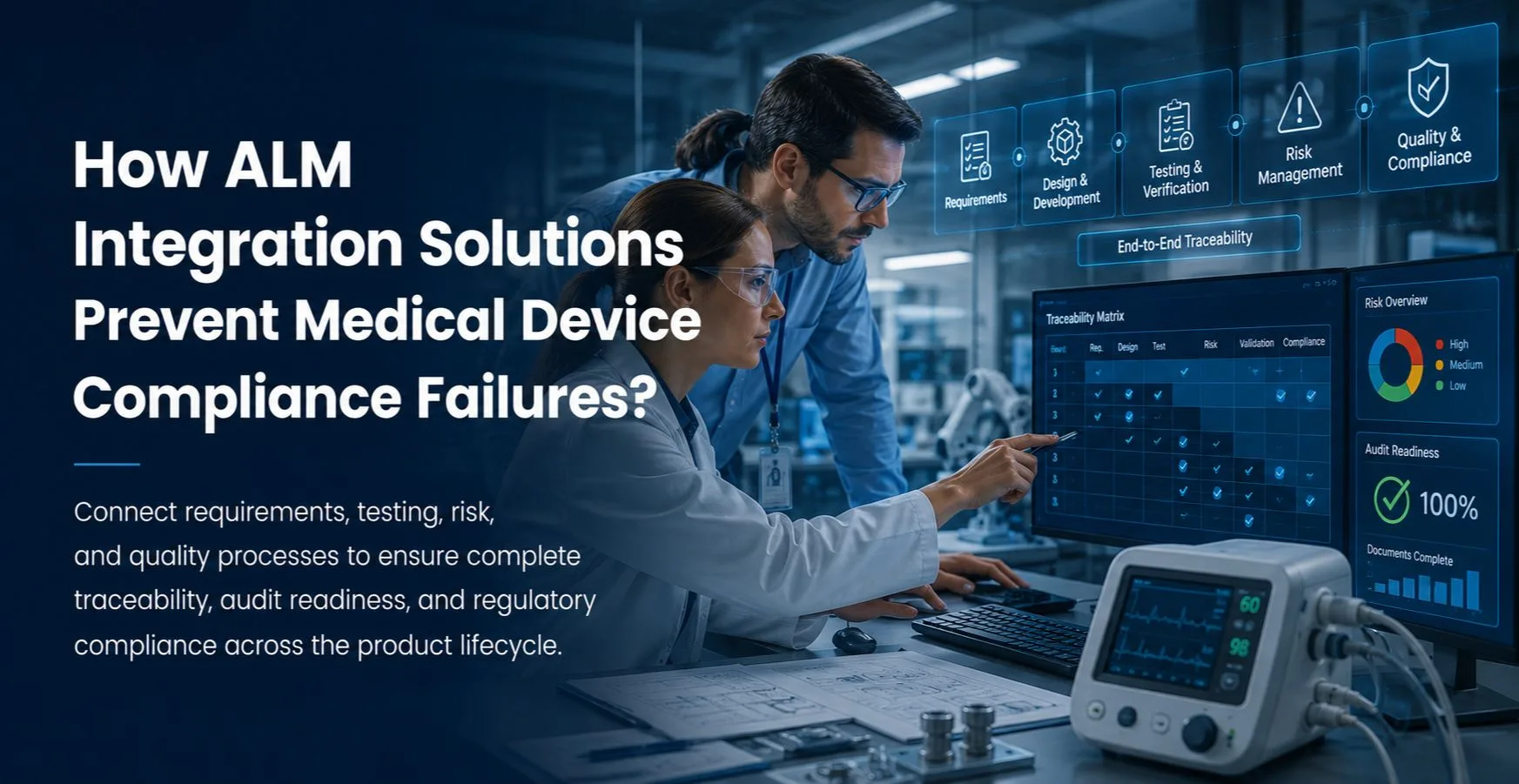
Medical device manufacturers face a difficult reality: innovation must move quickly, but compliance mistakes can be extraordinarily costly. A missing requirement trace, undocumented design change, incomplete validation record, or disconnected quality process can trigger audit findings, delay regulatory submissions, and increase product risk.
As regulatory expectations continue to evolve under frameworks such as FDA 21 CFR Part 820, ISO 13485, IEC 62304, EU MDR, and ISO 14971, organizations are under pressure to demonstrate complete traceability across the product lifecycle. Yet many compliance failures stem not from poor engineering, but from fragmented systems and disconnected processes.
This is where ALM integration solutions have become increasingly important. By connecting requirements, development activities, testing, risk management, quality processes, and regulatory documentation, organizations can significantly reduce compliance risks while improving development efficiency.
Why Medical Device Compliance Failures Still Occur
Short answer: Most compliance failures result from disconnected data, inconsistent processes, and inadequate traceability.
Medical device development involves collaboration among engineering, quality assurance, regulatory affairs, cybersecurity, manufacturing, and validation teams. When each group operates within separate systems, maintaining compliance becomes increasingly difficult.
Common compliance gaps include:
- Missing requirement-to-test traceability
- Incomplete design history files (DHF)
- Poor change management controls
- Inconsistent risk documentation
- Manual audit preparation processes
- Unverified software requirements
- Disconnected quality and engineering records
During regulatory inspections, organizations often discover that critical information exists but cannot be easily connected, verified, or demonstrated.
The challenge is no longer simply generating documentation—it is proving that every decision, requirement, risk assessment, and validation activity remains fully traceable throughout the product lifecycle.
How ALM Integration Solutions Strengthen Compliance
Short answer: They create a connected digital environment that automatically maintains traceability and compliance evidence.
Modern ALM integration solutions connect application lifecycle management platforms with quality management systems, product lifecycle management tools, requirements management applications, testing environments, and regulatory documentation repositories.
This integrated approach provides a single source of truth across development and compliance activities.
End-to-End Requirements Traceability
Regulators expect organizations to demonstrate how requirements flow through development, testing, verification, and validation.
Integrated ALM environments allow teams to trace:
- User needs
- System requirements
- Software requirements
- Design specifications
- Risk controls
- Verification activities
- Validation outcomes
Instead of manually assembling evidence during audits, organizations can generate traceability reports directly from connected systems.
Automated Change Impact Analysis
Every product modification introduces potential compliance risks.
Without integration, assessing downstream impacts often requires manual reviews across multiple departments.
With connected systems, organizations can quickly identify:
- Affected requirements
- Associated risks
- Linked test cases
- Validation requirements
- Regulatory documentation updates
This reduces the likelihood of overlooked compliance obligations.
The Growing Importance of ALM Integration Solutions in Medical Device Development
Short answer: Software complexity has increased faster than many compliance processes.
Medical devices increasingly rely on software-driven functionality, cybersecurity controls, connectivity features, and cloud-based services.
As software content grows, so does regulatory scrutiny.
A typical connected medical device may require coordination among:
- Software engineering teams
- Systems engineering groups
- Risk management specialists
- Quality assurance departments
- Regulatory affairs personnel
- Manufacturing teams
- Cybersecurity experts
Without effective ALM integration solutions, maintaining visibility across these functions becomes increasingly difficult.
Organizations that rely on spreadsheets, disconnected repositories, and manual document management often struggle to maintain audit readiness as product complexity expands.
The Role of Software Engineering Solutions in Compliance Success
Short answer: Compliance should be embedded into development workflows rather than managed separately.
Many organizations mistakenly treat compliance as a documentation exercise performed after development is complete.
Leading manufacturers take a different approach by implementing software engineering solutions that integrate compliance activities directly into engineering processes.
Examples include:
Requirements-Driven Development
Requirements are linked directly to:
- Design artifacts
- Source code
- Risk assessments
- Verification activities
- Validation evidence
This creates continuous traceability throughout development.
Continuous Verification
Modern engineering teams increasingly automate testing and validation processes.
Benefits include:
- Faster defect identification
- Improved documentation consistency
- Reduced human error
- Better audit evidence generation
Compliance becomes a byproduct of disciplined engineering practices rather than a separate administrative burden.
Why Compliance Audit Services Are Becoming More Strategic
Short answer: Organizations need proactive compliance visibility before regulators identify issues.
Traditional audits often occur after development milestones have been completed.
Today, many organizations use compliance audit services to continuously evaluate:
- Traceability completeness
- Documentation quality
- Process adherence
- Risk management effectiveness
- Regulatory readiness
This proactive approach helps identify weaknesses before they become costly findings.
For example, a manufacturer preparing for an FDA inspection may discover through internal audit assessments that several software requirements lack complete verification evidence. Resolving these gaps before regulatory review can prevent delays and reduce compliance risk.
Common Compliance Pitfalls That ALM Integration Helps Prevent
Even mature organizations encounter recurring compliance challenges.
Pitfall #1: Manual Traceability Matrices
Manual traceability management is difficult to maintain as projects evolve.
Integrated systems automatically update relationships between requirements, risks, tests, and validation records.
Pitfall #2: Disconnected Risk Management
Risk management often becomes isolated from development activities.
Effective ALM integration ensures risk controls remain linked to implementation and verification evidence throughout the lifecycle.
Pitfall #3: Inconsistent Documentation
Different teams frequently maintain conflicting versions of documents.
Integrated environments improve document control and reduce version-related compliance issues.
Pitfall #4: Audit Preparation Scrambles
Many organizations spend weeks gathering evidence before inspections.
Connected systems allow compliance records to be generated on demand, reducing audit preparation effort and stress.
Practical Implementation Framework
Organizations seeking stronger compliance performance should focus on five priorities:
- Centralize requirements management.
- Integrate ALM, QMS, PLM, and testing systems.
- Establish automated traceability workflows.
- Link risk management directly to development activities.
- Conduct ongoing compliance assessments rather than periodic reviews.
This approach helps create a sustainable compliance ecosystem rather than a reactive compliance process.
Industry Perspective: Moving Toward Continuous Compliance
Medical device manufacturers are increasingly shifting from document-centric compliance models to data-centric compliance strategies. Rather than treating regulatory evidence as static files, organizations are building connected digital ecosystems where traceability is continuously maintained throughout development.
Specialized providers offering Application Lifecycle Management expertise, reflect this broader industry trend by helping organizations connect engineering, quality, testing, and compliance processes within integrated development environments. The goal is not simply to pass audits, but to establish continuous compliance visibility throughout the product lifecycle.
Conclusion
Medical device compliance failures rarely occur because organizations lack technical expertise. More often, they result from fragmented systems, disconnected workflows, and incomplete traceability.
As regulatory expectations continue to increase, ALM integration solutions provide a practical path toward stronger compliance performance by connecting requirements, development, testing, quality, and risk management processes within a unified environment.
When combined with modern software engineering solutions and proactive compliance audit services, integrated ALM strategies help organizations reduce compliance risks, improve audit readiness, strengthen product quality, and accelerate development without compromising regulatory obligations.
The future of medical device compliance is not built on more documentation—it is built on better connectivity, stronger traceability, and continuous visibility across the entire product lifecycle.
FAQs
1. What are ALM integration solutions in medical device development?
ALM integration solutions connect requirements management, testing, quality systems, risk management, and development tools to create end-to-end traceability and improve compliance visibility throughout the medical device lifecycle.
2. Why is traceability important for regulatory compliance?
Traceability demonstrates how requirements are implemented, tested, validated, and linked to risk controls. Regulators often require evidence showing complete connections between development activities and compliance obligations.
3. How do ALM integration solutions support FDA inspections?
Integrated systems provide centralized access to requirements, testing records, risk assessments, change histories, and validation evidence, making it easier to demonstrate compliance during inspections and regulatory reviews.
4. Can ALM integration reduce audit preparation time?
Yes. Automated traceability, centralized documentation, and connected workflows allow organizations to generate compliance evidence more efficiently, reducing the manual effort typically associated with audit preparation.
5. What systems should be integrated with ALM platforms?
Organizations commonly integrate ALM with quality management systems, PLM platforms, requirements management tools, testing solutions, document control systems, and risk management applications to improve lifecycle visibility.
6. How do software engineering solutions improve compliance outcomes?
Modern software engineering solutions embed compliance activities into development workflows, enabling continuous verification, automated documentation, stronger traceability, and more consistent quality management practices.
7. When should manufacturers invest in compliance audit services?
Compliance audit services are most valuable before major regulatory submissions, inspections, product launches, or digital transformation initiatives, helping organizations identify and resolve compliance gaps proactively.