
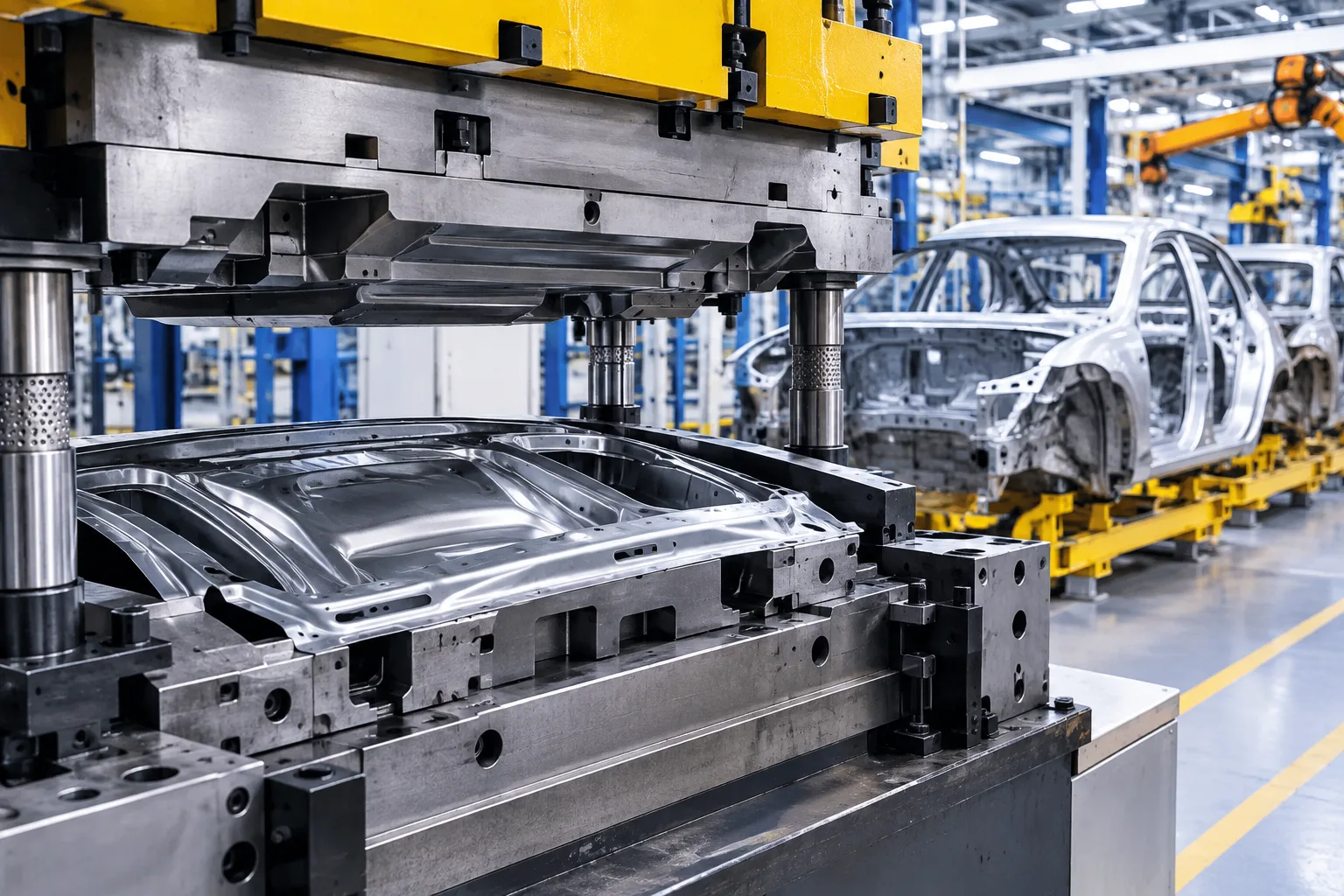
Automotive manufacturing requires precision, consistency, and efficient production processes to meet the growing demands of the mobility industry. Vehicle body components must maintain accurate dimensions, structural strength, and consistent quality throughout production. Automotive stamping dies play an important role in achieving these requirements by shaping metal sheets into components used in vehicle body manufacturing.
With advancements in manufacturing technology, automotive stamping dies have evolved to support complex component designs, improved production efficiency, and better integration with automated manufacturing systems. Companies such as HIROTEC combine engineering expertise and manufacturing capabilities to support automotive body production and tooling requirements.
Let's explore how automotive stamping dies improve vehicle body manufacturing efficiency and contribute to modern automotive production.
What Are Automotive Stamping Dies?
Automotive stamping dies are specialized tools used to shape sheet metal into specific forms through controlled pressure. They are designed according to the dimensions, shape, and functional requirements of individual automotive components.
These dies are commonly used to manufacture vehicle body parts, including doors, hoods, fenders, roof panels, and other structural components. Depending on the application, stamping processes may include forming, drawing, bending, and other operations.
The accuracy of stamping dies directly influences the quality, consistency, and fitment of manufactured components.
1. Improving Precision in Vehicle Body Components
Precision is essential in automotive body manufacturing because individual components must fit together accurately during assembly. Small dimensional variations can affect panel alignment, assembly processes, and overall product quality.
Automotive stamping dies are engineered to produce consistent component shapes and dimensions across production cycles. Proper die design, material selection, and maintenance help manufacturers maintain manufacturing accuracy.
Key benefits include:
- Consistent component dimensions
- Improved panel fitment
- Reduced dimensional variations
- Better assembly compatibility
By supporting repeatable manufacturing processes, precision stamping dies contribute to more reliable vehicle body production.
2. Increasing Production Efficiency
Automotive manufacturers often produce large quantities of body components while maintaining consistent quality. Efficient stamping operations can help reduce production time and support higher manufacturing output.
Well-designed stamping dies allow manufacturers to produce components through repeatable forming operations. When integrated with suitable presses and automated material-handling systems, stamping processes can support streamlined production workflows.
Production efficiency depends on several factors, including die design, press capacity, material properties, component complexity, and process optimization.
Manufacturers can improve operational performance by selecting stamping solutions that match their specific production requirements.
3. Reducing Material Waste
Material utilization is an important consideration in automotive manufacturing. Poor component design, incorrect forming parameters, and inefficient sheet layouts can contribute to unnecessary material waste.
Automotive stamping die development considers component geometry, sheet-metal characteristics, and forming requirements. Engineers can evaluate these factors during the design stage to support efficient material usage.
Appropriate die design may help reduce:
- Unnecessary material consumption
- Forming defects
- Production rework
- Manufacturing inconsistencies
However, actual material savings depend on the component design, material type, and production process.
4. Supporting Complex Automotive Component Designs
Modern vehicles require body components with different shapes, structural characteristics, and functional requirements. Manufacturing these components requires tooling capable of handling specific forming challenges.
Automotive stamping dies can be designed for different component geometries and production requirements. Engineering teams evaluate factors such as metal flow, forming depth, dimensional accuracy, and potential defects during die development.
Advanced design and simulation techniques can help identify potential manufacturing issues before production begins. This approach supports better tooling development and may reduce the need for extensive modifications during manufacturing.
For automotive manufacturers, effective die engineering is important for producing complex body components while maintaining quality standards.
5. Enabling Automation in Automotive Manufacturing
Automation has become an important part of modern vehicle body production. Robotic systems, automated material handling, and integrated production equipment help manufacturers coordinate different manufacturing operations.
Automotive stamping dies can be incorporated into automated production environments when their design and operating requirements are compatible with the overall system.
Automation can support:
- Consistent material handling
- Repeatable production cycles
- Improved workplace safety
- Better coordination between manufacturing stages
The effectiveness of an automated stamping process depends on tooling compatibility, equipment integration, programming, and production planning.
HIROTEC's broader manufacturing expertise includes automotive tooling and production equipment, supporting the integration of engineering and manufacturing processes.
6. Improving Tooling Reliability and Maintenance
The reliability of stamping dies affects production continuity and component quality. Repeated forming operations can subject tooling to mechanical loads and wear, making regular inspection and maintenance important.
Properly designed stamping dies, combined with appropriate maintenance practices, can help manufacturers manage tooling performance over time.
Maintenance activities may include:
- Inspecting die surfaces and components
- Checking alignment and wear
- Monitoring forming quality
- Replacing worn tooling parts when required
Preventive maintenance helps manufacturers identify potential issues early and reduce unexpected production interruptions. The maintenance requirements vary according to tooling design, production volume, material, and operating conditions.
ALSO CHECK - How Automotive Stamping Dies Improve Vehicle Body Manufacturing Efficiency
HIROTEC's Role in Automotive Stamping and Manufacturing Solutions
HIROTEC is an automotive engineering and manufacturing company established in 1932, with operations across multiple countries. Its capabilities include automotive closures, exhaust systems, manufacturing equipment, and stamping dies.
Through its integrated approach to product engineering, tool development, manufacturing, and production equipment, HIROTEC supports automotive manufacturing requirements across different stages of vehicle production.
Its expertise in automotive tooling and manufacturing technologies aligns with the industry's need for precision, process integration, and efficient production systems.
Conclusion
Automotive stamping dies play an important role in improving vehicle body manufacturing efficiency. From maintaining component precision and supporting complex designs to enabling automated production, well-engineered stamping solutions contribute to consistent manufacturing performance.
As automotive manufacturing continues to evolve, manufacturers require tooling and production systems that align with changing component requirements and operational goals.
HIROTEC's experience in automotive engineering, stamping dies, and manufacturing equipment supports the development of solutions for modern vehicle production.
For manufacturers seeking reliable automotive tooling and integrated manufacturing expertise, understanding the role of stamping dies is an important step toward improving production processes.