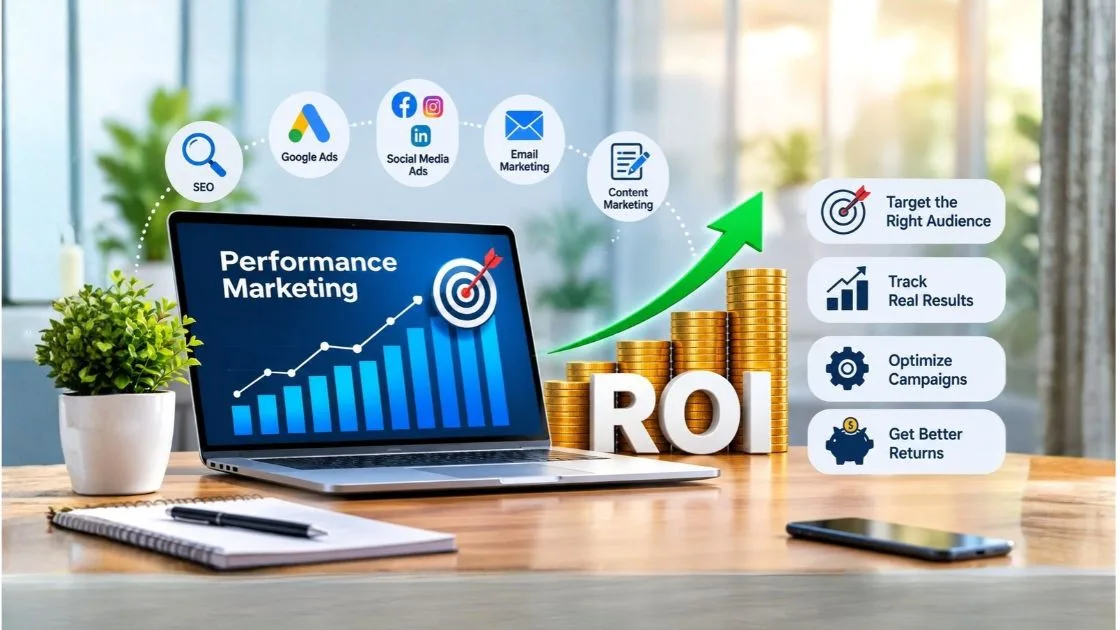
Summary: Performance marketing enables businesses to achieve better marketing returns by concentrating on measurable outcomes, including qualified leads, customer acquisition, purchases, and revenue. Through advertising platforms such as Google Ads, Facebook Ads, Instagram Ads, and LinkedIn Ads, companies can connect with relevant audiences and encourage valuable actions. Strategic audience selection, conversion measurement, advertising budget management, and ongoing campaign optimization help minimize wasted expenditure while improving profitability. Whether a startup, small business, or established organization, a structured performance marketing strategy supports informed decisions and long-term business growth.
Are your advertising campaigns delivering enough leads and sales to make your marketing investment worthwhile? Many companies spend money on digital advertisements without knowing which campaigns are actually contributing to business revenue. Although clicks, impressions, and website visits indicate audience activity, they do not necessarily represent business success. The real objective is to convert marketing expenditure into valuable customers and measurable revenue.
This is where performance marketing offers a practical solution. Rather than concentrating primarily on brand exposure and audience reach, this approach measures specific actions such as product purchases, website enquiries, registrations, and qualified leads. Businesses can leverage Google Ads, Facebook Ads, Instagram Ads, and LinkedIn Ads to connect with potential customers, evaluate advertising results, and make informed budget decisions.
For instance, a real estate business can measure property enquiries and site visit bookings, whereas an eCommerce company can evaluate purchases generated through paid advertising. Such insights help organizations identify effective campaigns, minimize unnecessary expenses, and achieve improved marketing ROI.
Understanding Performance Marketing and Its Business Value
Performance marketing is a results-oriented digital advertising strategy where campaign effectiveness is evaluated through measurable activities, including clicks, enquiries, purchases, registrations, app downloads, and lead submissions. Instead of considering impressions or website traffic as the only indicators of success, businesses measure outcomes that contribute directly to their objectives.
For example, an online retail company might track the number of completed orders from paid campaigns, while a property developer may monitor qualified enquiries and scheduled property visits.
This marketing approach uses advertising networks such as Google Ads, Facebook Ads, Instagram Ads, and LinkedIn Ads to reach relevant customer segments.
Its importance comes from the need to understand how marketing budgets are utilized and whether advertising activities generate meaningful business returns. Accurate conversion tracking and campaign evaluation allow marketers to discover profitable channels, strengthen lead generation, and distribute advertising investments more efficiently.
7 Ways a Results-Oriented Marketing Strategy Can Increase ROI
Improving marketing ROI does not simply mean reducing advertising expenditure. Businesses need to generate greater value from their marketing investments. Performance marketing makes this possible through several important practices.
1. Measures Actions That Contribute to Business Goals
A major benefit of performance marketing is its ability to measure specific customer actions. Businesses can determine how many users interact with advertisements, submit enquiry forms, purchase products, or complete other conversion activities.
For example, a software company advertising through LinkedIn can evaluate the number of product demonstration requests instead of measuring campaign success only through advertisement views.
These measurable insights allow marketing teams to understand which activities support business goals and which campaigns need further optimization.
2. Controls Advertising Costs and Limits Budget Waste
Advertising without understanding customer behaviour can result in unnecessary expenditure. Performance marketing helps identify irrelevant website visitors, ineffective search terms, and advertisements that fail to produce conversions.
Businesses can improve spending efficiency through negative keyword implementation, audience exclusions, geographic targeting, and regular budget adjustments.
For instance, a professional service provider operating in Pune might receive enquiries from locations outside its operational coverage. Refining location targeting allows the business to concentrate its advertising budget on audiences more likely to become customers.
3. Reaches Relevant Audiences and Generates Better Leads
A larger audience does not automatically translate into better business opportunities. Successful advertising requires reaching people based on their interests, demographics, purchasing intent, geographical location, and online activities.
Businesses can organize their target audiences according to different stages of the customer journey:
- Awareness: Introduce products and services to people discovering available solutions.
- Consideration: Reach individuals comparing different products, services, or providers.
- Conversion: Connect with potential customers who are prepared to make an enquiry or purchase.
- Remarketing: Re-engage website visitors and users who have previously interacted with the business.
This segmentation approach helps businesses prioritize relevant enquiries and improve lead quality instead of simply increasing the total number of leads.
4. Converts More Website Visitors Into Customers
Attracting website visitors through digital advertisements is only one part of a successful campaign. Businesses must also provide an effective experience that encourages visitors to take action.
Performance marketing combines advertisement improvements with conversion rate optimization (CRO) to make the customer journey more effective.
Marketers can experiment with different advertisement headlines, creative designs, landing page structures, calls to action, and enquiry forms to identify the elements that encourage conversions.
For example, a healthcare organization promoting appointment bookings can improve its landing page by including treatment information, doctor qualifications, clinic location, and an easy-to-complete appointment form.
Even a modest increase in conversion rates can generate additional enquiries without requiring a similar increase in advertising expenditure.
5. Uses Campaign Data for Faster Marketing Decisions
Performance marketing provides access to useful campaign information that helps businesses make better advertising decisions.
Tools such as Google Analytics 4, Google Ads conversion tracking, and Google Tag Manager allow marketers to evaluate important performance indicators, including:
- Website traffic and visitor engagement.
- Advertisement impressions and clicks.
- Cost per click (CPC).
- Cost per lead (CPL).
- Conversion percentages.
- Customer acquisition cost (CAC).
- Generated revenue and return on ad spend (ROAS).
By examining these indicators, businesses can identify which advertising channels, keywords, audiences, and creative formats deliver stronger outcomes.
Rather than evaluating campaign effectiveness only after advertisements stop running, marketers can use ongoing performance information to make timely improvements.
6. Expands Campaigns That Deliver Profitable Results
When advertising campaigns consistently generate qualified leads or profitable purchases, businesses can consider increasing their investment.
However, expanding campaign budgets without reviewing performance can increase acquisition expenses and negatively affect profitability.
A more effective strategy involves identifying successful search terms, audience groups, geographical segments, and advertisement creatives before increasing campaign expenditure.
This enables businesses to reach additional customers while maintaining better control over their marketing investments.
7. Strengthens Customer Acquisition and Repeat Business
Performance marketing also supports customer retention alongside new customer acquisition. Businesses can reconnect with existing customers and encourage repeat purchases through remarketing advertisements, personalized promotions, email campaigns, and audience segmentation.
For example, an eCommerce brand can use remarketing to reach shoppers who previously viewed a product but left the website without completing their purchase.
Combining customer acquisition with retention activities helps increase customer lifetime value (CLV) and supports more sustainable marketing returns.
Which Digital Advertising Platforms Deliver Better Performance Marketing Results?
Selecting suitable advertising platforms depends on business objectives, target audiences, industry requirements, and available budgets. Each performance marketing channel offers different opportunities.
Search Engine Marketing and Google Ads
Google Ads enables businesses to connect with people actively searching for particular products or services. Search advertising can target high-intent keywords, making it valuable for generating enquiries, acquiring leads, and increasing online sales.
For example, a website development company can target relevant commercial search queries to connect with businesses actively looking for website development solutions instead of allocating its entire advertising budget to general awareness campaigns.
Businesses can also explore effective Google Ads ROI strategies to understand how keyword selection, conversion measurement, and campaign improvements contribute to better advertising performance.
Social Media Advertising
Facebook, Instagram and LinkedIn provide advertising opportunities to reach audiences according to their interests, demographics, online behaviour, and engagement activities.
These channels can benefit eCommerce companies, educational institutions, healthcare providers, real estate businesses, and consumer-focused brands.
Audience segmentation, creative experimentation, and remarketing are useful techniques for improving social media advertising performance.
LinkedIn Advertising for B2B Lead Generation
LinkedIn Ads helps businesses reach professionals, company owners, industry specialists, and important decision-makers.
Organizations providing SaaS solutions, IT services, consulting, and other professional services can use LinkedIn advertising to connect with relevant business audiences and generate qualified enquiries.
Affiliate and Display Advertising
Affiliate marketing allows businesses to collaborate with publishers and marketing partners who promote their offerings through agreed commission-based or performance-based arrangements.
Display advertising helps organizations improve brand visibility across relevant websites and online platforms. When supported by remarketing campaigns, display advertisements can encourage previously interested visitors to return and complete their desired actions.
Key Performance Marketing KPIs Every Business Should Monitor
Measuring appropriate key performance indicators (KPIs) helps businesses determine whether their advertising investments are generating meaningful results.
Marketing MetricWhat It MeasuresReturn on Ad Spend (ROAS)Revenue generated compared with advertising expenditure.Customer Acquisition Cost (CAC)Average cost of acquiring a new customer.Cost Per Lead (CPL)Amount spent to generate one lead.Cost Per Click (CPC)Average cost paid for an advertising click.Cost Per Acquisition (CPA)Average cost of generating a defined conversion.Conversion RatePercentage of visitors who complete a desired action.Customer Lifetime Value (CLV)Estimated value a customer generates throughout the relationship.The most relevant performance indicators vary according to business models. An eCommerce organization may prioritize purchase revenue and ROAS, whereas a B2B company may focus on qualified enquiries, acquisition costs, and revenue from successfully converted leads.
Calculating Marketing ROI: A Practical Example
Marketing ROI evaluates the financial returns generated through marketing activities against the investment required to execute them.
A commonly used calculation is:
Marketing ROI = [(Incremental Profit − Marketing Investment) ÷ Marketing Investment] × 100
Consider a company investing ₹50,000 in an advertising campaign and generating ₹2,00,000 in attributable sales. Assume the contribution profit from these sales, before marketing expenditure, is ₹80,000.
The calculation would be:
- Marketing investment: ₹50,000
- Attributable sales revenue: ₹2,00,000
- Contribution profit before marketing: ₹80,000
- Profit after marketing investment: ₹30,000
- Marketing ROI: 60%
This indicates that the campaign delivered a 60% return on the marketing investment based on the specified contribution-profit assumptions.
Businesses should also distinguish between ROI and ROAS. ROAS measures advertising revenue against advertising expenditure, whereas ROI considers the return after accounting for relevant costs. Evaluating both metrics provides a more complete understanding of campaign profitability.
How the Right Digital Marketing Agency in PCMC Can Improve Advertising Results
Selecting an experienced marketing partner can influence how businesses plan, execute, and evaluate their advertising activities. A dependable Digital Marketing Company in PCMC can develop performance-oriented strategies according to business requirements, customer behaviour, and industry objectives.
Companies operating in Pimpri, Chinchwad, Wakad, Nigdi, Bhosari, Akurdi, and other areas across the Pune region can benefit from understanding local search behaviour and audience preferences.
For example, a manufacturing organization in Bhosari may prioritize B2B lead generation and decision-maker targeting, whereas a retail company in Pimpri might focus on location-based advertisements and customer enquiries.
An experienced digital marketing team can assist businesses with:
- Google Ads and PPC campaign management.
- Facebook and Instagram advertising.
- Local audience targeting and lead generation.
- Landing page design and conversion rate optimization.
- Google Analytics 4 implementation and conversion tracking.
- Campaign performance reporting and advertising budget management.
- Remarketing and customer acquisition strategies.
Businesses should assess potential marketing partners based on their strategic capabilities, transparent reporting, understanding of different industries, and ability to connect advertising performance with actual business outcomes.
A successful performance marketing strategy should prioritize measurable business growth rather than concentrating exclusively on increasing clicks, impressions, or advertising activity.
Common Performance Marketing Challenges Businesses Should Avoid
Even campaigns with substantial advertising budgets can deliver disappointing results when important optimization practices are overlooked.
Some frequent mistakes include:
- Measuring success through clicks alone: Increased website traffic does not necessarily produce qualified enquiries or purchases.
- Overlooking conversion tracking: Without reliable tracking, identifying profitable advertising campaigns becomes difficult.
- Selecting overly broad audiences: Irrelevant audience targeting can increase costs and reduce lead quality.
- Ignoring landing page performance: Complicated forms, unclear messaging, and poor website experiences can discourage conversions.
- Not evaluating lead quality: A large number of enquiries has limited value when most prospects are unlikely to become customers.
- Increasing budgets without analysis: Expanding campaigns without checking profitability can negatively impact ROI.
- Avoiding advertisement testing: Using identical creatives and messaging for extended periods can restrict campaign improvement.
Regular performance evaluations, audience research, and conversion optimization help businesses address these challenges and utilize their marketing budgets more effectively.
Transform Advertising Expenditure Into Measurable Business Results
Achieving stronger marketing ROI requires businesses to understand customer requirements, choose appropriate advertising channels, monitor meaningful conversions, and improve campaign performance continuously. Companies that connect advertising investments with qualified leads, actual purchases, and customer value can make more informed decisions about future growth.
Whether you operate a startup, manufacturing company, eCommerce business, or established service organization, a well-structured performance marketing strategy can help control unnecessary expenses and identify valuable business opportunities.
If your advertising campaigns are not delivering the expected results, consider evaluating your existing strategy, identifying missed conversion opportunities, and implementing a more results-focused approach. Working with an experienced digital marketing team can help turn advertising investments into measurable business outcomes.
Frequently Asked Questions About Performance Marketing
1. How can performance marketing help businesses achieve better ROI?
Performance marketing improves ROI by prioritizing measurable results such as customer enquiries, purchases, and qualified leads. Audience targeting, conversion tracking, budget management, and remarketing help businesses minimize unnecessary advertising expenses and improve campaign profitability.
2. Which advertising platform is most effective for generating business leads?
Google Ads is suitable for reaching people with strong purchasing intent, while Facebook and Instagram Ads help businesses connect with specific audience segments and generate demand. LinkedIn Ads can be particularly useful for B2B lead generation. Platform selection should depend on business objectives and target customers.
3. What is considered a good ROAS for digital advertising?
There is no fixed ROAS benchmark that applies to every business. Profit margins, operating expenses, customer lifetime value, and advertising costs influence the required return. A 4x ROAS might be profitable for one company but insufficient for another. Businesses should evaluate overall profitability before determining campaign success.
4. What advertising budget should small businesses allocate to performance marketing?
The appropriate investment depends on business objectives, industry competition, customer value, and expected acquisition costs. Small businesses can begin with a measurable budget, test different campaigns, evaluate lead quality, and gradually increase expenditure when results demonstrate sustainable profitability.
5. How quickly can performance marketing generate results?
Paid advertising can start generating clicks and enquiries soon after campaigns become active. However, achieving consistent and profitable performance requires sufficient conversion data, audience testing, landing page improvements, and continuous optimization. Actual timelines vary according to industry, competition, budget, and campaign objectives.