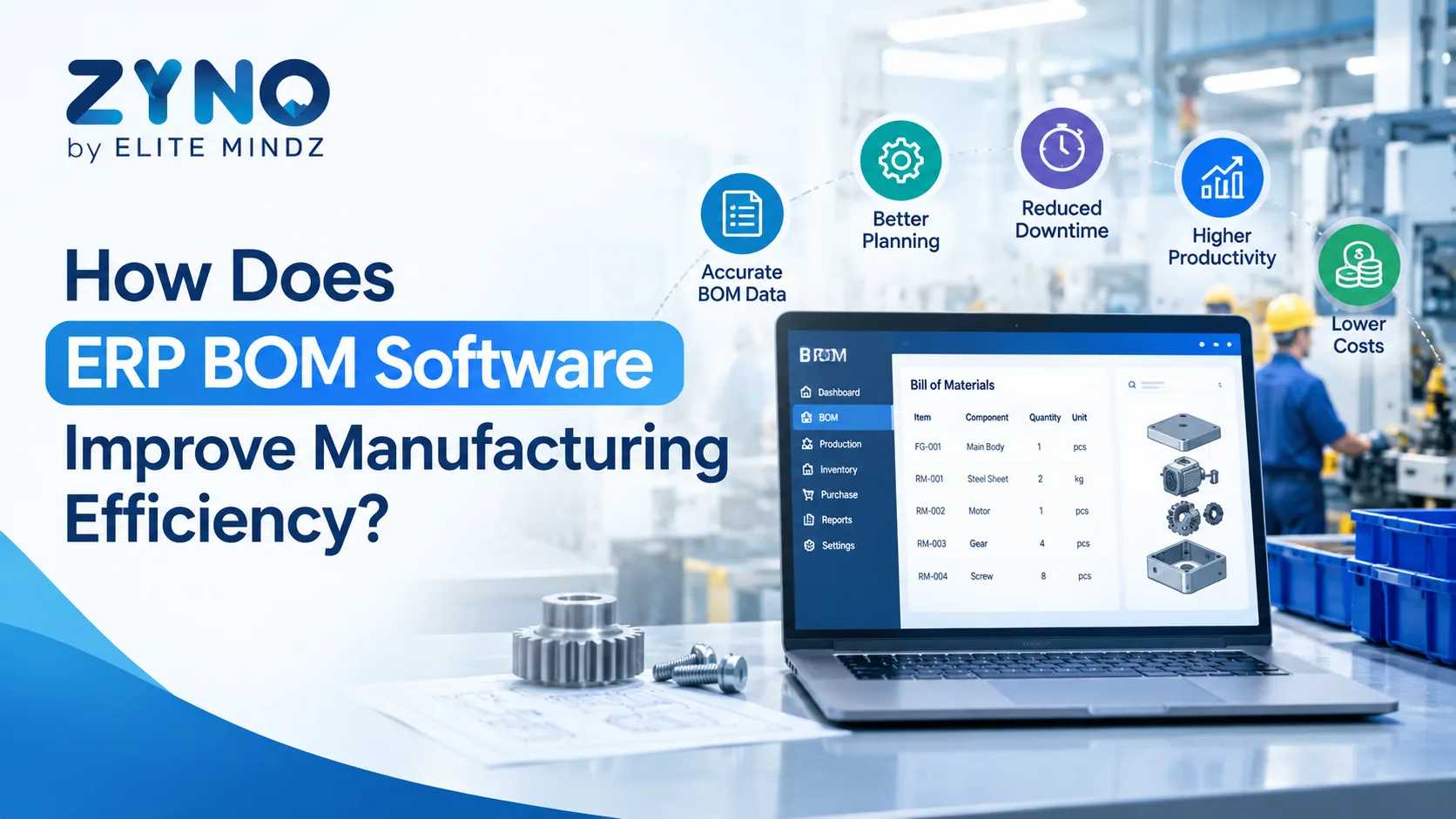
Manufacturing companies often deal with production errors, material shortages, incorrect quantities, outdated product specifications, and unexpected production costs. These problems can become more difficult to manage when Bills of Materials (BOMs) are maintained manually across spreadsheets or disconnected systems.
ERP BOM Software helps manufacturers centralize, manage, and update product structures while connecting BOM data with inventory, procurement, production planning, costing, and other manufacturing processes. By keeping accurate material and production information in one system, manufacturers can reduce errors, control costs, and improve production efficiency.
What Is ERP BOM Software?
ERP BOM Software is a solution within an ERP system that helps businesses create, maintain, and manage Bills of Materials digitally. A BOM contains the raw materials, components, subassemblies, quantities, specifications, and other information required to manufacture a product.
With ERP Bill of Materials Software, manufacturers can connect BOM information with production orders, inventory, purchasing, costing, and production schedules.
Instead of maintaining separate spreadsheets for different departments, teams can work with centralized BOM data.
How Can ERP BOM Software Reduce Production Errors?
1. Centralized BOM Information
One of the main causes of manufacturing errors is using outdated or inconsistent BOM information.
BOM Management Software provides a centralized location for product structures and material requirements. Production, procurement, inventory, and engineering teams can access the same approved BOM information.
This helps reduce errors caused by duplicate files, incorrect versions, or outdated specifications.
2. Improved BOM Accuracy
Manual BOM preparation can result in incorrect quantities, missing components, or calculation mistakes.
Bill of Materials Management through an ERP system can standardize BOM creation and validation. Manufacturers can define component quantities, units of measurement, production stages, and other relevant information.
Accurate BOM data helps production teams use the correct materials and quantities during manufacturing.
3. Better Version and Revision Control
Products frequently change because of design improvements, engineering changes, customer requirements, or material substitutions.
Without proper revision control, production teams may accidentally manufacture products using an older BOM.
ERP BOM Management allows businesses to maintain different BOM versions and track revisions. Approved changes can be reflected in production processes while previous versions remain available for reference.
This supports better control over engineering and production changes.
4. Fewer Material-Related Mistakes
Using incorrect materials can result in rework, defective products, and production delays.
BOM Software for Manufacturing helps define the required materials and components for each product. When connected with inventory and procurement modules, the system can also provide visibility into material availability.
This helps teams identify shortages before production begins instead of discovering them after work has started.
5. Automated Production Planning
Production planning depends heavily on accurate material requirements.
With ERP software for BOM management, BOM information can support material requirements planning and production scheduling. The system can calculate the materials needed for production orders based on product structures and quantities.
This helps production planners coordinate materials, capacity, and schedules more effectively.
How Can ERP BOM Software Reduce Manufacturing Costs?
Reducing errors is only one part of the benefit. Accurate BOM management can also contribute to better manufacturing cost control.
1. Better Material Cost Calculation
Materials often represent a significant portion of manufacturing costs.
Manufacturing BOM Software can connect component quantities and material costs with product costing. When material prices or quantities change, manufacturers can update relevant information and analyze the potential effect on product costs.
This provides better visibility into manufacturing expenses.
2. Reduced Material Waste
Incorrect quantities, over-ordering, and production mistakes can increase material waste.
By maintaining accurate BOM quantities and linking them with inventory information, manufacturers can improve material planning.
Better planning can help reduce unnecessary purchasing and minimize excess or unused materials.
3. Lower Rework and Scrap Costs
Production errors can lead to rework, rejected products, and scrap.
For example, if a product is manufactured using an incorrect component because of an outdated BOM, the entire batch may require inspection or rework.
Accurate BOM Management in ERP helps production teams work with approved product structures, reducing the risk of such mistakes.
4. Improved Inventory Optimization
Excess inventory ties up working capital, while insufficient inventory can interrupt production.
ERP BOM systems can connect BOM requirements with inventory management and procurement processes. This gives businesses better visibility into required materials and current stock levels.
Manufacturers can use this information to plan purchasing more efficiently and avoid unnecessary inventory buildup.
5. Better Procurement Decisions
Accurate BOM data can also improve purchasing decisions.
When procurement teams have visibility into the materials required for upcoming production, they can plan purchase orders based on actual requirements.
This can reduce emergency purchases, duplicate ordering, and unnecessary stock accumulation.
Key Features to Look for in ERP BOM Software
When selecting BOM Management Software, manufacturers should consider features such as:
- Multi-level BOM management
- BOM creation and editing
- Version and revision control
- Component and material tracking
- Quantity and unit management
- Engineering change management
- BOM comparison
- Production planning integration
- Inventory integration
- Procurement integration
- Product costing
- Material requirements planning
- Production order management
- Approval workflows
- Reporting and analytics
- Role-based access
- Audit trails
- Cloud accessibility
- API and third-party integrations
The right features depend on the organization's manufacturing model, product complexity, number of production sites, and business requirements.
ERP BOM Software and Production Planning
BOM information plays an important role in production planning.
A manufacturing ERP can use BOM data to determine which materials and components are required for a specific production order. When this information is combined with inventory availability and production schedules, planners can identify potential shortages and plan procurement accordingly.
This creates a connected workflow between BOM management, inventory, procurement, and production.
For manufacturers managing complex products with multiple levels of components, this integration can be particularly useful.
ERP BOM Software for Different Manufacturing Industries
ERP BOM Software for Production Planning can be useful across different manufacturing environments, including:
- Automotive manufacturing
- Electronics manufacturing
- Machinery manufacturing
- Industrial equipment
- Furniture manufacturing
- Textile and garment manufacturing
- Consumer goods
- Engineering and fabrication
- Pharmaceutical manufacturing
- Food and beverage manufacturing
The BOM structure and manufacturing workflow may differ by industry, but the need for accurate product and material information remains important.
How AI Can Improve BOM Management
Modern manufacturing ERP platforms are increasingly incorporating AI into production workflows.
AI can help analyze BOM-related information, identify unusual material requirements, detect potential inconsistencies, support demand forecasting, and generate operational insights.
When AI capabilities are combined with ERP BOM Software, manufacturers can move beyond basic BOM record keeping toward more intelligent production planning and decision support.
However, AI effectiveness depends on data quality, system integration, business rules, and the quality of historical manufacturing data.
Why Manufacturers Should Move Beyond Spreadsheet-Based BOM Management
Spreadsheets may work for simple product structures, but they can become difficult to manage as product complexity and production volume increase.
Common challenges include:
- Multiple BOM versions
- Duplicate files
- Manual calculations
- Limited revision tracking
- Data-entry errors
- Poor departmental coordination
- Difficult approval processes
- Limited integration with inventory
- Limited production visibility
- Manual cost calculations
An integrated Bill of Materials Software solution can reduce these challenges by connecting BOM information with broader manufacturing operations.
How to Choose the Right ERP BOM Software
Before selecting a solution, manufacturers should evaluate their existing production processes and identify where BOM-related errors and costs occur.
Consider:
Business requirements: Understand the number of products, components, BOM levels, production sites, and users.
Integration: Check whether the software integrates with inventory, procurement, production, finance, MES, CAD, or other existing systems.
Scalability: Make sure the platform can support increasing product complexity, users, locations, and production volumes.
Usability: Production and engineering teams should be able to create, update, review, and access BOM information without unnecessary complexity.
Reporting: Look for dashboards and reports that provide visibility into materials, costs, revisions, and production requirements.
Security: Role-based permissions and audit trails are important for controlling sensitive product and manufacturing data.
Conclusion
ERP BOM Software can help manufacturers reduce production errors and control costs by creating a centralized and connected approach to Bill of Materials management.
Accurate BOM information supports better production planning, inventory management, procurement, costing, and shop floor operations. Features such as revision control, automated material calculations, inventory integration, and approval workflows can help reduce mistakes and improve production accuracy.
For manufacturers looking to improve BOM Management in ERP, moving from disconnected spreadsheets to an integrated ERP platform can create a more reliable foundation for efficient and scalable manufacturing operations.
Frequently Asked Questions
1. What is ERP BOM Software?
ERP BOM Software helps manufacturers create, manage, update, and control Bills of Materials while connecting BOM data with inventory, procurement, production planning, and costing.
2. How does BOM software reduce production errors?
It reduces errors by centralizing BOM information, supporting revision control, standardizing material quantities, and connecting approved BOMs with production processes.
3. Can ERP BOM Software help reduce manufacturing costs?
Yes. Accurate BOM data can support better material planning, reduce waste and rework, improve inventory control, and provide better visibility into product costs.
4. Can BOM Software integrate with inventory management?
Yes. ERP-based BOM solutions can connect BOM requirements with inventory data to help manufacturers identify material availability and potential shortages.
5. Is ERP BOM Software suitable for complex manufacturing?
Yes. Multi-level BOMs, revision control, production planning, inventory integration, and costing features can make ERP BOM solutions useful for manufacturers managing complex products and production processes.