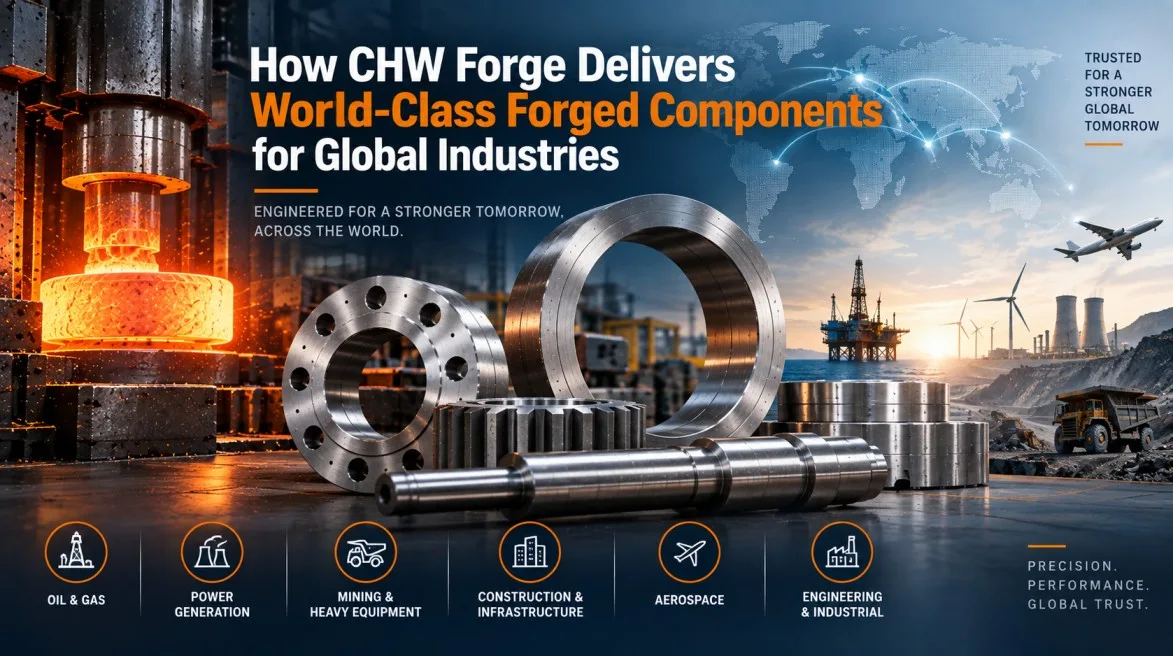
In industries where equipment operates under high loads, pressure, heat, vibration, or continuous stress, the quality of individual components can have a significant impact on overall performance.
For global OEMs, sourcing forged components is therefore not simply about finding a manufacturer that can shape metal.
It is about finding a manufacturing partner that can combine engineering expertise, process control, quality assurance, technology, and reliable delivery.
This is where the role of an experienced forging manufacturer becomes important.
With roots dating back to 1956, CHW Forge has developed its capabilities around the manufacturing of forged components for demanding industrial applications. The company identifies aerospace, oil & gas, power generation, heavy industrial equipment, mining, construction, infrastructure, and engineering among the sectors it serves.
So, what goes into delivering forged components for global industries?
More Than Six Decades of Forging Experience
CHW Forge was established in 1956, originally as Chaudhry Hammer Works. Over the decades, the company has expanded its manufacturing capabilities while continuing to focus on forging quality, process control, and customer requirements.
Experience matters in forging because every component presents different manufacturing considerations.
Material grade, component geometry, dimensions, forging method, heat treatment, machining, and inspection requirements can all influence the final product.
A long manufacturing history provides an important foundation for understanding these variables and developing repeatable processes.
A Broad Material Capability
Modern industries require components made from materials suited to very different operating environments.
CHW Forge states that it manufactures forgings in materials including carbon steel, alloy steel, stainless steel, duplex steel, aluminium, and titanium alloys.
This material range allows forging solutions to be developed for applications with different requirements for strength, corrosion resistance, weight, temperature performance, and other mechanical properties.
For OEMs, having access to multiple material capabilities can also simplify supplier qualification for different component programs.
Manufacturing for Demanding Industries
Forged components can be found across some of the world's most demanding industrial sectors.
CHW Forge's stated industry coverage includes:
- Aerospace
- Oil & Gas
- Power Generation
- Mining and Heavy Earth-Moving Equipment
- Engineering
- Construction and Infrastructure
- Nuclear applications
- Pressure vessels and process equipment
Each industry brings its own technical and quality requirements.
For example, aerospace applications can demand high precision and stringent quality standards, while heavy earth-moving equipment requires components capable of handling significant mechanical loads and demanding operating conditions.
A forging manufacturer therefore needs the flexibility to adapt its processes to different applications.
From Forging to Finished Components
Producing a high-quality forged component involves considerably more than the forging operation itself.
A typical manufacturing journey can involve:
Raw Material → Heating → Forging → Heat Treatment → Machining → Inspection → Final Delivery
Each stage contributes to the performance of the finished component.
CHW Forge describes its approach as process-driven, with capabilities spanning manufacturing technology, quality control, traceability, and integrated systems.
This integrated approach can be particularly valuable for OEMs looking for greater control and consistency across the manufacturing cycle.
Quality Is Built Into the Process
For critical industrial components, quality cannot simply be checked at the end of production.
It needs to be considered throughout the manufacturing process.
CHW Forge's current certification information lists certifications and approvals including ISO 9001, ISO 14001, ISO 45001, EN 9100, API 6A, PED, AD 2000-Merkblatt WO, and ISO 27001, among others. Its site also describes dedicated quality assurance, testing, and process controls.
These systems are relevant because global OEMs often require suppliers to demonstrate consistent processes, documented quality controls, and traceability.
Technology Meets Forging Expertise
Modern forging increasingly combines traditional manufacturing expertise with advanced technology.
Automation, digital production systems, CNC machining, process monitoring, inspection technologies, and enterprise software can help manufacturers improve consistency and operational visibility.
CHW Forge highlights technology integration, advanced machinery, process-driven operations, and an integrated ERP environment as part of its manufacturing approach.
The goal is not technology for its own sake.
The real objective is to use technology to support precision, repeatability, efficiency, traceability, and reliable delivery.
Supporting Global OEM Requirements
Global OEMs often have requirements that go beyond standard component specifications.
They may require:
- Customized component designs
- Specific material grades
- Defined mechanical properties
- Tight dimensional tolerances
- Heat-treatment specifications
- Non-destructive testing
- Detailed documentation
- Material traceability
- Specific delivery schedules
A forging supplier's ability to understand and manage these requirements can be as important as its production capacity.
CHW Forge describes its approach as customer-focused, with customized solutions and capabilities designed around specific industrial requirements.
Large Components for Heavy Industry
Some industrial applications require components of substantial size and weight.
For example, CHW Forge states that its forged blocks can reach 25,000 kg, with maximum dimensions of up to 1,800 mm in width, 600 mm in thickness, and 6,000 mm in length. Its pressure-vessel and process-equipment capabilities include non-standard forgings up to 4,500 mm in diameter and 25,000 kg.
Its material-handling and earth-moving applications include large-diameter track and slew rings, with stated external diameters ranging from 500 mm to 4,500 mm.
These capabilities demonstrate why manufacturing infrastructure and equipment range matter when OEMs evaluate potential forging partners.
Why the Manufacturing Partner Matters
For an OEM, the relationship with a forging supplier can extend well beyond a purchase order.
A long-term manufacturing partner needs to understand:
What the component is → Where it will be used → What conditions it will face → What standards it must meet → How consistently it needs to be produced
This requires collaboration between engineering, production, quality, procurement, and logistics teams.
The strongest supplier relationships are therefore built around more than price.
They depend on technical capability, communication, consistency, quality, and delivery performance.
CHW Forge and the Global Forging Industry
India's manufacturing ecosystem is increasingly connected to global industrial supply chains, and CHW Forge represents one example of an Indian forging manufacturer serving international industries.
From aerospace and power generation to oil & gas, mining, heavy engineering, and infrastructure, the company has developed capabilities around a wide range of industrial applications.
Its stated focus on quality, technology, sustainability, traceability, and customer requirements reflects the broader direction of modern forging: moving from traditional component manufacturing toward integrated engineering and manufacturing partnerships.
Final Thoughts
Delivering a high-quality forged component requires much more than applying force to heated metal.
It requires the right material, engineering knowledge, manufacturing process, quality controls, technology, inspection, and delivery systems.
For global industries, these factors become particularly important because forged components often form part of equipment that must operate reliably in demanding environments.
With its forging heritage dating back to 1956 and capabilities across multiple materials and industrial sectors, CHW Forge continues to position itself as an Indian forging manufacturer serving the requirements of global industries.
Ultimately, world-class forging is not defined by one machine or one process.
It is built through experience, engineering, technology, quality, and a commitment to getting the details right at every stage of manufacturing.