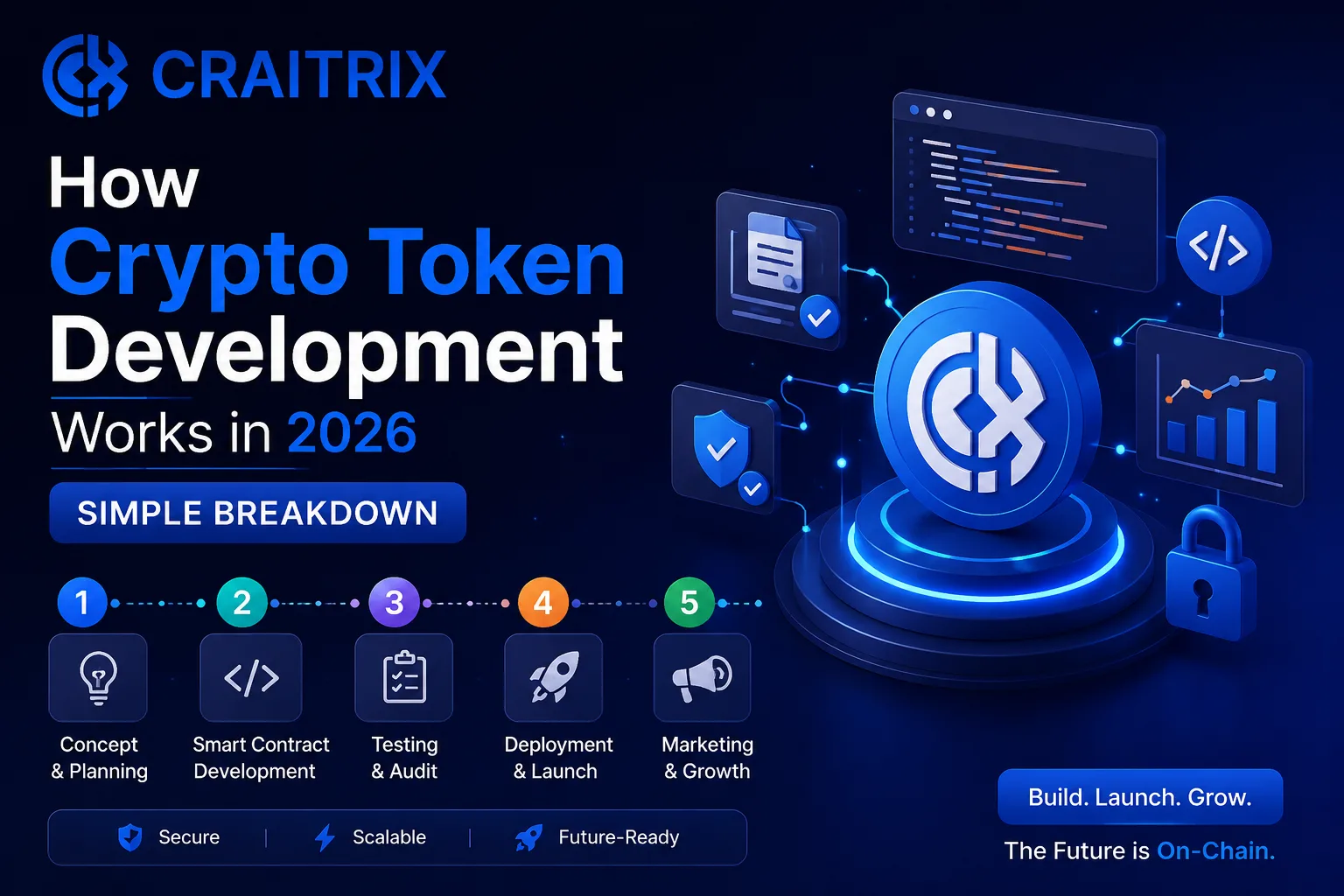
Crypto token development is the process of creating a digital asset that runs on top of an existing blockchain network. Unlike building a whole new blockchain from scratch, a token is programmed using smart contracts and follows rules that already exist on networks like Ethereum or BNB Chain. Think of it like building an app on an operating system instead of building a new phone.
In simple words, a token can represent almost anything: a reward point, a voting right, ownership in a project, or access to a service. Businesses use tokens to build loyalty systems, raise funds, power platforms, or give users a stake in how a project grows.
Token vs Coin: Quick Difference
A coin has its own independent blockchain (Bitcoin, Ethereum, Solana). A token is built on top of an existing blockchain and depends on that network's infrastructure. Coins are used mainly as currency or gas fees. Tokens can serve many purposes: utility, governance, rewards, or represent real-world assets.
Why Businesses Are Launching Tokens Now
In 2026, more businesses are turning to tokens because they offer faster fundraising, direct community ownership, and new ways to reward loyal users without middlemen. Startups use tokens to bootstrap early adoption. Established companies use them to add transparency to loyalty programs. Web3 gaming and creator platforms use tokens to let users truly own in-app value.
How Crypto Token Development Works (Step-by-Step)
Define use case and business model. Before any code is written, the purpose of the token needs to be clear. Is it for payments, governance, rewards, or asset representation? This decision shapes every step that follows.
Choose a blockchain. Ethereum offers strong security and adoption. BNB Chain offers lower fees.
Polygon offers speed with Ethereum compatibility. The right chain depends on budget, target users, and technical needs.
Select a token standard. ERC-20 is the most common standard on Ethereum. BEP-20 works on BNB Chain. Other standards like ERC-721 (NFTs) or ERC-1155 exist for non-fungible or hybrid use cases.
Smart contract development. This is where the token's rules get written into code: total supply, transfer rules, minting, burning, and any special functions.
Tokenomics design. Supply limits, distribution plans, and utility need to be mapped out carefully.
Poor tokenomics is one of the biggest reasons tokens fail after launch.
Testing and security audit. Every smart contract should be tested on a testnet and reviewed by an independent auditor before going live. Skipping this step is a common and costly mistake.
Token deployment. Once tested, the contract is deployed to the mainnet, making the token officially live on the blockchain.Listing and launch. The final step involves listing on exchanges, setting up liquidity pools, and launching marketing efforts to build initial traction.
Types of Crypto Tokens You Can Build
Utility tokens give holders access to a product or service, like platform credits or in-app currency. Security tokens represent ownership in a real asset, such as equity or real estate, and usually fall under financial regulations.
Governance tokens let holders vote on project decisions, giving the community a direct say. Stablecoins are pegged to a stable asset like the US dollar to reduce volatility. Meme and community tokens are built mainly around culture and community engagement rather than a specific utility.
Key Features of a Successful Crypto Token
A token's long-term success depends on a few non-negotiable features. Security and smart contract safety come first, since any vulnerability can be exploited within minutes of launch. Scalability matters too, especially if the token expects high transaction volume.
Liquidity support ensures users can actually buy and sell without major price slippage. Wallet compatibility across MetaMask, Trust Wallet, and other major wallets is essential for adoption. And transparency, through public audits and clear tokenomics, builds the trust needed for long-term holding.
Token Development Cost in 2026 (Estimated Breakdown)
A basic token, built on an existing standard with minimal custom features, is typically the most affordable option and can be developed relatively quickly. An advanced token with custom functions like staking, vesting, burn mechanisms, or cross-chain compatibility takes more development time and costs more.
Costs also vary by blockchain. Ethereum deployment tends to cost more due to gas fees and its security requirements, while BNB Chain and Polygon are generally more budget-friendly. Hidden costs to plan for include audit fees, liquidity pool funding, exchange listing fees, and ongoing marketing spend after launch.
Crypto Token Development Timeline
The planning phase, covering use case definition and tokenomics design, usually takes the most upfront thinking even though it involves the least amount of coding. The development phase, where smart contracts are actually built, follows next. Testing and audit is a phase businesses should never rush, since this is where most vulnerabilities are caught. Once everything checks out, the launch timeline moves quickly, from mainnet deployment to public listing.
Tokenomics Explained (Simple Version)
Tokenomics is the economic design behind a token. It answers questions like: how many tokens exist, who gets them, and why would anyone want to hold or use them.
Total supply and distribution determine scarcity and how tokens are split between the team, investors, and community.
Vesting and allocation schedules prevent early investors or team members from selling all at once and crashing the price. Utility and demand creation is what actually gives a token long-term value, whether through staking rewards, access rights, or platform usage. Inflation vs deflation models decide whether new tokens are minted over time or whether the supply shrinks through burning mechanisms.
Smart Contracts in Token Development
Smart contracts are self-executing pieces of code that automatically enforce the rules of a token once deployed. They handle everything from transfers to minting without needing a middleman.
They work by running on the blockchain itself, meaning once deployed, the rules cannot be quietly changed by any single party. This is powerful, but it also means mistakes are hard to fix after launch.
Common vulnerabilities to avoid include reentrancy attacks, integer overflow bugs, and poorly restricted minting functions. This is exactly why third-party audits are considered essential rather than optional in 2026.
Best Blockchains for Token Development in 2026
Ethereum remains the most trusted and widely adopted option, especially for projects that prioritize security and investor confidence. BNB Chain offers a lower-cost alternative with strong exchange support through Binance.
Polygon combines Ethereum compatibility with significantly lower fees, making it popular for gaming and consumer apps. Solana is gaining traction for its speed and low transaction costs, particularly among high-frequency use cases. Emerging chains focused on modular architecture and cross-chain interoperability are also worth watching this year as more projects experiment with multi-chain token strategies.
Legal and Compliance Considerations
Regulations vary significantly by country, and businesses need to understand local rules before launching. KYC and AML basics are becoming standard expectations even for smaller projects, especially where tokens involve fundraising. Security token regulations are particularly strict, since these tokens often fall under existing financial securities law. Getting legal guidance early avoids costly restructuring later.
Common Mistakes to Avoid
Poor tokenomics is one of the most frequent reasons tokens lose value shortly after launch. Building a token with no real utility, purely for hype, rarely holds long-term interest. Ignoring security audits to save time or money is a risk that has cost projects millions in exploits. And a weak marketing strategy, even for a technically solid token, often means low adoption regardless of how good the underlying product is.
How to Launch and Promote Your Crypto Token
Pre-launch strategies like building a waitlist, teaser content, and early community incentives help create demand before the token goes live. Community building through Discord, Telegram, and X (formerly Twitter) keeps early supporters engaged and invested in the project's success. Exchange listing, whether on a decentralized exchange first or a centralized exchange development one later, is a major milestone that boosts visibility and liquidity. Ongoing marketing channels, including influencer partnerships, content marketing, and paid campaigns, help sustain momentum well past the initial launch hype.
Why Businesses Choose Token Development Companies
Working with an experienced crypto token development company gives businesses a faster path to launch without the trial and error of building in-house from scratch. These companies bring technical expertise across multiple blockchains and token standards, along with established security and compliance practices that reduce the risk of costly mistakes. For most businesses, this combination of speed, experience, and risk reduction makes outsourcing development a practical choice rather than a shortcut.
Final Thoughts: Is Crypto Token Development Worth It in 2026?
Crypto token development in 2026 is no longer just for crypto-native startups. Businesses across gaming, loyalty programs, real estate, and community platforms are exploring tokens as a way to build direct value with their users. Success still comes down to the fundamentals: a clear use case, solid tokenomics, tested smart contracts, and a real go-to-market plan. Done right, token development can open doors that traditional funding and loyalty models simply cannot.
#crypto token development ,#crypto token development company,# crypto token development service