
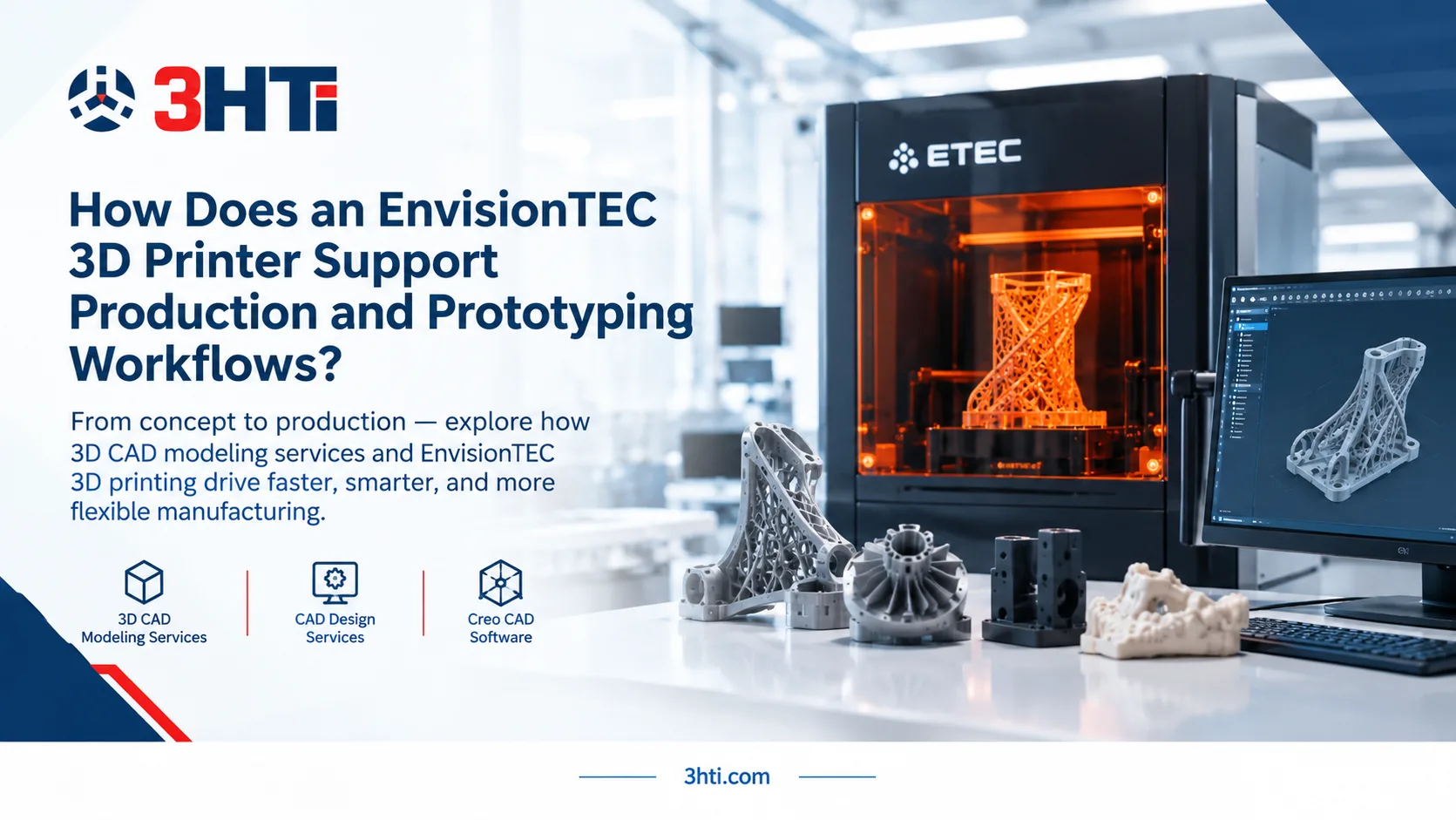
3D CAD modeling services and industrial additive manufacturing increasingly work together as engineering organizations move from digital product concepts to functional prototypes, tooling, and production parts. EnvisionTEC, now operating under the ETEC brand within Desktop Metal, has built its technology around professional-grade polymer 3D printing for prototypes, tooling, low-volume production, and mass production.
For manufacturers evaluating industrial 3D printing, the important question is not simply whether a printer can produce a prototype. The greater opportunity is connecting accurate CAD models, design validation, additive manufacturing, and production workflows into a repeatable engineering process.
What Is an EnvisionTEC 3D Printer?
EnvisionTEC was acquired by Desktop Metal in February 2021. Today, its industrial polymer 3D-printing portfolio is marketed as ETEC and includes systems such as the Envision One, Xtreme 8K, Pro XL, and D4K.
The current ETEC portfolio covers different production requirements. The Envision One uses Continuous Digital Light Manufacturing (cDLM), while the Xtreme 8K uses a top-down Digital Light Processing array. ETEC positions these systems for applications ranging from high-resolution parts to high-volume production.
For organizations that still search for "EnvisionTEC 3D printer," understanding this brand evolution is important: EnvisionTEC is the historical brand name, while ETEC is the current industrial polymer 3D-printing brand.
How 3D CAD Modeling Connects to Additive Manufacturing
The foundation of an additive workflow is the digital product definition. Engineers first create or refine a 3D CAD model, then prepare that geometry for the selected printing technology, material, and application.
This makes 3D CAD modeling services particularly important when a company needs production-ready geometry rather than a visually acceptable concept model.
3HTi's CAD services cover the product-development cycle from concept development through production drawings, including parametric and surface modeling, design optimization, reverse engineering, GD&T, topology optimization, DFM/DFA/DfAM, and CAD integration.
A strong workflow therefore looks like:
Concept → 3D CAD model → Design optimization → DfAM → Print preparation → Prototype or production part → Validation → Manufacturing
The objective is to reduce unnecessary iterations between engineering and physical production.
1. Rapid Prototyping and Design Validation
One of the most established uses of professional 3D printing is producing physical prototypes directly from digital designs.
Instead of waiting for conventional tooling or machining, engineering teams can manufacture a physical representation of a component, assembly interface, enclosure, fixture, or other design element and evaluate it before committing to a larger production process.
This can support checks such as:
- Form and fit
- Assembly interfaces
- Ergonomics
- Clearance
- Functional geometry
- Surface characteristics
- Design intent
- Manufacturing feasibility
The benefit is particularly relevant when design changes are frequent. A revised CAD model can move through the additive workflow without requiring a completely new conventional tooling strategy.
2. From Prototype to End-Use Production
Industrial polymer printing is no longer limited to visual prototypes. ETEC positions several of its systems for end-use production.
The Xtreme 8K, for example, is designed for high-volume production and has a build envelope of 450 × 371 × 399 mm. ETEC states that the system can produce thousands of parts per day and supports materials including hard plastics, high-temperature plastics, elastomers, and rubbers.
The Envision One is positioned for rapid production of strong, fully isotropic end-use parts. Its cDLM process enables continuous printing by reducing the delay associated with separating each cured layer from the film.
This creates a potential bridge between prototyping and low- or medium-volume production where traditional tooling economics may not be attractive.
3. Manufacturing Tooling, Jigs, and Fixtures
Another important application is producing the tools that support conventional manufacturing.
ETEC specifically highlights on-demand production of jigs, fixtures, and mold inserts. These manufacturing aids can otherwise require machining resources and lead time, potentially creating bottlenecks when production requirements change quickly.
For engineering teams, this means additive manufacturing can contribute to the manufacturing process even when the final product itself is not 3D printed.
A production workflow could therefore use CAD and additive manufacturing to create:
- Assembly fixtures
- Inspection aids
- Production jigs
- Mold inserts
- Pilot-run tooling
- Customized manufacturing aids
This is where CAD design services and additive manufacturing become closely connected: the quality of the fixture or tool depends on the accuracy and manufacturability of its underlying digital definition.
4. Design for Additive Manufacturing
Simply transferring a conventional CAD model to a printer does not necessarily produce the best additive result.
Design for Additive Manufacturing (DfAM) considers the capabilities and constraints of the printing process. Engineers can rethink geometry using topology optimization, lattice structures, part consolidation, and other techniques that exploit additive manufacturing rather than merely replicate subtractive designs.
PTC's Creo platform includes additive manufacturing capabilities such as lattice generation, printability checks, tray preparation, support-material generation, and direct print connectivity.
This makes Creo CAD software relevant to organizations building a connected CAD-to-additive workflow. A parametric CAD environment can maintain design intent while engineers optimize geometry for the selected production process.
5. Scaling From Engineering Prototype to Production
The transition from prototype to production requires more than increasing printer volume. Engineering organizations must consider material qualification, dimensional requirements, repeatability, post-processing, inspection, production economics, and workflow integration.
ETEC's current portfolio spans desktop high-resolution systems through production-oriented platforms. Its Xtreme 8K, for example, is specifically designed around high-volume production, while other systems address smaller, higher-resolution end-use parts.
The appropriate system therefore depends on the product, required throughput, material, geometry, resolution, and production model rather than printer size alone.
Which Industries Can Benefit?
Industrial additive manufacturing can be particularly useful where companies need complex geometry, customization, tooling flexibility, or shorter development cycles.
ETEC identifies applications across industries including automotive, aerospace and defense, healthcare, industrial manufacturing, consumer products, and machine design.
For engineering-driven organizations, the greatest value often comes from integrating additive manufacturing into the existing product-development environment rather than treating the printer as a standalone machine.
Choosing the Right CAD and Printing Workflow
Before adopting an EnvisionTEC/ETEC system, engineering leaders should evaluate:
- Part requirements: prototype, tooling, low-volume, or end-use production.
- Geometry: size, complexity, wall thickness, features, and assembly requirements.
- Material: mechanical properties, temperature resistance, flexibility, and application requirements.
- Resolution: required feature detail and surface finish.
- Throughput: expected build frequency and production volume.
- CAD readiness: whether existing models require redesign or DfAM optimization.
- Post-processing: finishing, inspection, curing, machining, or assembly requirements.
- Digital workflow: how CAD, PLM, manufacturing, and quality data will remain connected.
This evaluation prevents organizations from selecting a printer based solely on headline specifications.
Conclusion
An EnvisionTEC 3D printer—now represented by ETEC's industrial polymer portfolio—can support much more than rapid prototyping. Depending on the system and application, the technology can contribute to physical design validation, manufacturing tooling, low-volume production, and high-volume production of end-use polymer parts.
The strongest results come from connecting the printer to a disciplined digital engineering workflow. 3D CAD modeling services, DfAM, design optimization, and production documentation provide the digital foundation, while platforms such as Creo can connect detailed product design with additive manufacturing preparation.
Frequently Asked Questions
What is an EnvisionTEC 3D printer used for?
EnvisionTEC's technology, now marketed under ETEC, supports professional polymer 3D printing for prototypes, tooling, low-volume production, and end-use manufacturing.
Is EnvisionTEC still the current brand name?
EnvisionTEC was acquired by Desktop Metal in 2021. The industrial polymer 3D-printing business is now marketed as ETEC.
How do 3D CAD modeling services support 3D printing?
They provide accurate, manufacturable digital models that can be optimized for additive manufacturing, including geometry refinement, DfAM, topology optimization, GD&T, and production documentation.
Can ETEC printers be used for production rather than just prototypes?
Yes. ETEC offers systems specifically positioned for end-use and high-volume production, including the Envision One and Xtreme 8K.
How does Creo CAD software fit into additive manufacturing?
Creo provides additive-manufacturing capabilities including lattice modeling, printability validation, tray preparation, support generation, and print connectivity, helping connect product design with additive production.