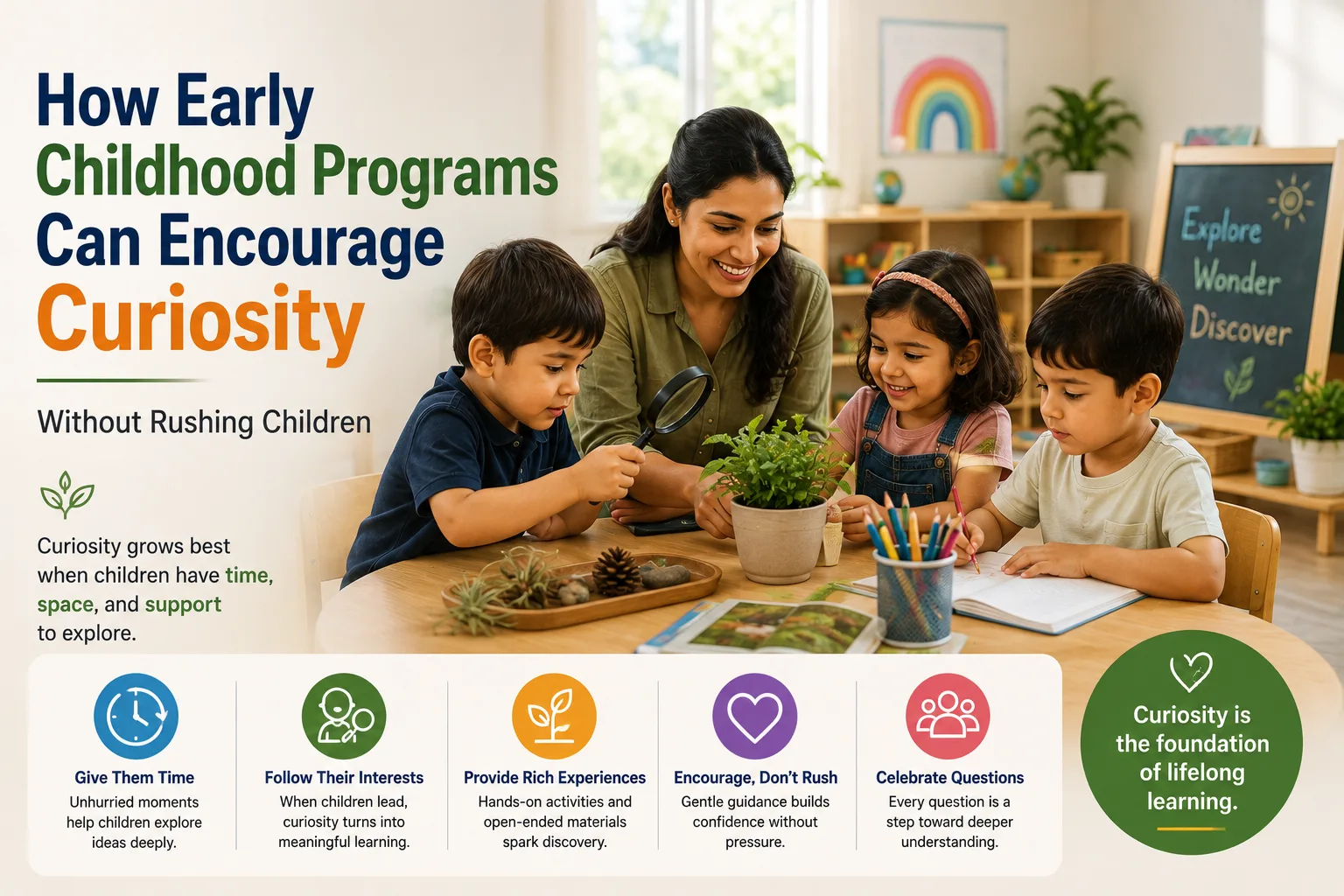
Children are naturally curious. The challenge for an early-learning environment is not to create curiosity, but to give it enough space to grow.
A toddler asking "Why?" for the tenth time in one morning isn't necessarily being difficult.
They are trying to understand how the world works.
Why does rain fall?
Where does the moon go during the day?
Why does a toy float?
How does a bird fly?
What happens if I put these two things together?
These questions may seem simple to adults, but they represent an important part of early learning.
Well-designed childhood education programs in Faridabad can use that natural curiosity as a starting point for exploration rather than trying to rush children towards formal academic outcomes before they are ready.
Curiosity Begins With Questions
Young children don't need complicated lessons to become curious.
A simple observation can start a conversation.
A child notices that two leaves are different sizes.
Instead of immediately explaining why, an adult might ask:
"Which one is bigger?"
"Why do you think they're different?"
"What do you notice about the colours?"
The child is now observing, comparing, describing, and thinking.
There isn't necessarily one correct answer.
The purpose is to encourage the child to look more closely.
Children Need Time to Explore
Curiosity can disappear quickly when every activity has an expected result.
Imagine giving children a collection of blocks.
One approach is to show them exactly what to build.
Another is to let them experiment.
They may build something unexpected.
They may discover that one arrangement is stronger than another.
They may knock it down and start again.
That process gives children opportunities to make decisions and discover relationships for themselves.
An early-learning environment doesn't have to remove structure to provide this freedom.
It simply needs to leave room for exploration within the structure.
Why Adults Don't Need to Answer Every Question Immediately
When a child asks a question, the natural response is often to provide the answer.
Sometimes that's exactly what the child needs.
But there are also moments when responding with another question can encourage deeper thinking.
Child: "Why is the ice melting?"
Adult: "What do you think is making it melt?"
The child might offer an idea.
Now there is something to investigate.
The adult can then provide information, demonstrate something simple, or continue the conversation.
This approach helps children understand that questions can lead to exploration.
Curiosity Can Be Part of Everyday Activities
Children don't need a special science lesson every day to explore ideas.
Ordinary activities can become opportunities for discovery.
During a Walk
A child can notice different leaves, sounds, vehicles, insects, or changes in weather.
During Art
Children can experiment with shapes, textures, colours, and materials.
During Water Play
They can observe what floats, what sinks, and how water moves.
During Storytelling
They can predict what might happen next.
During Construction
They can experiment with balance, height, size, and stability.
These experiences can be simple and still provide rich opportunities for thinking.
What Does "Academic" Mean for a Young Child?
Parents researching an academic preschool in Faridabad may understandably want their child to develop strong foundational skills.
But early academic learning doesn't have to mean long periods of worksheets or memorisation.
Children can develop early literacy through:
- Stories
- Rhymes
- Conversations
- Picture books
- Sound awareness
- Drawing and mark-making
Early numeracy can develop through:
- Counting objects
- Sorting
- Comparing sizes
- Recognising patterns
- Simple games
- Everyday quantities
The method matters.
Young children often learn concepts more meaningfully when they can connect them with something they can see, touch, discuss, or experience.
Avoid Turning Every Activity Into a Test
Imagine a child drawing a picture of a house.
An adult could ask:
"What is this?"
"How many windows does it have?"
"What colour is the roof?"
Those questions can be useful.
But the conversation doesn't need to become an assessment.
Sometimes it is enough to ask:
"Tell me about your picture."
The child may then explain a detailed story that wasn't obvious from the drawing.
The adult learns something about the child's thinking, while the child gets an opportunity to communicate.
Curiosity and Confidence Are Connected
Children need to feel comfortable making guesses.
If every incorrect answer is immediately corrected, some children may become reluctant to speak.
A supportive environment can communicate that it is okay to wonder, predict, experiment, and change your mind.
For example:
"I thought the block would fit here, but it doesn't."
"Let's try another way."
That small experience teaches an important lesson:
Being wrong can be part of learning.
What Parents Can Observe in an Early-Learning Environment
When visiting a Childcare Centre in Faridabad, parents can watch how adults respond to children's questions.
Are children encouraged to speak?
Do adults listen to their ideas?
Are questions welcomed?
Do children get opportunities to explore materials?
Can they sometimes choose how to approach an activity?
Do adults ask children what they think?
These observations can provide useful clues about the learning culture.
Curiosity Doesn't Mean Complete Freedom
A child-led approach doesn't mean adults simply stand back and allow anything to happen.
Children still need boundaries.
They need routines.
They need safety guidance.
They need adults to introduce new experiences.
They also need help when an activity becomes too difficult.
The balance is important.
Adults can provide the framework while children have meaningful opportunities to participate within it.
Parents Can Encourage Curiosity at Home
You don't need expensive educational resources.
Try changing the way you respond to everyday observations.
If your child notices a puddle, ask:
"Where do you think the water came from?"
If they find a feather:
"Who might have left this here?"
If they are building with blocks:
"What could make your tower stronger?"
You don't need to know the perfect answer every time.
Sometimes discovering something together is more valuable than immediately explaining it.
Don't Rush Every Developmental Stage
Parents naturally want their children to progress.
But early childhood is not a race.
Children need opportunities to develop communication, movement, social skills, independence, creativity, and early academic understanding alongside one another.
A programme that focuses only on visible academic outcomes may overlook other important aspects of development.
When evaluating childhood education programs in Faridabad, parents can therefore ask how the programme supports the child as a whole rather than focusing on one narrow measure of progress.
Questions Worth Asking a Preschool
Parents can ask:
- How are children's questions encouraged?
- Do children have opportunities for open-ended activities?
- How are early literacy and numeracy introduced?
- How much time is available for exploration?
- How do teachers respond when children make mistakes?
- Are children encouraged to explain their ideas?
- How are activities adapted for different developmental stages?
The answers can help parents understand whether the programme values curiosity as part of learning.
The Long-Term Value of Curiosity
A curious child doesn't simply collect answers.
They learn to ask questions.
They notice details.
They test ideas.
They listen to other perspectives.
They try again when something doesn't work.
These habits can remain useful long after the preschool years.
That's why early childhood learning doesn't need to be about getting children to know as much as possible as quickly as possible.
Sometimes the more valuable goal is helping children remain interested in finding things out.
Families exploring childhood education programs in Faridabad can also visit Little Columbus to learn more about its early-learning programmes.
A child's question may take only a few seconds to ask.
But giving that question time, attention, and space to develop can turn an ordinary moment into a meaningful learning experience.