
As more manufacturers move production closer to North America, nearshoring has become much more than a strategy for reducing shipping times. Companies are looking to build supply chains that are flexible, efficient, and capable of adapting to changing market demands. However, relocating production alone doesn't guarantee better results.
Many businesses discover that simply moving manufacturing to a new location without improving internal processes can lead to the same inefficiencies they experienced before. That's where lean manufacturing makes a difference.
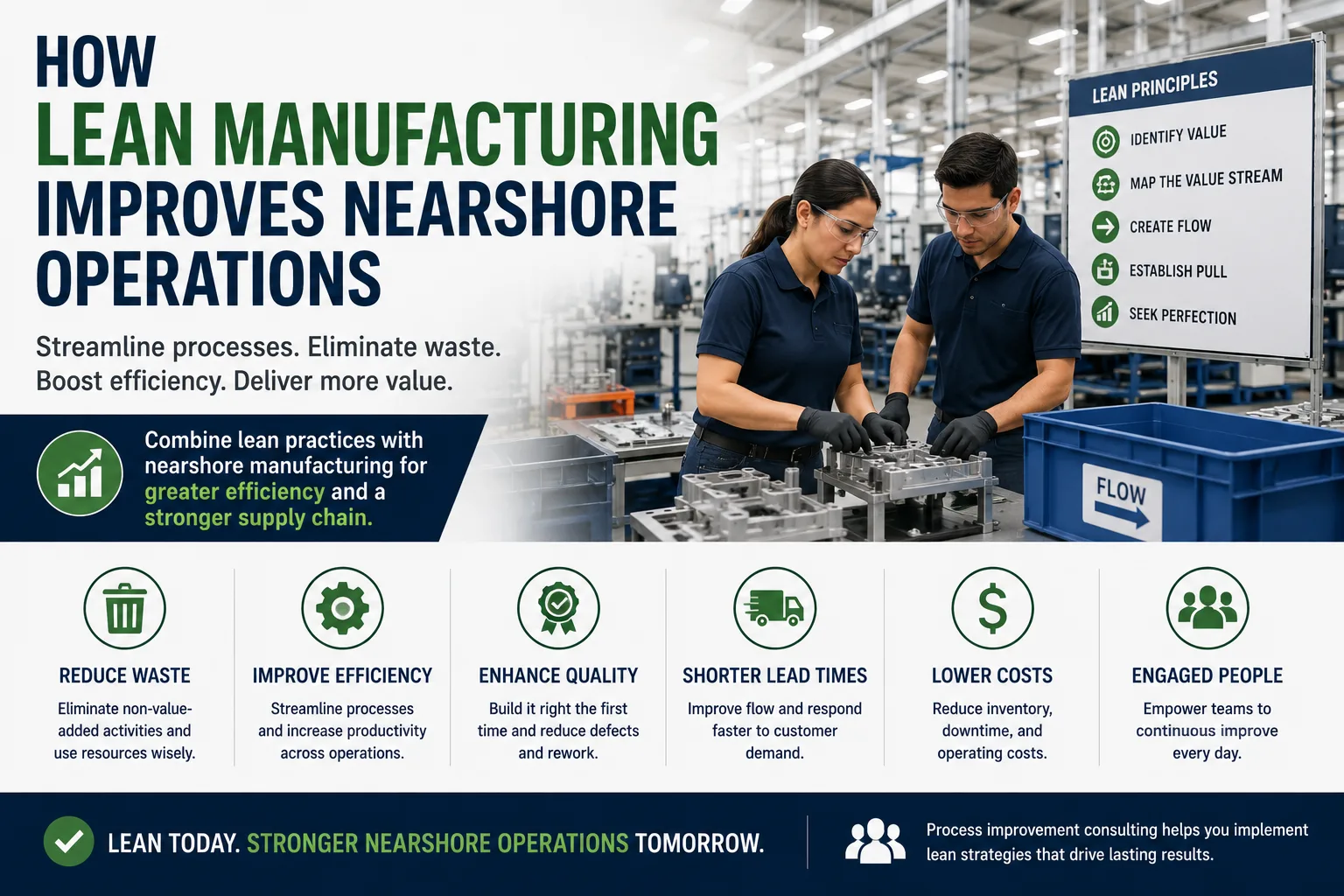
By combining lean manufacturing principles with process improvement consulting, manufacturers can streamline operations, improve quality, reduce waste, and maximize the benefits of nearshore production. Whether you're launching a new facility or transitioning production to an existing supplier, lean practices help ensure your nearshore operation delivers measurable value.

What Is Lean Manufacturing?
Lean manufacturing is a systematic approach to improving production by eliminating activities that don't add value to the customer.
Rather than focusing only on increasing output, lean manufacturing aims to create smoother, more efficient processes that use fewer resources while maintaining or improving product quality.
The core objectives of lean manufacturing include:
- Reducing waste
- Improving workflow
- Increasing productivity
- Enhancing product quality
- Shortening production cycles
- Creating continuous improvement
The result is higher manufacturing efficiency, lower operating costs, and greater customer satisfaction.
Why Lean Matters in Nearshore Operations
Nearshoring offers many advantages, including shorter transportation times, improved communication, and better supply chain visibility. However, if manufacturing processes remain inefficient, these benefits may never be fully realized.
For example, a company may reduce shipping time from four weeks to four days, but if production delays, excessive inventory, or quality problems continue inside the factory, customer lead times may still suffer.
Lean manufacturing helps eliminate these operational bottlenecks, allowing businesses to take full advantage of their nearshore investment.
Reducing Waste Throughout Production
Waste exists in almost every manufacturing operation.
Lean manufacturing identifies and eliminates activities that consume resources without creating value.
Common forms of waste include:
- Excess inventory
- Unnecessary transportation
- Waiting between production steps
- Overproduction
- Defective products
- Unnecessary motion
- Excess processing
Reducing these inefficiencies creates a more streamlined production environment while lowering overall operating costs.
In nearshore facilities, this often leads to faster production schedules and more consistent deliveries.
Improving Manufacturing Efficiency
One of the primary goals of lean manufacturing is improving manufacturing efficiency.
Efficient production means more than simply producing faster. It involves creating stable, repeatable processes that consistently deliver quality products with minimal waste.
Lean techniques improve efficiency by:
- Balancing production lines
- Standardizing work procedures
- Reducing machine downtime
- Improving equipment utilization
- Simplifying material flow
- Eliminating unnecessary movement
When every process works together efficiently, manufacturers can increase output without significantly increasing costs.
Faster Response to Customer Demand
Customer expectations continue to evolve.
Many businesses now require:
- Smaller production runs
- Faster product launches
- Customized products
- Shorter delivery times
Traditional manufacturing systems often struggle to adapt to these changing requirements.
Lean manufacturing creates more flexible production environments capable of responding quickly to shifting demand.
Combined with nearshore operations, manufacturers can reduce both production time and transportation time, creating a significant competitive advantage.
Better Quality Through Standardized Processes
Quality problems create expensive ripple effects throughout the supply chain.
Defective products increase:
- Rework
- Scrap
- Customer complaints
- Warranty claims
- Delivery delays
Lean manufacturing emphasizes process consistency rather than relying solely on final inspections.
Standardized work instructions, visual controls, and root cause analysis help manufacturers identify problems early before defects reach customers.
Higher first-pass quality improves profitability while strengthening customer relationships.
Lower Inventory and Improved Cash Flow
Traditional manufacturing often depends on large inventory buffers to compensate for production uncertainty.
This approach ties up working capital while increasing storage costs.
Lean manufacturing promotes a more efficient flow of materials throughout production.
Benefits include:
- Lower inventory levels
- Reduced warehouse space
- Better inventory accuracy
- Improved cash flow
- Less obsolete inventory
For nearshore operations, shorter transportation distances make lean inventory strategies even more effective.
Companies can replenish inventory faster without maintaining excessive stock.
The Role of Process Improvement Consulting
Implementing lean manufacturing requires more than introducing a few new tools.
Every manufacturing operation has unique challenges that require careful analysis.
This is where process improvement consulting provides significant value.
Experienced consultants evaluate existing operations and identify opportunities to improve productivity through:
- Factory assessments
- Value stream mapping
- Workflow analysis
- Production line balancing
- Capacity planning
- Equipment utilization reviews
- Continuous improvement initiatives
Rather than applying generic solutions, consultants develop practical recommendations based on the specific needs of each operation.
This structured approach helps organizations achieve measurable improvements while minimizing disruption during implementation.
Lean Tools That Support Nearshore Success
Several lean manufacturing tools are particularly valuable for nearshore operations.
Value Stream Mapping
This technique visualizes the entire production process, helping manufacturers identify delays, bottlenecks, and unnecessary activities.
5S Workplace Organization
A clean and organized workplace improves safety, productivity, and equipment reliability.
Kaizen
Kaizen encourages continuous, incremental improvements by involving employees in solving operational challenges.
Standardized Work
Documented procedures help maintain consistency, reduce variation, and simplify employee training.
SMED (Single-Minute Exchange of Die)
Reducing equipment changeover time allows manufacturers to produce smaller batches more efficiently.
Root Cause Analysis
Rather than treating symptoms, manufacturers identify and eliminate the underlying causes of recurring problems.
Together, these tools support continuous operational improvement and sustainable growth.
Common Mistakes to Avoid
While lean manufacturing offers significant benefits, some companies encounter challenges during implementation.
Treating Lean as a One-Time Project
Lean is an ongoing management philosophy, not a short-term initiative.
Continuous improvement should become part of daily operations.
Focusing Only on Cost Reduction
Lean isn't simply about cutting expenses.
The goal is to improve value, quality, and operational performance while eliminating waste.
Ignoring Employee Involvement
Employees often understand production challenges better than anyone else.
Successful lean programs encourage participation from every level of the organization.
Skipping Process Analysis
Implementing solutions before understanding the root cause often leads to disappointing results.
Thorough process evaluation should always come first.
Key Takeaways
Manufacturers investing in nearshore operations achieve better results when they combine relocation with operational excellence.
Lean manufacturing helps businesses:
- Reduce waste
- Improve manufacturing efficiency
- Increase production flexibility
- Enhance product quality
- Lower inventory costs
- Improve customer satisfaction
- Build more resilient operations
Working with experienced process improvement consulting professionals can accelerate these improvements while helping manufacturers avoid common implementation challenges.
Final Thoughts
Nearshoring creates exciting opportunities for manufacturers looking to strengthen their supply chains, reduce lead times, and improve responsiveness to customers. But relocating production is only one part of the equation.
To achieve lasting success, manufacturers must also optimize how products are built. Lean manufacturing provides the framework for eliminating waste, improving efficiency, and creating consistent, high-quality production processes.
When supported by expert process improvement consulting, lean initiatives become even more effective. Consultants can identify hidden inefficiencies, develop practical improvement strategies, and guide implementation without disrupting day-to-day operations.
Companies that combine lean manufacturing with well-planned nearshore operations are better positioned to improve manufacturing efficiency, control costs, and build supply chains that remain competitive in an increasingly demanding global market. By focusing on continuous improvement instead of short-term fixes, manufacturers can create long-term value for both their business and their customers.