
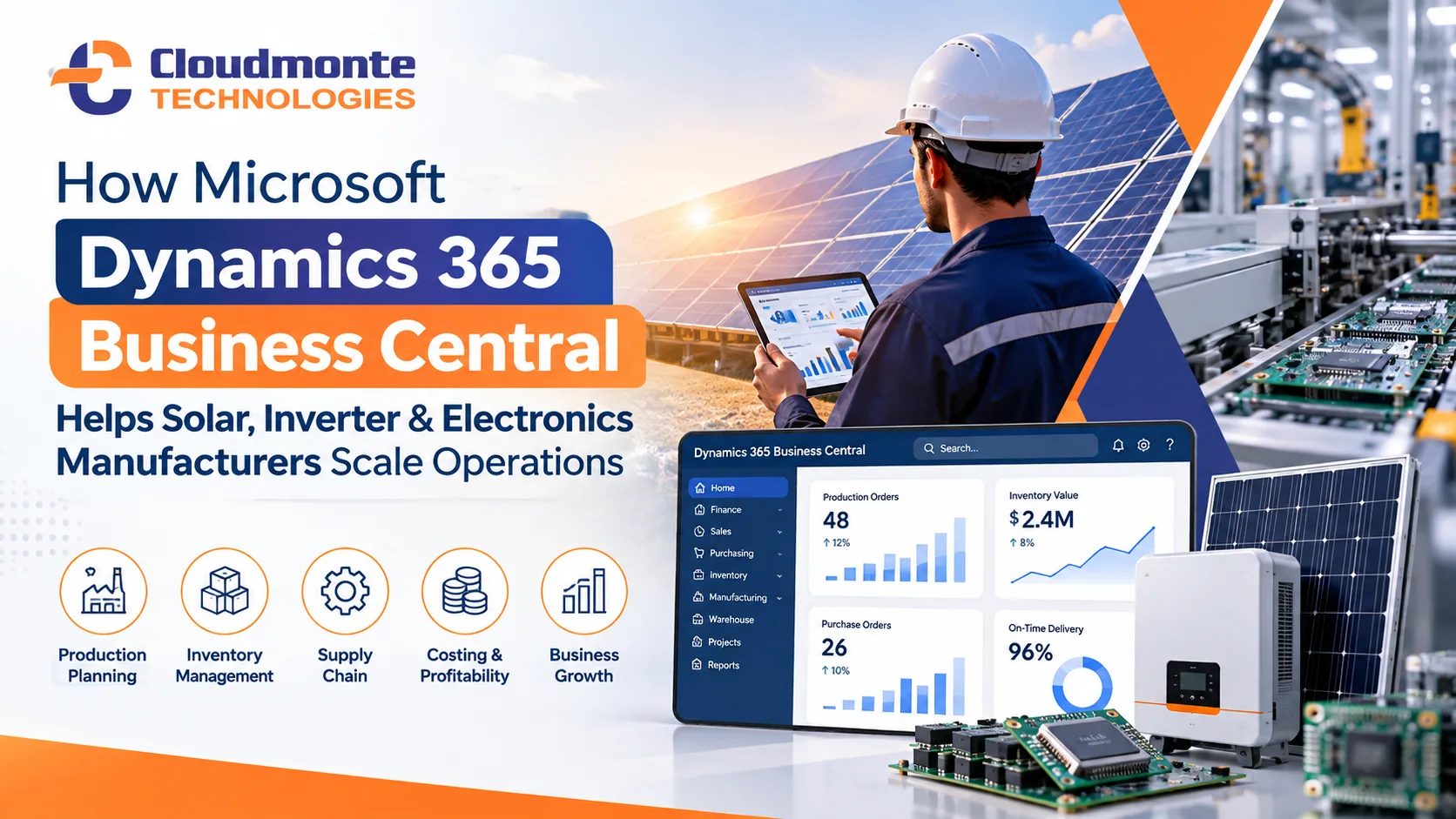
The solar and electronics manufacturing landscape is changing quickly.
Demand for solar modules, inverters, energy equipment, electronic components, and related technologies is creating new opportunities for manufacturers across the USA, Canada, Europe, and the UAE.
But growing demand brings another challenge: operational complexity.
A manufacturer may have hundreds of components to procure, multiple production stages to manage, different warehouses to coordinate, suppliers across countries, changing customer demand, and increasingly detailed financial requirements.
At a smaller scale, spreadsheets and disconnected applications may seem manageable.
As the business grows, they can become a source of delays, duplicate data, inventory problems, production bottlenecks, and limited visibility.
This is where Microsoft Dynamics 365 Business Central can play an important role.
Business Central brings areas such as finance, manufacturing, inventory, purchasing, sales, supply planning, and warehouse operations into a connected business management environment. Microsoft states that its manufacturing capabilities support planning, scheduling, execution, and analysis, including production BOMs, routings, work centers, machine centers, production orders, costing, and related processes. Microsoft
For solar, inverter, and electronics manufacturers, that connected approach can provide a stronger foundation for scaling operations.
The Manufacturing Challenge: Growth Creates More Complexity
Consider a solar equipment manufacturer that has started receiving larger orders from distributors and commercial customers.
The company now needs to coordinate:
- Raw materials
- Electronic components
- Production BOMs
- Supplier purchasing
- Production schedules
- Machine capacity
- Warehouse inventory
- Quality processes
- Finished products
- Customer orders
- Shipping
- Invoicing
- Financial reporting
Each department may have its own spreadsheet or software.
The purchasing team knows what has been ordered.
The warehouse team knows what is physically available.
Production knows what is currently being manufactured.
Finance has its own cost information.
Sales has another view of customer demand.
Management then has to bring all these pieces together to answer a simple question:
“What is actually happening across the business?”
This is the problem a connected ERP environment is designed to address.
What Is Microsoft Dynamics 365 Business Central?
Microsoft Dynamics 365 Business Central is an ERP platform designed to connect core business operations.
It supports areas including:
- Financial management
- Sales
- Purchasing
- Inventory
- Supply planning
- Manufacturing
- Warehouse management
- Project management
- Reporting and analytics
For manufacturers, Business Central provides functionality around production BOMs, routings, production orders, work centers, machine centers, capacity, and production costing. Microsoft
The important point is that manufacturing does not operate separately from the rest of the company.
A production decision can affect inventory.
Inventory affects purchasing.
Purchasing affects cash flow.
Production costs affect profitability.
Customer demand affects production planning.
Business Central is designed to connect these processes.
1. Better Production Planning for Solar Manufacturers
Solar manufacturing requires careful coordination between demand, materials, production capacity, and finished-goods inventory.
If customer demand increases unexpectedly, production needs to determine whether enough components are available.
If materials are delayed, procurement needs visibility into the potential impact on production.
Business Central's supply-planning functionality can balance demand and supply for items that are purchased, assembled, manufactured, or transferred between locations. Its planning tools can generate suggestions for purchase, transfer, assembly, and production orders. Microsoft
For a solar manufacturer, this can help structure planning around materials such as:
- Solar cells
- Glass
- Frames
- Encapsulants
- Backsheets
- Junction boxes
- Connectors
- Cables
- Packaging materials
The objective is not simply to have more data.
The objective is to make the data useful for planning.
2. Managing Bills of Materials More Effectively
A manufactured product is rarely just one item.
A solar module, inverter, or electronic product can consist of multiple components and subassemblies.
A Bill of Materials (BOM) defines the components required to produce the finished product.
Business Central supports production BOMs that define components and subassemblies used to produce an item. These BOMs become part of the production process when production orders are created. Microsoft
For example, an inverter could have a structure such as:
Finished Inverter
→ Control board
→ Power components
→ Capacitors
→ Connectors
→ Cooling system
→ Enclosure
→ Wiring
→ Display/interface components
Managing this structure inside an ERP system can provide greater consistency between engineering, procurement, inventory, and production.
This becomes particularly valuable when a company manages multiple product variants.
3. Supporting Inverter Manufacturing
Inverter manufacturing presents a different set of challenges from traditional mechanical manufacturing.
Products may involve a combination of:
- Electronic components
- PCBs
- Power components
- Cooling systems
- Connectors
- Wiring
- Enclosures
- Control systems
- Subassemblies
The production process may involve multiple operations before a finished inverter is ready for shipment.
Business Central production orders bring together the product, BOM, routing, components, operations, and capacity requirements. Microsoft
This creates a structured connection between:
Materials → Production Operations → Finished Product → Inventory
For a growing inverter manufacturer, this can make production information easier to manage across departments.
4. Managing Multi-Level Manufacturing
Electronics and inverter products often contain subassemblies that are manufactured separately.
For example:
Finished Inverter
→ Control Assembly
→ Power Assembly
→ Cooling Assembly
→ Housing Assembly
Each subassembly can have its own BOM and production process.
Business Central supports multilevel production planning, where production requirements can flow through different levels of a BOM structure. Microsoft
This can help manufacturers understand how demand for a finished product translates into requirements for subassemblies and components.
Instead of looking only at the finished product, planners can see the broader manufacturing structure.
5. Improving Inventory Visibility
Inventory management is one of the biggest challenges for solar and electronics manufacturers.
Too much inventory can tie up working capital.
Too little inventory can interrupt production.
The problem becomes more difficult when the company manages thousands of components.
Business Central provides inventory management and supply-planning capabilities designed to help organizations replenish inventory based on demand and availability. Microsoft also highlights inventory forecasting and supply-chain optimization capabilities in Business Central. Microsoft
Manufacturers can structure inventory around categories such as:
Raw Materials
Materials purchased for production.
Components
Electronic, mechanical, and other parts used in assemblies.
Work in Progress
Items currently undergoing production.
Finished Goods
Completed products ready for customers.
Spare Parts
Items required for service and after-sales support.
This creates a more connected view of inventory across procurement, production, warehouse, sales, and finance.
6. Connecting Procurement With Production
Imagine that an inverter manufacturer receives a large customer order.
The sales team knows about the order.
Production needs to manufacture the required quantity.
But production cannot start unless the necessary components are available.
This creates a chain:
Customer Demand
↓
Production Requirement
↓
Component Requirement
↓
Inventory Check
↓
Purchase Requirement
↓
Supplier Order
↓
Production
Business Central's planning functionality is designed to evaluate supply and demand and generate planning suggestions for purchasing, production, transfers, and other replenishment activities. Microsoft
This can help procurement teams work from production requirements rather than relying entirely on manual communication.
7. Planning Production Capacity
Materials are only one side of manufacturing.
A company can have enough components but still face a production bottleneck if the required machines, work centers, or production resources are unavailable.
Business Central allows manufacturers to model work centers and machine centers, including their capacity, calendars, efficiency, and costs. Microsoft
This can help manufacturers structure production around:
- Production lines
- Machines
- Work centers
- Machine centers
- Operators
- Production operations
- Working hours
- Capacity
- Setup time
For growing solar and electronics manufacturers, capacity planning becomes increasingly important as order volumes increase.
8. Connecting Manufacturing With Finance
Manufacturing decisions directly affect financial performance.
Every product has costs.
Those costs can include:
- Materials
- Components
- Labor
- Machine time
- Production overhead
- Subcontracting
- Warehousing
- Logistics
Business Central connects manufacturing with costing and financial processes, allowing organizations to work with production-related cost information alongside broader financial operations. Microsoft
This gives management a more connected perspective:
Production + Inventory + Cost + Revenue + Profitability
Instead of manually collecting information from multiple departments, finance and management can work with data connected to the underlying business processes.
9. Supporting Quality and Production Control
For solar and electronics manufacturers, production output is only part of the equation.
The organization also needs to know whether products meet the required specifications.
Quality-related processes may involve:
- Incoming material checks
- Production inspections
- Testing
- Defect tracking
- Scrap
- Rework
- Finished-product checks
Business Central's manufacturing environment connects production with related inventory, costing, warehouse, quality, and analytics processes. Microsoft
The exact quality workflow will depend on the manufacturer's requirements and any specialized quality solution or extension used alongside Business Central.
10. Supporting International Manufacturing Operations
Manufacturers serving international markets face another layer of complexity.
A company may have:
- Manufacturing in Canada
- Customers in the USA
- Suppliers in Asia
- Distribution operations in Europe
- Regional sales in the UAE
When operations expand across locations, disconnected systems can make reporting and coordination more difficult.
A properly designed ERP environment can help establish standardized processes for:
- Procurement
- Inventory
- Production
- Sales
- Finance
- Warehousing
- Reporting
The actual implementation should be designed around the company's legal entities, locations, currencies, tax requirements, supply-chain structure, and operational processes.
Business Central for Solar Manufacturers in the USA
The USA is an important market for solar and energy technology companies, with manufacturers and suppliers operating across different parts of the value chain.
For a growing manufacturer, Business Central can provide a connected environment for:
- Manufacturing
- Procurement
- Inventory
- Supply planning
- Finance
- Sales
- Warehouse operations
- Reporting
The key is to configure the ERP around the organization's actual manufacturing model rather than attempting to force every business into the same process.
Business Central for Solar & Electronics Manufacturers in Canada
Canadian manufacturers may operate within complex regional and international supply chains.
For organizations sourcing components internationally and selling across North American markets, visibility into inventory, purchasing, production, and financial performance becomes increasingly important.
Business Central can provide a common platform for managing these processes while supporting integrations and extensions where additional functionality is required.
Business Central for Manufacturers in Europe
European manufacturing operations can involve multiple countries, suppliers, warehouses, and customer markets.
An ERP implementation may therefore need to address:
- Multi-location operations
- Purchasing
- Manufacturing
- Inventory
- Finance
- Warehouse management
- Reporting
- Integrations
Business Central can provide a foundation for connecting these processes, while the specific implementation must account for the company's countries of operation and applicable local requirements.
Business Central for Solar & Electronics Manufacturers in the UAE
The UAE's position as a regional commercial and logistics hub makes supply-chain visibility particularly important for businesses serving Middle Eastern and international markets.
For manufacturers and distributors operating in the UAE, Business Central can help connect:
Procurement → Inventory → Manufacturing → Sales → Finance → Distribution
A properly designed implementation can also integrate Business Central with other systems used across the organization.
Why Businesses Need a Dynamics 365 Business Central Development Partner
Buying ERP software is not the same as implementing an ERP system successfully.
Every manufacturing company has different:
- Products
- BOMs
- Production processes
- Warehouses
- Suppliers
- Approval workflows
- Financial structures
- Customer processes
- Reporting requirements
- Integrations
This is why organizations often work with a Dynamics 365 Business Central development company or implementation partner.
Depending on the project, a development and implementation partner may support:
- Business Central implementation
- Configuration
- Custom development
- Extensions
- Integration
- Data migration
- Manufacturing setup
- Workflow automation
- Reporting
- Testing
- Training
- Post-go-live support
The goal should not be to customize everything.
A good implementation balances standard Business Central functionality, process improvement, configuration, and targeted customization.
Choosing a Dynamics 365 Business Central Development Company in India
Companies searching for a Dynamics 365 Business Central development company in India may be looking for expertise in implementation, customization, integration, data migration, manufacturing, and ongoing support.
For an international manufacturer, location alone should not determine the selection.
Look at:
- Microsoft Business Central experience
- Manufacturing expertise
- ERP implementation methodology
- Integration capabilities
- Data migration experience
- Custom extension development
- Support model
- Understanding of international operations
The right partner should understand both the technology and the manufacturing business process.
Dynamics 365 Business Central Development Company in USA
Organizations searching for a Dynamics 365 Business Central development company in USA may require implementation, development, integration, migration, or support services.
For solar and electronics manufacturers, relevant experience can include:
- Manufacturing
- Supply planning
- Inventory
- Production BOMs
- Production orders
- Finance
- Warehouse management
- Business Central integrations
The implementation should be based on the organization's operational requirements rather than a generic ERP template.
Dynamics 365 Business Central Development Company in UK
A Dynamics 365 Business Central development company in UK can help organizations implement and extend Business Central around their manufacturing and business processes.
For manufacturers, services may include:
- Business Central implementation
- Manufacturing configuration
- Custom extensions
- System integration
- Data migration
- Workflow automation
- Reporting
- Support
The most important factor is whether the partner can translate business requirements into a practical Business Central solution.
Dynamics 365 Business Central Development Company in Europe
Companies searching for a Dynamics 365 Business Central development company in Europe may need support across multiple business locations and operational processes.
For manufacturers, the project may involve:
Finance + Manufacturing + Procurement + Inventory + Warehouse + Sales + Reporting
A good implementation should also consider the company's geographic structure, integrations, data requirements, and local business requirements.
Dynamics 365 Business Central Development Company in UAE
Organizations looking for a Dynamics 365 Business Central development company in UAE may need ERP implementation, customization, integration, migration, or support.
For solar, inverter, and electronics businesses, the ERP solution can be designed to connect manufacturing with procurement, inventory, finance, sales, and distribution.
Again, the right implementation depends on the company's actual processes and operational requirements.
What Manufacturers Should Do Before Implementing Business Central
Before starting an ERP project, manufacturers should document their current processes.
1. Map the Production Process
Document every major step from raw material receipt to finished product.
2. Define Product Structures
Document BOMs, subassemblies, variants, and component relationships.
3. Review Inventory
Identify how raw materials, components, WIP, finished goods, and spare parts are currently managed.
4. Review Procurement
Document suppliers, lead times, purchasing rules, minimum quantities, and approval processes.
5. Review Production Capacity
Identify machines, work centers, operators, shifts, and production constraints.
6. Define Financial Requirements
Document costing, budgeting, accounts payable, accounts receivable, profitability, and reporting requirements.
7. Identify Integrations
List systems that need to communicate with Business Central.
These may include:
- CRM
- E-commerce
- Warehouse systems
- Banking systems
- Manufacturing systems
- Customer portals
- Reporting platforms
8. Define Management KPIs
Examples include:
- Production output
- Production cost
- Inventory value
- Material availability
- Order fulfillment
- Supplier performance
- Capacity utilization
- Gross margin
- On-time delivery
From Disconnected Data to Connected Manufacturing
The real value of ERP is not simply replacing spreadsheets.
It is connecting business processes.
Consider this example.
A customer places an order for 5,000 inverters.
The sales order creates demand.
↓
Production planning identifies the required production quantity.
↓
The BOM determines the required components.
↓
Inventory checks available stock.
↓
Planning identifies shortages.
↓
Procurement receives purchase requirements.
↓
Materials arrive at the warehouse.
↓
Production orders are released.
↓
Components are consumed.
↓
Finished inverters are produced.
↓
Inventory is updated.
↓
Products are shipped.
↓
Finance records the relevant financial transactions.
This is the kind of connected business process that modern manufacturers increasingly need.
Business Central's production and planning functionality is specifically designed to connect demand, supply, production BOMs, routings, production orders, capacity, and inventory processes. Microsoft
Why This Matters as Solar and Electronics Businesses Scale
A small manufacturing operation can sometimes survive with spreadsheets and manual coordination.
A growing operation becomes different.
More customers mean more orders.
More products mean more BOMs.
More suppliers mean more procurement complexity.
More locations mean more inventory movements.
More production means more capacity planning.
More markets mean more financial and operational requirements.
At that point, the organization needs more than individual software tools.
It needs a connected operating model.
That is where an ERP platform such as Microsoft Dynamics 365 Business Central can become strategically important.
Final Thoughts
Solar, inverter, and electronics manufacturing are entering an increasingly connected and competitive environment.
Manufacturers need to manage production, components, inventory, suppliers, capacity, customer demand, financial performance, and distribution without creating unnecessary complexity.
Microsoft Dynamics 365 Business Central provides manufacturing capabilities covering production BOMs, routings, work centers, machine centers, production orders, capacity, supply planning, inventory, and costing. Microsoft
For businesses operating in the USA, Canada, Europe, and UAE, the right implementation can provide a stronger foundation for connecting manufacturing operations with finance, supply chain, inventory, sales, and management reporting.
But successful ERP transformation is not about software alone.
It is about people, processes, data, technology, and continuous improvement working together.
For solar, inverter, and electronics manufacturers planning their next stage of growth, Dynamics 365 Business Central can be an important part of that journey—provided it is implemented around the organization's real business requirements.