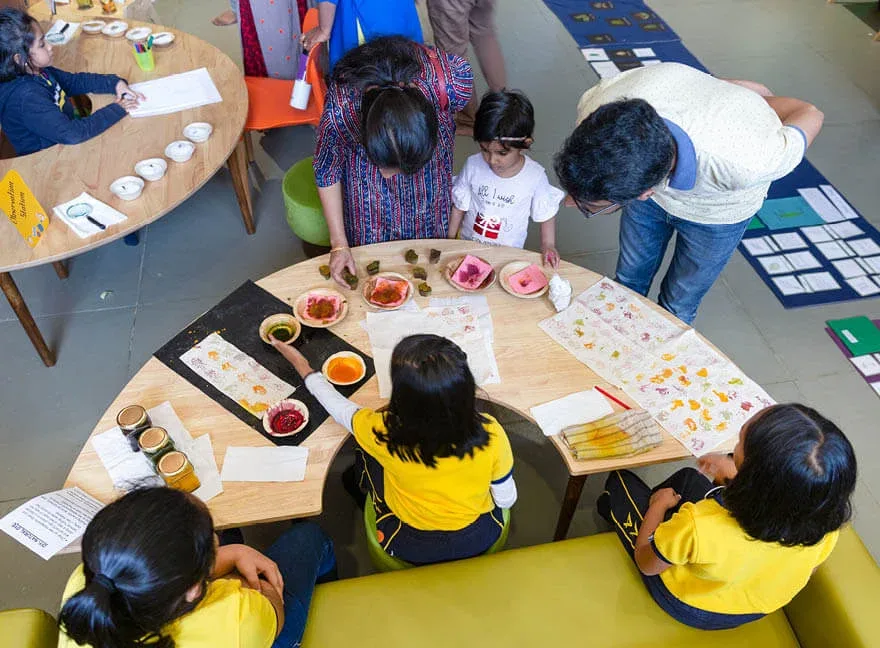
Children are naturally curious about the world around them. They want to know why plants grow, how rain forms, what makes objects move, and why different materials behave differently.
These everyday questions provide valuable opportunities for learning.
Montessori education encourages children to explore their surroundings, observe changes, and discover connections between different concepts. Instead of focusing only on textbook explanations, learners are encouraged to develop understanding through practical experiences.
This approach can help children build curiosity, confidence, and the foundations of scientific thinking from an early age.
Encouraging Curiosity Through Everyday Experiences
Curiosity plays an important role in a child's intellectual development.
When children are encouraged to ask questions and explore unfamiliar ideas, they become more actively involved in learning.
Montessori environments provide opportunities for learners to observe objects, compare materials, identify patterns, and investigate how things work.
A simple activity involving water, plants, or different shapes can lead to meaningful discussions and discoveries.
For example, observing how seeds grow introduces children to basic biological concepts. Comparing objects of different sizes and weights can encourage early mathematical and scientific reasoning.
Facilitators support these experiences by asking thoughtful questions and guiding learners towards understanding.
Rather than providing every answer immediately, they encourage children to think about what they have observed.
Developing Observation Skills
Observation is one of the foundations of scientific learning.
Before children can understand complex concepts, they need opportunities to notice details, recognise differences, and identify relationships.
Montessori learning materials and activities encourage children to use their senses while exploring the environment.
Sorting objects according to size, shape, or texture helps learners develop attention to detail.
Activities involving plants, natural materials, and environmental changes encourage children to observe patterns over time.
These experiences can strengthen concentration and improve the ability to describe findings.
Parents exploring Montessori Schools in Bangalore may consider how classroom activities encourage observation and exploration alongside academic learning.
A learning environment that welcomes curiosity can make discovering new concepts more meaningful.
Learning Through Questions and Experiments
Scientific thinking begins when children start asking questions about what they observe.
Why does one object float while another sinks? Why do some plants need more sunlight? What happens when two materials are mixed?
Simple questions like these encourage learners to investigate possible explanations.
Montessori education supports exploration by allowing children to interact with learning materials and examine the results.
For example, a water-based activity may introduce the idea of floating and sinking. Learners can observe different objects, make predictions, and compare the results.
The purpose is not necessarily to memorise scientific definitions immediately.
Instead, children begin developing habits of inquiry, reasoning, and problem-solving.
Facilitators can guide discussions and help learners connect their observations with broader concepts.
Over time, these experiences can support the development of analytical thinking.
Connecting Science with Other Subjects
Learning becomes more interesting when children understand how different subjects are connected.
An activity about growing plants, for example, can introduce several areas of knowledge.
Children may observe biological growth, measure plant height, record changes, discuss weather conditions, and learn new vocabulary.
Mathematics becomes useful for measurement, language helps describe observations, and science explains the processes involved.
Montessori education encourages this interconnected understanding through practical learning experiences.
Instead of approaching every subject as an isolated topic, learners explore how different concepts relate to everyday life.
This approach may help children understand why academic knowledge matters beyond the classroom.
It can also encourage creativity and the ability to consider problems from different perspectives.
Supporting Environmental Awareness
Children often develop an interest in nature through direct experiences with their surroundings.
Observing trees, insects, birds, and seasonal changes can encourage awareness of the environment.
Montessori activities may include discussions about plants, animals, conservation, and responsible use of natural resources.
These experiences can help children develop respect for living things and understand that their actions affect the world around them.
Parents can support this interest through simple activities at home.
Growing a small plant, observing birds, visiting a park, or discussing changes in the weather provides opportunities for meaningful learning.
Encouraging children to ask questions about these experiences can help strengthen their curiosity.
Building a Foundation for Future Academic Learning
As children progress into higher grades, scientific subjects require increasingly detailed understanding.
They begin exploring concepts involving matter, energy, living organisms, and the physical environment.
Early experiences involving observation, reasoning, and investigation can provide useful foundations for this learning.
Parents considering a Montessori Based CBSE School in Bangalore may find it valuable to understand how Montessori principles support the development of these abilities.
Airaa Academy, located in Banashankari 6th Stage, Kengeri Hobli, Bangalore, follows an educational approach that connects Montessori learning principles with the CBSE curriculum.
Its Elementary Montessori approach emphasises exploration, conceptual understanding, and meaningful connections between subjects.
Scientific thinking is not limited to laboratories or examinations. It begins when children feel comfortable asking questions and exploring the world around them.
By encouraging curiosity, observation, and independent discovery, Montessori education can help learners develop a positive relationship with science and lifelong learning.