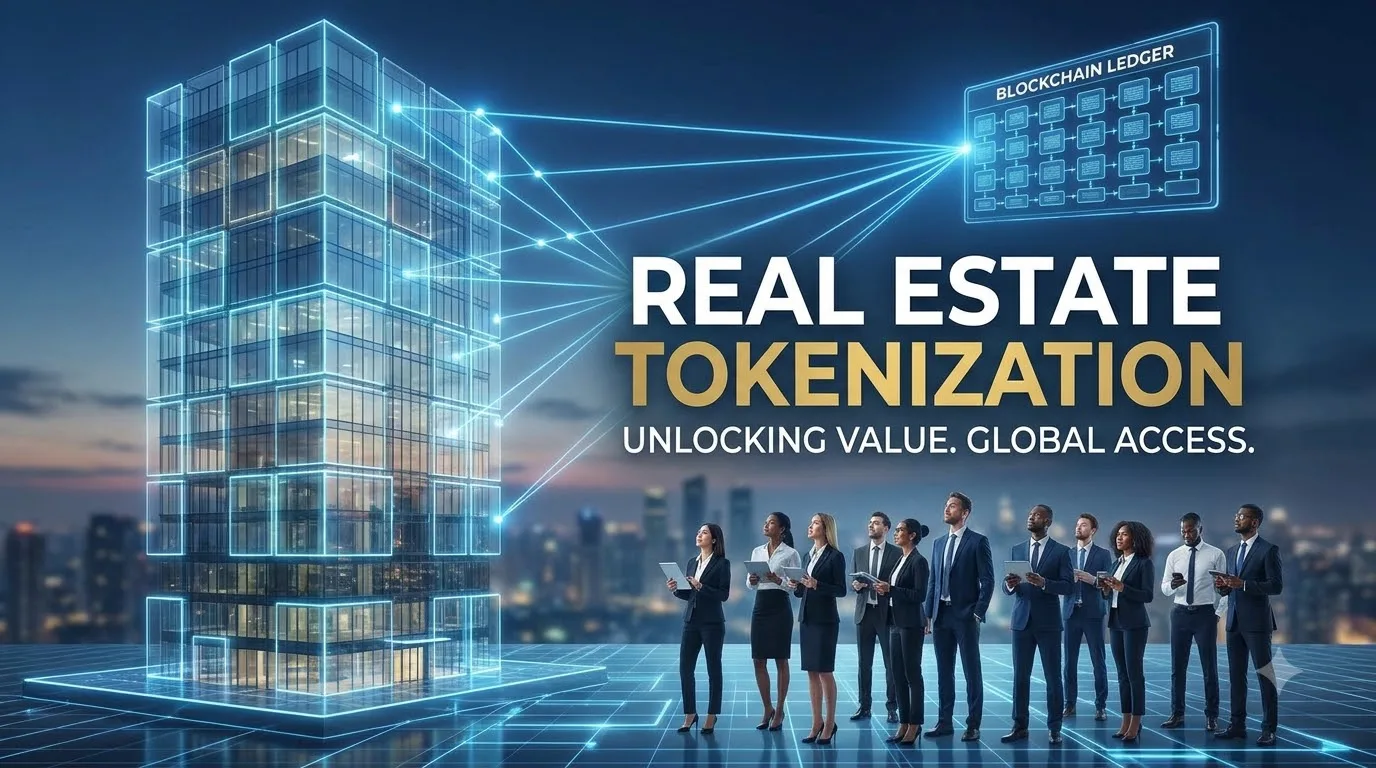
Real estate tokenization is increasingly being considered by property owners, developers, fund managers, and investment platforms looking for more flexible ways to raise capital and distribute ownership. By representing an economic or ownership interest in a property through blockchain-based tokens, an asset that traditionally requires substantial capital and extensive paperwork can potentially be divided into smaller digital units.
However, tokenizing a property is not simply a matter of creating tokens on a blockchain. The real cost depends on the legal structure, property type, jurisdiction, compliance requirements, blockchain infrastructure, smart contracts, investor onboarding, custody, marketplace functionality, and ongoing administration. A basic token issuance may cost tens of thousands of dollars, while a fully regulated platform supporting multiple properties and secondary trading can require a substantially larger investment.
Deloitte estimates that tokenized real estate could grow from less than $300 billion in 2024 to approximately $4 trillion by 2035, highlighting the potential scale of the sector. Understanding the cost structure is therefore important for anyone considering entering this market.
What Does Real Estate Tokenization Actually Involve?
Before discussing pricing, it is important to understand what is being built. Tokenization converts an ownership interest, economic right, debt claim, fund interest, or similar entitlement connected to real estate into blockchain-based digital tokens.
The blockchain itself is only one component. A typical structure may involve a special-purpose vehicle such as an LLC or trust that legally holds the property. Tokens are then issued to represent defined interests in that entity. Depending on the jurisdiction and structure, token holders might receive rental income, appreciation rights, voting rights, repayment rights, or another contractual economic interest.
This distinction explains why tokenization costs more than ordinary cryptocurrency token creation. A developer can technically deploy a simple token contract relatively inexpensively. Creating a legally enforceable investment product around a real estate asset requires considerably more work.
For example, Lofty uses individual legal entities for properties and issues blockchain-based interests representing ownership in those entities. Its platform demonstrates how legal ownership, blockchain infrastructure, investor onboarding, property management, and secondary-market functionality can operate together.
Typical Cost Range for Tokenizing One Property
There is no universal price because every project has different legal and technical requirements. Nevertheless, a practical planning range can be established.
Tokenization ScopeApproximate Cost RangeBasic single-property tokenization$20,000–$40,000Compliance-focused tokenization$40,000–$75,000Advanced real estate tokenization platform$75,000–$150,000+Multi-property enterprise platform$150,000–$300,000+Institutional-grade ecosystem$300,000–$500,000+These figures should be treated as planning estimates rather than fixed market prices. Legal work, securities compliance, property due diligence, integrations, security requirements, and jurisdiction can substantially change the final budget.
For a single property, the most important insight is that technology may not be the largest expense. Legal structuring and regulatory compliance can become the dominant cost, especially when tokens are offered to external investors.
1. Property Due Diligence and Legal Structuring
The first major expense is establishing exactly what investors will own.
A property may need title verification, valuation, tax review, debt assessment, insurance review, environmental checks, ownership verification, and corporate structuring. If the property is placed into an SPV, lawyers must determine how that entity interacts with the token holders and what rights the tokens represent.
This work is essential because blockchain immutability does not automatically make an underlying ownership claim legally valid. The legal documents must connect the digital token with enforceable rights.
Depending on the jurisdiction, the project may also require:
- Property and title due diligence
- SPV or company formation
- Investment agreement drafting
- Token-holder agreements
- Offering documents
- Tax structuring
- Securities-law analysis
- Investor disclosure documents
- Legal opinions
For a straightforward project, legal and structuring expenses might begin around $10,000–$25,000, while complex cross-border or securities-based offerings can move considerably higher.
The regulatory question is particularly important. If a token represents an investment contract or security, the project may fall under securities regulations. In the United States, for example, tokenized securities raise questions around registration or exemptions, investor eligibility, disclosures, custody, and trading restrictions. Recent SEC-related commentary on tokenized securities has also emphasized issues such as backing, custody, disclosure, redemption, auditing, cybersecurity, and market surveillance.
2. Smart Contract Development
Once the legal structure has been established, the next major component is blockchain development.
A real estate token smart contract may need to support much more than basic token transfers. Depending on the offering, it can include investor eligibility controls, whitelisting, transfer restrictions, ownership tracking, dividend or rental distribution logic, voting, redemption mechanisms, and administrative controls.
A basic contract may cost approximately $5,000–$15,000, while a sophisticated regulated security-token architecture can cost substantially more.
The choice of token standard also matters. A conventional fungible token standard may not provide all the controls required for regulated real estate interests. Security-token frameworks can incorporate identity restrictions, compliance checks, and transfer rules directly into the token infrastructure.
This is one reason projects should avoid choosing a blockchain solely because its transaction fees are cheap. Deloitte notes that blockchain selection involves considerations including scalability, security, regulatory compliance, confidentiality, data integrity, custody, and asset-distribution requirements.
3. Smart Contract Auditing and Security
Security auditing is another important cost that should not be treated as optional.
A vulnerability in a token contract could potentially allow unauthorized transfers, incorrect distributions, administrative abuse, or other serious consequences. Real estate projects can involve substantial asset values, making smart-contract security particularly important.
A professional audit might cost approximately $5,000–$20,000 or more, depending on contract complexity and the reputation of the auditing firm.
Enterprise projects may also require multiple audits, penetration testing, infrastructure security assessments, wallet-security reviews, and continuous monitoring.
The cost should therefore be considered part of the initial investment rather than an unnecessary technical add-on.
4. Blockchain and Infrastructure Costs
Blockchain transaction fees are generally not the largest part of the initial tokenization budget, but they still need to be considered.
Costs can include:
- Token deployment
- Contract deployment
- Transaction fees
- Wallet infrastructure
- RPC/API services
- Blockchain data indexing
- Node infrastructure
- Monitoring tools
Different networks have different transaction economics and technical characteristics. A project handling thousands of investors and frequent distributions needs to consider scalability rather than focusing exclusively on deployment cost.
For example, Algorand has been used by Lofty for property tokenization, with the platform highlighting fast settlement and low transaction costs as important factors in its architecture.
5. Investor KYC, AML, and Compliance Infrastructure
If tokens are being sold to investors, compliance infrastructure can become a major component of the budget.
The platform may need to verify investor identity, determine eligibility, screen investors against sanctions and watchlists, maintain transaction records, and enforce jurisdiction-specific restrictions.
This can involve integrating third-party KYC and AML providers rather than building every compliance function internally.
Initial integration costs may range from several thousand dollars upward, while ongoing expenses depend on the number of investors and transactions.
This is especially important for security-oriented tokenization because a blockchain wallet address alone does not establish who legally owns an investment.
6. Tokenization Platform Development
If the goal is to tokenize a single property and distribute tokens privately, a custom investor platform may be relatively simple.
A larger platform, however, can require:
- Property listing dashboards
- Investor registration
- KYC integration
- Wallet connectivity
- Token purchase functionality
- Portfolio management
- Rental-income distribution
- Investor reporting
- Administrative dashboards
- Property management integrations
- Payment gateways
- Secondary trading
- Analytics
A basic investor portal could add $15,000–$30,000 to development costs, while a sophisticated platform can push the budget above $100,000.
This distinction is crucial. Tokenizing one building is fundamentally different from building a marketplace where hundreds of properties can be tokenized and traded.
7. Secondary Marketplace Development
Liquidity is one of the major attractions of tokenization, but creating liquidity is not automatic.
A token can exist on a blockchain without having an active market. If investors cannot find buyers, the token may remain difficult to sell.
A secondary marketplace can therefore require order books, trading mechanisms, transfer restrictions, investor eligibility controls, custody integrations, settlement infrastructure, compliance monitoring, and market-surveillance tools.
This can add tens of thousands of dollars to development costs and potentially much more for institutional-grade infrastructure.
The experience of Lofty illustrates why marketplace infrastructure matters. The platform combines fractional property ownership with a marketplace where investors can purchase and sell property interests.
8. Ongoing Property and Token Administration
The initial development budget is only part of the financial picture.
After tokens are issued, someone still needs to manage the underlying property and maintain the token ecosystem. Depending on the structure, recurring expenses can include accounting, tax reporting, property management, investor communications, compliance monitoring, smart-contract maintenance, custody, legal support, insurance, and platform hosting.
Rental distributions also need reliable accounting. If a property generates monthly rental income, the platform must determine how much belongs to token holders, account for expenses, calculate each holder's entitlement, and distribute funds accurately.
This operational layer is often overlooked when companies estimate tokenization costs.
What Determines the Final Tokenization Cost?
The biggest variables are usually legal complexity, regulatory requirements, platform scope, and the number of properties being tokenized.
A project involving one commercial property and a limited group of verified investors may require a relatively modest infrastructure. A platform targeting retail investors across multiple countries is fundamentally different.
Key cost drivers include:
Jurisdiction: Different countries have different securities, property, tax, and digital-asset regulations.
Asset type: A residential rental property may be simpler than a large commercial development, hotel, infrastructure project, or property fund.
Investor base: Institutional investors generally require different infrastructure from a retail offering.
Token model: Ownership tokens, debt tokens, fund interests, and revenue-sharing tokens can require different legal and technical structures.
Blockchain: Network fees, tooling, scalability, ecosystem maturity, and integrations influence development decisions.
Liquidity requirements: A private issuance costs less than a platform designed for secondary-market trading.
Example: Estimating a Single $5 Million Property
Consider a hypothetical $5 million commercial property that a developer wants to fractionalize among investors.
A possible budget could look like this:
ComponentEstimated CostLegal and regulatory structuring$20,000Property due diligence$8,000Smart contract development$15,000Smart contract audit$8,000KYC/AML integration$5,000Investor platform$20,000Blockchain infrastructure$5,000Documentation and testing$5,000Estimated initial budget$86,000This example demonstrates an important principle: the tokenization expense is relatively small compared with the value of the underlying property, but it still requires a meaningful investment to create a compliant and reliable financial product.
A more advanced platform with secondary trading, automated distributions, multiple properties, institutional custody, and sophisticated compliance could easily exceed $150,000 or $300,000.
How Can Businesses Reduce Tokenization Costs?
The goal should not simply be to find the cheapest developer. Cutting costs in the wrong areas can create significantly larger legal and security problems later.
A more efficient approach is to begin with a clearly defined tokenization model. Determine whether the objective is private fundraising, fractional ownership, a regulated security offering, or a scalable marketplace.
Businesses can also reduce unnecessary costs by:
- Starting with one carefully selected property
- Using established blockchain infrastructure
- Integrating proven KYC and payment providers
- Reusing audited contract components where appropriate
- Designing the compliance framework before development
- Building essential features first
- Planning the architecture for future properties
- Avoiding unnecessary custom blockchain development
The most effective strategy is usually modular development: establish the legal and compliance foundation first, develop the core token infrastructure, launch a controlled pilot, and then expand into secondary trading and multi-property functionality.
Is Real Estate Tokenization Worth the Cost?
For a property owner, tokenization should not be viewed simply as a cheaper alternative to traditional fundraising. Its potential value comes from changing how ownership, capital formation, settlement, and investor participation are organized.
Tokenization can potentially reduce administrative friction, enable fractional participation, automate certain processes, and create digital infrastructure for new forms of real estate investment. Deloitte identifies reduced operational inefficiency, lower administrative burdens, and broader investor participation among the potential benefits.
Real-world platforms demonstrate that fractionalized property participation can be offered at dramatically lower minimum investment levels than traditional direct ownership. Lofty, for example, has marketed property interests with minimum investments as low as $50.
Nevertheless, tokenization does not eliminate the fundamental risks of real estate. Property values can fall, tenants can default, properties can remain vacant, markets can become illiquid, and regulatory frameworks can evolve. Blockchain improves the infrastructure surrounding an asset; it does not guarantee that the underlying investment will perform well.
Conclusion
The cost to tokenize a real estate property can range from roughly $20,000 for a relatively focused project to several hundred thousand dollars for a sophisticated, regulated, multi-property ecosystem. The final amount depends primarily on legal structuring, compliance, smart-contract complexity, platform functionality, security, and ongoing administration rather than simply the blockchain used. As the market develops, selecting an experienced technology partner becomes increasingly important for connecting these components into a secure and scalable solution. Blockchain App Factory provides best services for real estate tokenization, helping businesses approach tokenization with the technical infrastructure, smart contracts, platform development, and broader Web3 capabilities required for building a future-ready ecosystem.
FAQs
1. What is the average cost to tokenize real estate?
A basic single-property project may cost around $20,000–$40,000, while advanced or regulated platforms can cost $75,000–$150,000 or considerably more.
2. What is the biggest expense in real estate tokenization?
Legal structuring and regulatory compliance can be among the largest expenses, particularly when tokens represent investment or securities interests.
3. Does blockchain choice affect tokenization cost?
Yes. Blockchain transaction costs, scalability, security, development tools, integrations, and ecosystem maturity can all affect the overall budget.
4. Is smart contract auditing necessary?
For serious investment-oriented projects, professional auditing is strongly recommended because vulnerabilities can expose token holders and property operators to significant risks.
5. Can one property be divided into thousands of tokens?
Yes. A property can be represented by many digital tokens, provided the underlying legal and regulatory structure supports the intended fractional ownership or economic rights.