
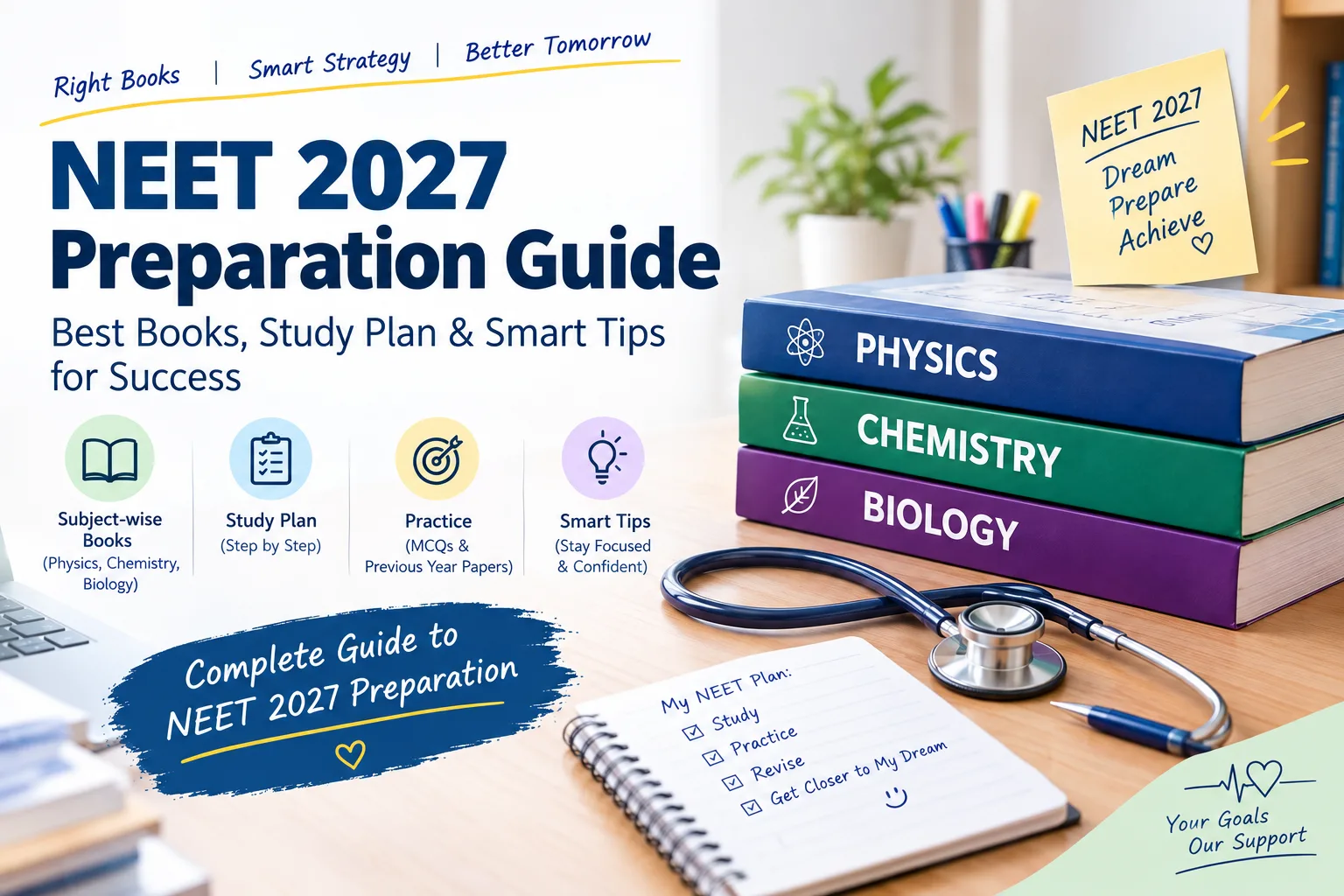
Preparing for NEET is a long process, and having a clear study plan can make it much easier to manage. Students preparing for NEET 2027 have enough time to build their concepts, practise questions and improve their weaker subjects step by step.
A common mistake is to start preparation by collecting too many resources. Instead, focus on understanding the syllabus, choosing suitable NEET preparation books, and following a study routine that you can maintain consistently.
Start With the NEET Syllabus
Before deciding what to study each day, go through the NEET syllabus and divide it into smaller topics. Physics, Chemistry and Biology require different approaches, so your timetable should give each subject enough attention.
Begin with chapters that form the foundation for other topics. Once your basic concepts are clear, move towards more difficult chapters and regular question practice.
Keeping a checklist of completed chapters can also help you see your progress without relying only on test scores.
Choose Your Study Material Carefully
The number of books available for entrance-exam preparation can sometimes make students confused about what to choose. You don't need several books covering exactly the same topics.
A practical set of NEET books can include:
- Your primary textbooks
- Subject-wise reference material
- MCQ and question-bank books
- Previous-year question papers
- Mock-test material
- Revision notes
The important thing is to actually complete the resources you choose. A book that you study thoroughly is generally more useful than several books that remain unfinished.
Give Biology Consistent Attention
Biology requires regular reading and revision. Students should develop the habit of revisiting chapters instead of leaving the entire Biology syllabus for the final months.
While studying, highlight important points and maintain short revision notes. Diagrams, terminology and factual details should be revised repeatedly.
After completing a chapter, solve questions related to that chapter. If you make repeated mistakes in one area, return to the relevant concept before moving forward.
Make Physics More Practice-Oriented
Physics can become easier to manage when preparation combines concepts with problem-solving.
Start by understanding the theory and important formulas. Then solve basic questions before moving to more challenging problems. Don't simply look at the solution when you get an answer wrong. Try to identify exactly where your approach went off track.
Maintaining a small formula notebook can also make revision quicker during the later stages of preparation.
Divide Chemistry Into Three Parts
Chemistry can be approached differently depending on the section.
Physical Chemistry:
Focus on concepts, formulas and numerical practice. Solve enough questions to become comfortable with calculations.
Organic Chemistry:
Understand reactions and their underlying concepts instead of attempting to memorise everything independently.
Inorganic Chemistry:
Regular reading and revision are important because many details need to remain fresh in memory.
A balanced routine should include all three areas instead of spending several weeks on only one section.
Create a Weekly Study Routine
A daily timetable doesn't need to be complicated. The objective should be consistency.
For example, a student can divide the day into blocks for:
- Learning new concepts
- Solving MCQs
- Revising older chapters
- Taking a short test
- Reviewing mistakes
Keep some flexibility in the schedule. If a difficult chapter takes longer than expected, adjust the next day's plan rather than abandoning the entire timetable.
Weekly targets are often easier to maintain than unrealistic daily targets.
Use Questions to Check Your Progress
Reading a chapter can create the feeling that you understand it, but questions provide a more practical test.
After completing a topic, attempt chapter-wise MCQs without immediately checking the answers. Record your score and mark the questions you couldn't solve.
Your mistakes can generally be divided into a few categories:
- Concept not understood
- Formula or fact forgotten
- Calculation mistake
- Question misunderstood
- Careless error
This simple classification can help you identify what needs more attention.
When Should You Start Mock Tests?
Mock tests should gradually become part of your preparation rather than being saved entirely for the end.
Initially, chapter-wise tests can be enough. As more of the syllabus is completed, move towards larger subject tests and eventually full-length tests.
When reviewing a mock test, don't focus only on the final score. Spend time analysing incorrect and unanswered questions. The analysis is where much of the value of a test comes from.
Revision Should Start Early
Revision is not something that should begin only a few weeks before NEET.
A simple approach is to revise a chapter shortly after completing it and then revisit it again after a longer interval. This helps keep older topics active while you continue learning new ones.
Your revision notes should be short enough to review quickly. Avoid rewriting entire chapters into notebooks.
Buying NEET UG Books Online
Students searching for NEET UG books online should compare books based on their preparation needs rather than choosing a title simply because it is popular.
Check the subject, edition, syllabus coverage, question format and level of difficulty before purchasing. If you already have good resources for a subject, another similar book may not add much value.
For students beginning preparation for NEET 2027, it can be useful to organise books separately for concept building, practice and revision.
Keep Your Preparation Simple
NEET preparation can become stressful when students constantly change their timetable, teachers or study material.
Once you find a routine that works, give it enough time before making major changes. Track your progress through completed chapters, practice questions and test performance.
The goal isn't to study every available resource. It is to understand the syllabus thoroughly and become increasingly comfortable with exam-style questions.
Final Takeaway
A successful NEET 2027 preparation plan doesn't need to be complicated. Start with the syllabus, select reliable study resources, divide your time between Physics, Chemistry and Biology, and practise questions regularly.
The right NEET study material can support your preparation, but consistency is what allows you to make progress. Build your routine gradually, revise completed topics and use mock tests to identify areas that need more work.
With a structured approach, preparation becomes less about studying everything at once and more about completing one topic, one chapter and one test at a time.