
Sawdust is one of the most widely available biomass materials in the wood processing industry. Sawmills, furniture factories, woodworking plants, timber companies, and other wood processing businesses can produce large amounts of sawdust every day. With appropriate processing technology, this material can be converted into wood pellets, biomass briquettes, animal bedding, boiler fuel, and other valuable products.
However, fresh sawdust often contains too much moisture for direct processing. High moisture can reduce pellet mill performance, increase energy consumption, affect pellet quality, and make storage more difficult. Therefore, drying is an important stage in many sawdust processing projects.
When planning a drying project, one of the first questions buyers usually ask is the sawdust dryer price. However, the purchase price of the dryer is only one part of the total investment. The actual cost depends on the raw material, moisture content, capacity, heat source, dryer configuration, automation level, auxiliary equipment, installation requirements, and other factors.
Understanding these factors can help buyers choose suitable equipment and avoid selecting a dryer based only on its initial price.
Why Sawdust Needs to Be Dried
Moisture has a major influence on sawdust processing.
Sawdust generated from freshly cut timber can contain a significant amount of water. Even sawdust from wood processing plants can absorb moisture during transportation or outdoor storage.
When wet sawdust is used directly for pellet production, it can cause several problems.
The first problem is unstable pelletizing. Excess moisture can make the material difficult to compress and can reduce the efficiency of the pellet mill.
The second problem is poor pellet quality. Pellets may have lower durability, irregular surfaces, or higher levels of fines.
The third problem is increased energy consumption. Both drying and pelletizing require energy, so controlling moisture efficiently is important for overall production economics.
The fourth problem is storage. Wet sawdust can deteriorate more quickly and may become difficult to handle.
For these reasons, a properly designed drying system can significantly improve the performance of a biomass processing plant.
What Is a Sawdust Dryer
A sawdust dryer is industrial equipment designed to reduce the moisture content of sawdust using controlled heat and airflow.
The basic process involves introducing wet sawdust into a drying chamber while heated air passes through the material.
Heat causes water to evaporate from the sawdust, while the airflow carries the moisture away from the material.
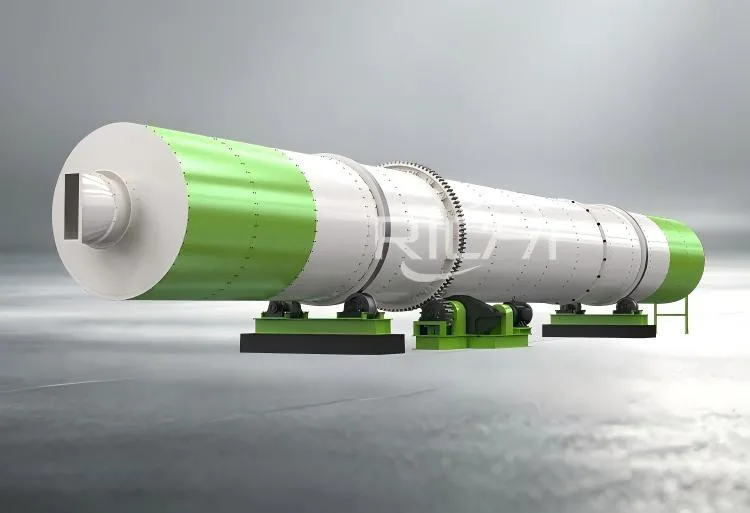
Industrial sawdust dryers are available in different configurations. Rotary dryers are commonly used for continuous biomass processing because they can handle large quantities of material and operate for extended periods.
A complete drying system may include:
- Raw material hopper
- Feeding equipment
- Heat source
- Drying drum
- Exhaust fan
- Cyclone separator
- Dust collector
- Conveyor
- Control system
- Moisture monitoring equipment
The final configuration depends on the production requirements of the customer.
(Learn more: https://pelletisingmachine.com/sawdust-dryer-machine/)
How a Sawdust Dryer Works
The working principle is relatively simple.
Wet sawdust enters the dryer through a controlled feeding system.
Inside a rotary drying chamber, the material is continuously lifted and dropped as the drum rotates.
Hot air passes through the material and transfers thermal energy to the sawdust.
Water evaporates from the particles and is carried away with the exhaust air.
As the sawdust moves through the drying chamber, its moisture content gradually decreases.
At the discharge end, the dried sawdust is transported to the next production stage.
For wood pellet production, this may be a fine grinding machine or directly a pellet mill depending on the raw material size.
The Relationship Between Dryer Price and Capacity
Capacity is one of the most important factors affecting equipment cost.
A small dryer designed for a few hundred kilograms per hour will generally have a different configuration from an industrial system designed for several tons per hour.
Larger dryers require:
- Larger drying drums
- Higher thermal capacity
- Larger motors
- More powerful fans
- Larger feeding systems
- Larger dust collection equipment
- More robust supporting structures
Therefore, buyers should not compare equipment only by the nominal price.
A more useful comparison is the cost of achieving the required drying capacity.
For example, a low-priced dryer may appear attractive initially, but if it cannot process the required amount of wet sawdust, the buyer may eventually need additional equipment.
Initial Moisture and Dryer Cost
Initial moisture has a direct influence on the drying system.
Suppose one factory receives sawdust with 25% moisture while another receives sawdust with 45% moisture.
Even if both factories want to process the same number of tons per hour, the second factory must remove much more water.
This means the required thermal capacity will be higher.
Consequently, the dryer configuration and investment can also be different.
This is why a professional supplier should ask for the actual moisture content before providing a final equipment recommendation.
Final Moisture Requirements
The desired final moisture is another important factor.
For wood pellet production, sawdust is often dried to around 10% to 15% moisture, although the optimum value depends on the raw material and pelletizing process.
Drying material from 40% to 15% requires less energy than drying it from 40% to 10%.
Therefore, customers should identify the actual moisture requirement instead of simply requesting the lowest possible moisture content.
Over-drying can increase fuel consumption without necessarily improving pellet quality.
Sawdust Dryer Price and Heat Source
The heat source can have a significant influence on both investment and operating costs.
Different projects may use different fuels depending on local conditions.
Possible heat sources include:
- Biomass residues
- Wood chips
- Bark
- Natural gas
- Coal
- Other industrial fuels
For sawmills and wood processing plants, using available wood residues as fuel may be an attractive option if the material is suitable and the heating system is properly designed.
However, the economic advantage depends on the moisture content and availability of the biomass fuel, as well as local energy prices.
The heat source should therefore be considered as part of the entire drying system rather than as a separate component.
Rotary Dryer Investment Factors
Rotary dryers are widely used in industrial sawdust processing.
A rotary dryer typically consists of a rotating drum, feeding system, hot-air system, discharge system, and exhaust system.
The investment depends on the size and configuration of the dryer.
Larger drums require more steel and stronger supporting structures. They may also require larger motors and more powerful transmission systems.
Internal lifting structures can also be customized according to the characteristics of the sawdust.
The dryer may be configured for different material capacities and moisture reduction requirements.
Auxiliary Equipment Affects the Total Cost
When discussing sawdust dryer price, it is important to distinguish between the price of the main dryer and the cost of the complete drying system.
A complete system may require several auxiliary machines.
Feeding Equipment
A stable feeding system ensures continuous material flow.
Heat Furnace
The furnace generates the hot air required for drying.
Cyclone
A cyclone separates some of the solid particles from the exhaust airflow.
Dust Collector
A dust collector helps control fine particles and improve environmental performance.
Conveyor
Conveyors transport wet and dry sawdust between different processing stages.
Control Cabinet
The control system allows operators to monitor and adjust important operating parameters.
When these components are included, the total project cost will naturally be higher than the price of the drying drum alone.
Manual and Automatic Drying Systems
The automation level can also affect investment.
A basic system may rely more heavily on manual operation.
Operators may manually monitor temperature, feeding rate, and material moisture.
A more advanced system can incorporate sensors and automatic controls.
The system may monitor:
- Drying temperature
- Feed rate
- Airflow
- Motor status
- Exhaust conditions
- Material moisture
Automation can increase the initial investment, but it can also improve production stability and reduce the need for constant manual adjustment.
For large industrial pellet plants, automated control is often worth considering because the plant may operate continuously for many hours per day.
Small Sawdust Dryers
Small-scale sawdust processing projects usually have lower production requirements.
For example, a small woodworking business may only need to process a limited amount of sawdust each day.
In such cases, a compact drying system may be sufficient.
The main advantages include:
- Lower initial investment
- Smaller footprint
- Easier operation
- Lower supporting infrastructure requirements
However, the equipment should still be selected according to actual moisture and production requirements.
A small dryer that is overloaded continuously may consume more energy and have shorter service life.
Medium-Scale Sawdust Drying
Medium-scale production requires a more stable continuous drying solution.
These projects may process several tons of sawdust per hour.
A rotary drying system can provide continuous material movement and consistent heat transfer.
The dryer can be connected to a biomass furnace, dust collection system, conveyor, and downstream pellet production equipment.
This configuration is commonly considered for commercial biomass processing.
Large-Scale Industrial Sawdust Drying
Large pellet plants can process substantial quantities of sawdust every hour.
For these projects, the drying system becomes a major part of the production line.
The system may include:
Raw Material Storage → Feeding → Crushing → Drying → Dust Collection → Fine Grinding → Pelletizing
A large-scale drying system may also incorporate automatic temperature control, moisture monitoring, centralized control, and safety systems.
The initial investment is higher, but the system is designed for continuous industrial operation.
How to Compare Different Sawdust Dryer Prices
Buyers should avoid comparing dryers based only on purchase price.
Instead, several technical and economic factors should be evaluated.
Drying Capacity
Check how many tons of wet sawdust the dryer can process per hour under the specified moisture conditions.
Water Evaporation Capacity
Determine how much water the dryer can remove per hour.
This is particularly important when raw material moisture varies significantly.
Energy Consumption
Compare the estimated fuel consumption under similar operating conditions.
Final Moisture
Confirm whether the dryer can consistently achieve the required final moisture.
Equipment Materials
The quality and thickness of steel, bearings, gears, motors, and other components can influence durability and maintenance requirements.
Automation
Determine how much of the drying process can be automatically controlled.
Auxiliary Equipment
Check whether the quotation includes the furnace, cyclone, dust collector, conveyors, control system, and other equipment.
Installation
Confirm whether installation, commissioning, and operator training are included.
A complete comparison provides a much more accurate picture of the actual project investment.
Why the Cheapest Dryer May Not Be the Best Choice
A low purchase price does not necessarily mean a low total cost.
If a dryer has poor thermal efficiency, fuel consumption may be higher.
If the drying capacity is insufficient, production may be interrupted.
If the equipment uses low-quality components, maintenance and replacement costs may increase.
If the dust collection system is inadequate, environmental and operational problems may occur.
Therefore, buyers should evaluate the total cost of ownership rather than focusing exclusively on the initial quotation.
Energy Consumption and Operating Cost
For a sawdust drying project, operating costs are often more important than the initial purchase price.
The main operating costs may include:
- Fuel
- Electricity
- Labor
- Maintenance
- Spare parts
- Dust collection
- Material handling
Fuel consumption can be particularly important because drying requires substantial thermal energy.
A well-designed system can reduce unnecessary heat loss and avoid over-drying.
Heat recovery may also be considered depending on the plant configuration.
How to Reduce Sawdust Drying Costs
Several strategies can help reduce drying expenses.
Use Appropriate Moisture Targets
Do not dry sawdust more than necessary.
Select an Efficient Heat Source
Use the most economical suitable fuel available locally.
Minimize Heat Loss
Insulate hot-air ducts and drying equipment properly.
Maintain Stable Feeding
Stable feeding improves drying consistency and reduces unnecessary temperature fluctuations.
Maintain the Equipment
Clean dust collectors and inspect fans, bearings, motors, and transmission components regularly.
Monitor Moisture
Moisture monitoring helps prevent under-drying and over-drying.
Sawdust Dryer Price for a Complete Pellet Plant
A customer planning a complete wood pellet production line should not consider the dryer independently.
The drying system should match the capacity of the pellet mill.
For example, if a pellet plant requires 8 tons of dried sawdust per hour, the dryer should provide sufficient dried material to maintain continuous pellet production.
If the dryer cannot keep up, the pellet mill will have insufficient raw material.
On the other hand, an extremely oversized dryer can increase investment and energy costs.
The ideal solution is to balance the capacities of the dryer and pelletizing equipment.
Example of a Sawdust Drying Project
Consider a factory producing wood pellets from sawdust.
The factory receives approximately 12 tons of wet sawdust per hour at 40% moisture.
The target moisture after drying is approximately 12%.
The drying system must remove a significant amount of water before the material reaches the pellet mill.
The complete process may include:
Wet Sawdust → Feeding → Heat Generation → Rotary Drying → Cyclone → Dust Collection → Fine Grinding → Pelletizing
After pelletizing, the hot pellets are cooled, screened, and packed.
In this type of project, the dryer should be sized according to the actual wet feed rate and water evaporation requirement.
The customer should also consider the heat source and dust collection system when evaluating the total investment.
Sawdust Dryer Price Depends on Project Configuration
There is no single standard price that applies to every sawdust dryer.
Two customers may request the same nominal capacity but receive different equipment recommendations because their raw materials and operating conditions are different.
For example, one customer may have:
- Low initial moisture
- Clean sawdust
- Available biomass fuel
- Small production capacity
Another customer may have:
- High initial moisture
- Mixed wood residues
- Limited fuel availability
- Large continuous production
The second project will naturally require a more complex system.
Therefore, an accurate quotation should be based on project-specific technical parameters.
Questions to Ask Before Buying a Sawdust Dryer
Before requesting a quotation, buyers should prepare several key pieces of information.
What Is the Raw Material?
Is it sawdust, wood chips, wood shavings, or a mixture?
What Is the Initial Moisture?
Provide an actual measured value whenever possible.
What Is the Target Moisture?
Specify the required moisture after drying.
How Much Material Needs to Be Processed?
State the required tons per hour.
What Heat Source Is Available?
Identify biomass, gas, coal, or other available fuels.
How Many Hours Will the Plant Operate?
Daily operating hours affect equipment utilization.
What Is the Final Product?
Tell the supplier whether the dried material will be used for pellets, briquettes, bedding, or another product.
The more accurate this information is, the more suitable the equipment recommendation can be.
RICHI Sawdust Drying Solutions
For commercial sawdust processing projects, RICHI Machinery can provide customized equipment configurations based on raw material characteristics and production requirements.
The solution can be designed around parameters such as initial moisture, final moisture, capacity, available fuel, plant layout, and downstream processing.
Depending on the project, a complete solution can include sawdust crushing, drying, fine grinding, pelletizing, cooling, screening, packing, conveying, and dust collection.
This turnkey approach allows the drying system to be properly matched with the rest of the production line.
Conclusion
Sawdust drying is an important process for wood pellet production and other biomass applications. Controlling moisture can improve pelletizing performance, product quality, storage stability, and overall production efficiency.
When evaluating sawdust dryer price, buyers should look beyond the initial equipment quotation. Capacity, initial moisture, target moisture, heat source, energy consumption, automation, auxiliary equipment, installation, and maintenance requirements can all influence the final investment.
A suitable dryer should be selected according to the actual production conditions rather than simply choosing the cheapest available machine.
For small projects, a compact drying system may be sufficient. For medium and large-scale biomass plants, a continuous rotary drying system can provide stable processing capacity and better integration with downstream pellet production.
Most importantly, the dryer should be treated as part of a complete processing system. Proper coordination between feeding, heating, drying, dust collection, conveying, grinding, pelletizing, cooling, and packing can help create a more reliable and efficient biomass production line.
By evaluating both investment cost and long-term operating performance, businesses can choose a sawdust drying solution that provides better value over the entire service life of the equipment.