
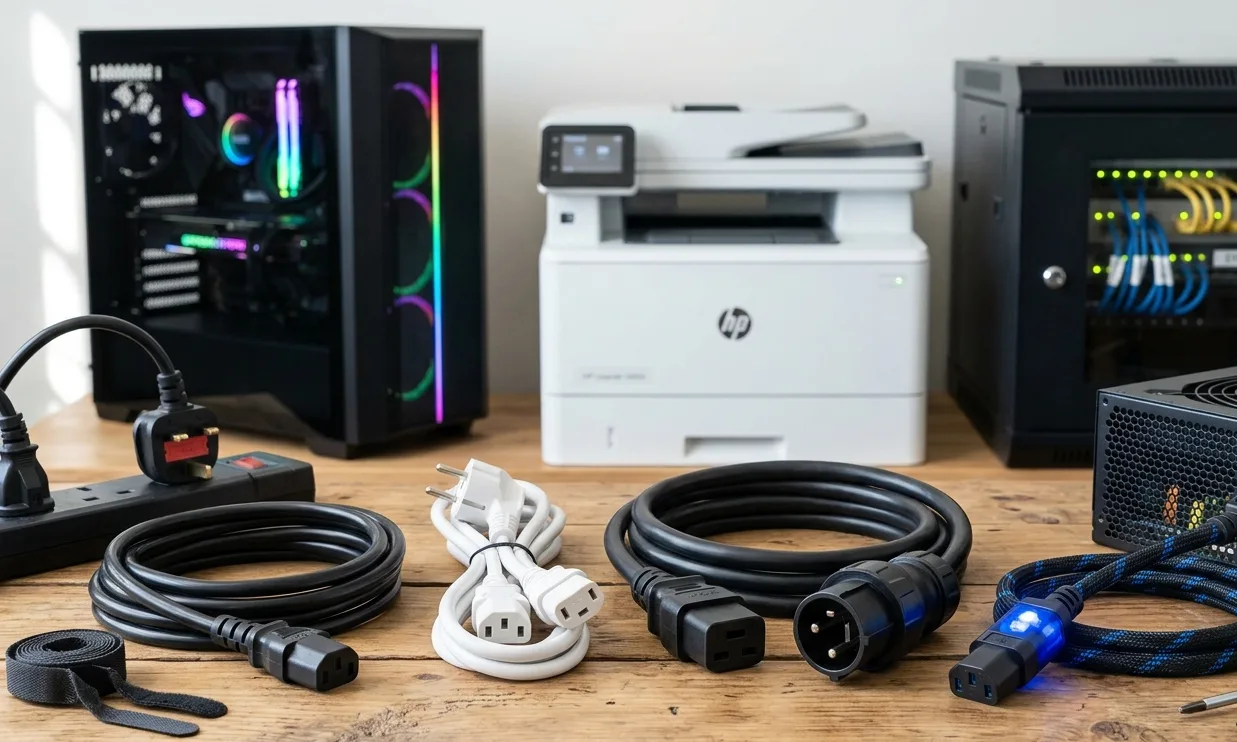
Most people don't think twice about power cords. You buy a device, plug it in, and move on with your day. But here's the thing using the wrong power cord can damage your equipment, create a real safety hazard, or simply leave you frustrated because the plug doesn't fit the inlet.
Why Power Cords Aren't "One Size Fits All"
It's tempting to think all power cords are basically the same. A plug on one end, a connector on the other, electricity flows through. Simple, right?
Not quite. Different devices have different power requirements, and the connectors are designed specifically to match those needs. A cord that works perfectly for your desktop PC might be completely wrong for a rack-mounted server. And using a cord that can't handle the amperage your device demands isn't just inconvenient it's a fire risk.
Understanding NEMA Power Cords
If you're in the US and powering a typical desktop PC, home printer, or monitor, you're almost certainly dealing with NEMA connectors. The most common one is the NEMA 5-15 a standard three-prong plug you've seen your entire life. It handles 15 amps at 125 volts, which covers the vast majority of everyday electronics without any issue.
For heavier devices, you'll come across the NEMA 5-20, a 20-amp version often used in workstations and office equipment. There are also 240-volt variants like the NEMA 6-15 and 6-20, which show up with industrial tools or high-draw hardware that needs more power than a standard outlet provides.
Then there are locking connectors the NEMA L5-15, L5-20, and similar variants. These twist and lock into the outlet so they can't be accidentally pulled out. If you've ever been in a server room or telecom closet, you've seen these. They exist because an unexpected disconnection in that environment isn't just annoying it can take down critical systems.
Understanding IEC 320 Power Cords
Walk into any data center and you'll be surrounded by IEC connectors. These are standardized connectors used on desktops, servers, printers, networking gear, and medical devices worldwide. Knowing the common types saves you a lot of guesswork.
The C13 and C14 pair is probably the most recognized combination in the world. The C13 is the three-pronged female end that plugs into your device you see it on the back of desktop power supplies, monitors, and network switches constantly. The C14 is the male inlet on the device itself. These cords handle 10 amps and are the everyday workhorse for general computing equipment.
The C15 looks almost identical to the C13 but has a small notch that makes them non-interchangeable. That notch exists for a reason the C15 is rated for higher operating temperatures, up to 120 degrees Celsius. It's the right choice for devices that run hot, like certain switches or high-performance servers. Don't substitute a C13 cord onto a device that calls for a C15, especially in a hot-running environment.
Practical Things to Get Right Before You Buy
Start by looking at the back of your device. The shape of the inlet will tell you exactly which IEC connector you need on the cord's device end. The wall-plug end depends on your country and outlet configuration. That combination inlet type plus local outlet standard narrows your options down quickly and takes most of the guesswork out of it.
Pay attention to length. It sounds basic, but people regularly buy cords that are too short and end up stressing the connectors, or too long and create a tangled mess that becomes a tripping hazard. Measure the distance, add a little slack, and buy accordingly.
Wire gauge matters more than people expect. Gauge is measured in AWG, and the lower the number, the thicker the wire. Thicker wire handles more current safely. For most home and office use, 18 AWG is perfectly fine. For servers and high-draw commercial equipment, 14 or 16 AWG is the safer choice and worth the small extra cost.
The Bottom Line
Power cords are the kind of thing nobody thinks about until something goes wrong. A failed cord on a home PC is an inconvenience. A failed cord on a production server at two in the morning is a very different problem.
Taking a few minutes to understand what your device actually needs the right connector type, the correct amperage rating, the appropriate wire gauge makes a real difference in both safety and reliability.
Original Article :- https://www.molecularcloud.org/p/how-to-choose-the-right-power-cord-for-your-pc-printer-or-server-in-2026