Introduction
The television industry has moved far beyond traditional cable and satellite broadcasting. Today, content owners, businesses, media companies, educators, and independent creators can reach audiences through internet-based television services without building a conventional broadcast network. If you want to create your own TV channel online, modern cloud and streaming technologies make it possible to launch a professional channel with comparatively flexible infrastructure and distribution options.
One of the most interesting models is the FAST channel, or free ad-supported streaming television channel. FAST combines the familiar experience of scheduled television with internet streaming and advertising. Instead of requiring viewers to select individual programs whenever they want to watch, a FAST channel delivers continuous programming according to a predefined schedule.
Understanding Online TV Channels
What an Online TV Channel Requires
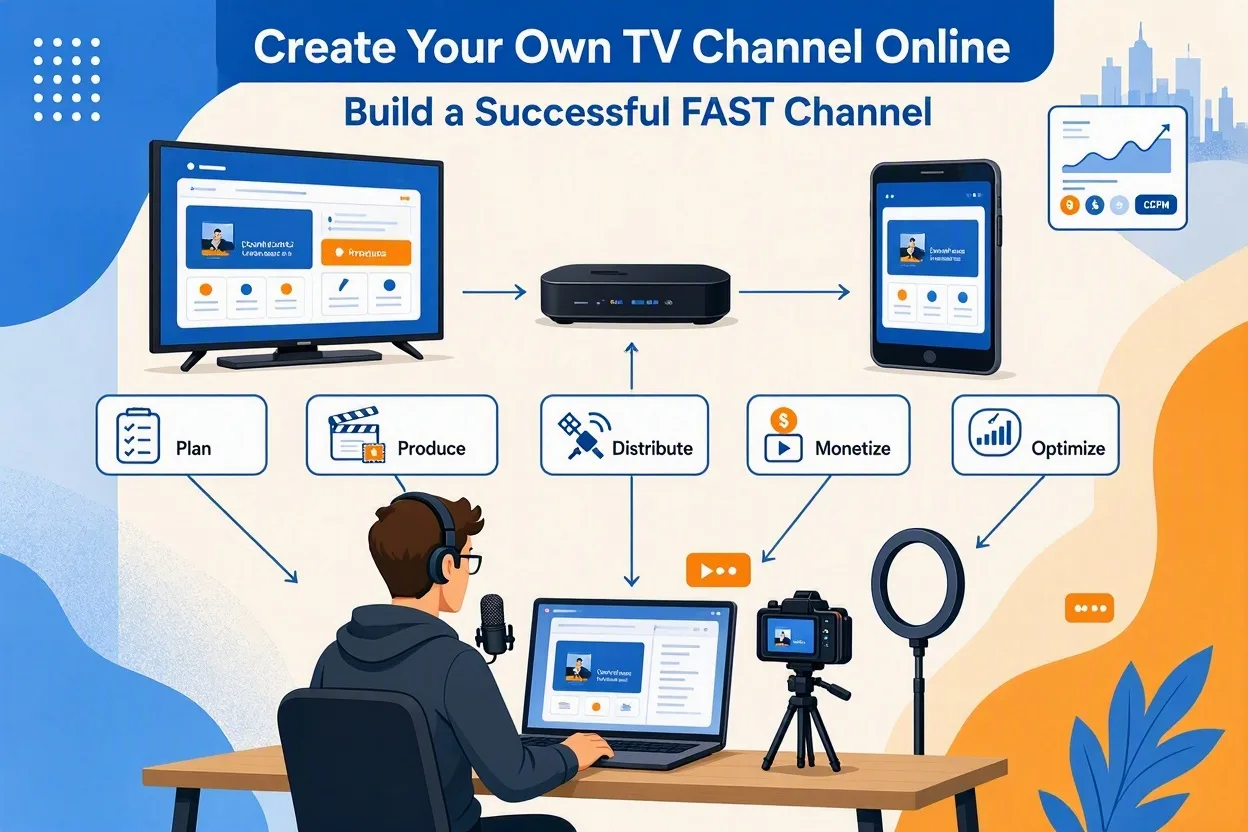
An online television channel needs several connected components working together. Content must first be stored and organized, then prepared for streaming and delivered through a reliable distribution infrastructure. A scheduling and playout system determines what viewers see at each point in the day, while encoding and streaming services convert the output into a format suitable for internet-connected devices.
The viewer may ultimately watch through a website, mobile application, smart-TV application, or streaming device. Although the interface can be simple, the infrastructure behind it needs to coordinate content, scheduling, streaming, monitoring, and analytics.
From Content Library to Live Channel
A business does not necessarily need to produce new programming every day. Existing movies, interviews, documentaries, educational programs, sports content, news segments, or other licensed material can be organized into a continuous schedule. This makes it possible to transform an existing library into a television-style service.
Building a FAST Channel
Choosing the Channel Concept
Before launching a FAST channel, the operator should define its audience and programming identity. A channel focused on classic movies will require a different content strategy from one dedicated to fitness, news, children's programming, or regional entertainment.
A focused concept also makes marketing and programming decisions easier. Viewers should understand why the channel exists and what type of content they can expect when they tune in.
Preparing the Content
Content needs to be checked for technical quality and distribution rights before it enters the channel workflow. Video files may need transcoding into appropriate streaming formats, while metadata such as titles, descriptions, categories, episode information, artwork, and duration should be organized consistently.
Rights management is particularly important because content may have geographic, platform, or time-based restrictions.
Creating the Programming Schedule
The Role of Playout
A professional online channel requires more than a collection of video files. The content must be arranged into a schedule and played in the correct order. Playout technology handles this process by executing the programming timeline and delivering the appropriate media to the channel output.
A schedule can contain programs, promotional clips, advertising breaks, station branding, and other elements. Automation allows the channel to operate continuously without requiring an operator to manually start every program.
Building a Television-Like Experience
A successful FAST channel should feel familiar to viewers. Programs can be organized into morning, afternoon, evening, and late-night blocks. Repetition can be controlled through scheduling rules, while popular programs can be placed strategically to encourage viewing.
Streaming and Distribution
Delivering the Channel Online
Once the schedule is prepared, the resulting channel output needs to be encoded and packaged for internet delivery. Adaptive streaming can provide different quality levels so viewers can receive an appropriate stream according to their connection and device.
A content delivery network can then distribute the stream efficiently to audiences in different locations.
Supporting Multiple Devices
When businesses create your own TV channel online, they can choose to distribute it through multiple endpoints. A website can provide browser-based viewing, while mobile and connected-TV applications can offer a more dedicated experience.
Smart-TV and streaming-device distribution can significantly expand the potential audience because viewers can access the channel directly from their television.
Monetizing a FAST Channel
Advertising as a Revenue Model
Advertising is one of the defining characteristics of the FAST model. Instead of charging viewers a traditional subscription fee, the service can generate revenue by presenting advertisements around or within scheduled programming.
Advertising opportunities can be planned within the channel schedule and connected to appropriate ad-insertion technology. Server-side ad insertion can also support dynamic advertising strategies where the technical architecture permits it.
Measuring Performance
Analytics are essential for understanding whether the channel is attracting and retaining viewers. Operators can monitor concurrent viewing, watch duration, program performance, audience trends, and technical playback data.
These insights can influence future scheduling and content decisions.
Managing the Channel
Monitoring the Playout Workflow
A continuously operating channel needs monitoring at several stages. Operators should be able to identify problems such as missing media, stream interruptions, encoding failures, audio problems, or unexpected schedule gaps.
Automated alerts can help technical teams respond quickly when an issue occurs.
Scaling the Service
Once the first channel is stable, the same infrastructure can potentially support additional channels. A media company could create separate FAST channels around different genres, audiences, regions, or content libraries without rebuilding the entire streaming operation from scratch.
Conclusion
The ability to create your own TV channel online has changed the economics and technical possibilities of television distribution. Businesses no longer need to rely exclusively on traditional broadcast infrastructure to establish a recognizable channel and reach viewers across digital platforms.
A FAST channel provides an especially attractive model because it combines scheduled programming, internet delivery, and advertising. However, launching one successfully requires more than putting videos into a playlist. Content rights, media preparation, metadata, scheduling, automated playout, streaming, CDN delivery, applications, monitoring, analytics, and monetization all need to work together.
The strongest approach is to build a scalable media infrastructure from the beginning. A centralized content library can supply both scheduled programming and on-demand services, while automated scheduling and playout can keep the channel operating consistently. As the audience grows, the same foundation can support additional applications, distribution platforms, and channels.
For organizations with an existing video library, launching a FAST service can also provide a new way to generate value from content that might otherwise remain difficult to discover. With the right programming strategy and technical architecture, an online television channel can move beyond being simply a stream of videos and become a complete, professionally operated digital television service.