
The Problem with Picking an AI Development Partner Right Now
Everyone says they build AI agents. The landing pages look similar. The pitch decks hit the same notes: "autonomous," "intelligent," "enterprise-grade." But once you start a project, the differences become very clear, very fast.
Some companies have genuinely shipped production AI systems. Others learned the terminology last quarter. The challenge for any buyer is that the gap between those two groups is invisible until you are already three months into an engagement.
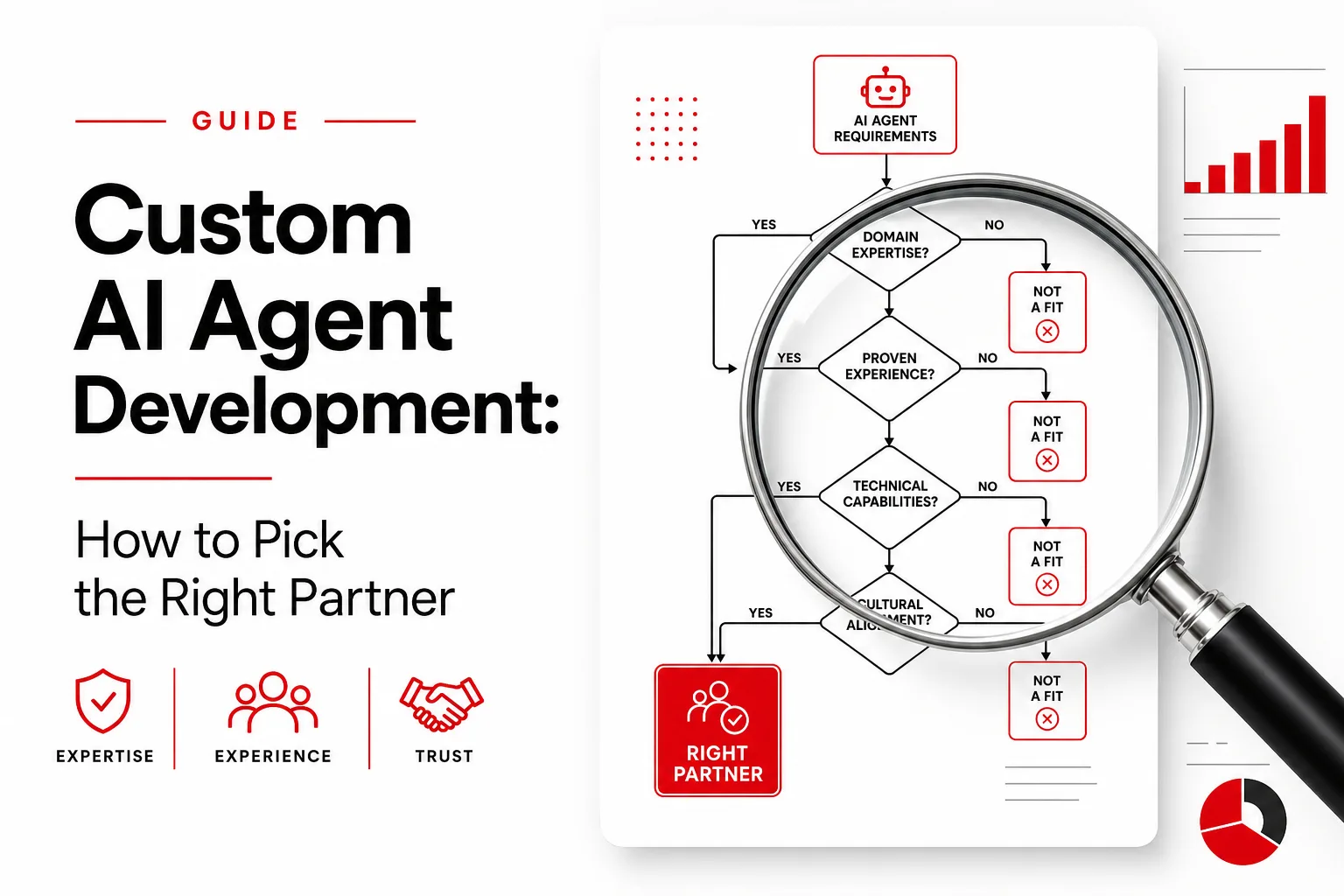
This guide gives you a structured scoring framework to evaluate any AI agent development company before you sign anything. It covers what to ask, what to look for in the answers, and how to weight each factor so you can compare vendors with some objectivity.
What Makes AI Agent Development Different from Standard Software Projects
Before you can evaluate vendors, it helps to understand what actually makes this work distinct.
A custom AI agent is not a chatbot you configure in an afternoon. It is a system that perceives inputs, reasons about them using a language model or other AI components, and takes actions in the world. That might mean retrieving and summarizing data from multiple systems, drafting and sending communications, executing multi-step workflows, or making decisions within defined boundaries.
This requires expertise across at least three domains: AI/ML engineering (model selection, fine-tuning, prompt architecture), software engineering (APIs, data pipelines, integration layers), and product thinking (what the agent should and should not do autonomously). Vendors who are strong in only one of these tend to build agents that are either impressive demos or frustrating production systems.
AI agent development services that hold up under real workloads are built at this intersection. When you are screening vendors, this is the first filter.
The Buyer Scoring Framework: Six Dimensions
Score each vendor from 1 to 5 on each dimension. A total of 25 or above out of 30 is a strong signal. Below 18 is a red flag.
1. Technical Depth (Weight: High)
What to ask: Walk me through a recent AI agent you built. What was the model? How did you handle hallucinations or unexpected outputs? What happened when it failed in production?
Good answers get specific. They name the models used (GPT-4, Claude, Gemini, or open-source alternatives), describe the orchestration layer (LangChain, LlamaIndex, custom), and talk about failure modes honestly. Weak answers stay abstract.
Look for evidence that the team has worked with retrieval-augmented generation (RAG), tool use, memory systems, and agent evaluation frameworks. These are not optional features in serious production systems. They are the infrastructure that keeps agents reliable.
If you plan to hire AI agent developers on a staff augmentation basis, ask to interview them directly. Check for familiarity with evaluation benchmarks, latency constraints, and cost management at scale.
Score 5: Specific technical depth, honest about failure modes, clear methodology
Score 1: Cannot explain architecture choices or deflects with marketing language
2. Relevant Use Case Experience (Weight: High)
What to ask: Have you built AI agent development solutions in my industry or for similar workflows?
This matters more than general AI experience. An AI agent consultant who has built document processing systems for financial services will build a better solution for a compliance team than a generalist who has only built customer support bots.
Ask for case studies with outcomes, not just descriptions. "We built an AI agent for a logistics company" is a starting point. "We built an AI agent that reduced manual data entry by 60% across three warehouse systems" tells you something.
You can also look at firms like LeewayHertz AI development to understand what documented case study quality looks like in this market, then hold any vendor you are evaluating to that same standard of specificity.
Score 5: Direct use case match with documented outcomes
Score 1: No relevant experience, or examples are vague
3. Integration and Data Engineering Capability (Weight: Medium-High)
Most enterprise AI agents do not fail because the model is wrong. They fail because the surrounding data infrastructure is weak.
Ask how the vendor handles integrations with your existing systems. Can they connect to your CRM, ERP, or document management tools? How do they structure the data pipelines that feed the agent? What does their approach to chunking, embedding, and retrieval look like for RAG-based systems?
Vendors who can only build the AI layer and expect your team to handle integration are a risk, unless you have strong in-house engineering capacity. AI agent development services should cover the full stack from data ingestion to agent output.
Score 5: Deep integration experience, handles full data pipeline
Score 1: Treats integration as "your problem"
4. Delivery Model and Team Structure (Weight: Medium)
What to ask: Who will actually work on this project? Will I have a dedicated team or a shared resource pool?
The answer reveals a lot. Projects with clear ownership and a dedicated technical lead tend to run differently from those where you get whoever is available that week.
Ask about engagement model options. Some organizations benefit from hiring AI developers in India through a dedicated team model, which gives them cost-effective access to senior engineering talent without the overhead of building in-house capacity. Others need a fixed-price engagement with defined milestones. Others need a hybrid.
Good vendors will help you choose the right model based on your project's complexity and risk profile, not steer you toward the one that works best for them.
Score 5: Transparent team structure, flexible engagement models, clear ownership
Score 1: Vague on who does the work, one-size-fits-all contracts
5. Evaluation and Quality Assurance for AI Systems (Weight: Medium)
This is the dimension most buyers skip, and it is where a lot of AI projects go sideways.
AI systems behave probabilistically. The same input can produce different outputs. That means traditional software QA is not enough. Ask the vendor how they evaluate agent performance before go-live and how they monitor it in production.
Specifically: Do they define success metrics before they start building? Do they build evaluation datasets to test the agent against expected outputs? Do they have processes for catching regressions when models update?
A generative AI development company that cannot answer these questions clearly has probably not shipped enough agents into production to know what breaks.
Score 5: Defined evaluation methodology, production monitoring, regression testing
Score 1: "We'll test it before launch" with no further detail
6. Communication and Collaboration Fit (Weight: Medium)
Technical skill is necessary but not enough. You will be working closely with this team for months. Communication quality compounds over time.
Pay attention to how the vendor communicates during the sales process itself. Do they ask good questions about your problem? Do they push back when something you want is not advisable? Do they explain trade-offs clearly?
An AI agent consultant who only tells you what you want to hear will cause problems later. The best partners challenge assumptions early, when it is cheap to adjust, rather than late, when it is expensive.
Score 5: Asks probing questions, explains trade-offs, pushes back constructively
Score 1: Only validates your ideas, gives no friction
A Real-World Example: How This Framework Plays Out
Consider a manufacturing firm evaluating three vendors for an AI agent that would process supplier quotes and flag anomalies. All three vendors said they could build it.
Vendor A scored high on technical depth (they had built similar quote-processing systems) and integration capability, but could not clearly explain their evaluation approach. Score: 22.
Vendor B had excellent case study documentation and a mature evaluation methodology, but their team structure was unclear and they had no manufacturing experience. Score: 19.
Vendor C had a lower profile but answered every technical question with specifics, had built one directly analogous system, and explained exactly what they would do if the agent started flagging too many false positives. Score: 27.
They chose Vendor C. Six months later, the agent was processing 85% of incoming supplier quotes without human review.
The framework did not make the decision. It organized the information so the decision was easier to make.
What to Ask Before You Sign
Here are the five questions that separate vendors with genuine depth from those with good marketing:
"Tell me about a time an AI agent you built failed in production. What happened and how did you fix it?" Vendors who have never had a production failure either have not shipped much or are not being honest.
"How do you handle prompt injection or adversarial inputs?" This is a basic security consideration for any agent that handles external data. The answer tells you whether security is an afterthought.
"What is your stance on model lock-in?" Good vendors build with model abstraction in mind. If the best model changes (and it will), you want to be able to switch without rewriting the entire system.
"What metrics will we use to declare this project a success?" Vague answers are a warning sign. AI agent development solutions should have clear performance benchmarks before a line of code is written.
"Who owns the code and the fine-tuned models at the end of the engagement?" This should be you. Confirm it before you start.
How MetaDesign Solutions Approaches AI Agent Development
MetaDesign Solutions has been building enterprise software systems since 2010. The AI/ML engineering practice applies that same foundation to custom AI agent development: starting with the technical architecture that matches your actual use case, integrating with the data systems you already run, and building evaluation frameworks before the agent ever touches production workloads.
The team works across engagement models including dedicated teams, staff augmentation, and fixed-price delivery, depending on what fits the project. Clients across financial services, healthcare, and enterprise technology have used this approach to ship AI agents that handle real volume reliably, not just demo well.
If you are in the evaluation process now, the conversation starts here: sales@metadesignsolutions.com
Conclusion
The AI agent market is noisy. Most vendors sound similar at the proposal stage. The scoring framework in this guide forces specificity: it asks vendors to show their work, not just describe their capabilities.
Technical depth, relevant experience, integration capability, delivery model, evaluation methodology, and communication fit. Score each one honestly, compare vendors side by side, and the right choice gets considerably clearer.
Pick the partner who has done this before and can prove it.
Frequently Asked Questions
1. What is custom AI agent development?
Custom AI agent development is the process of building AI systems tailored to a specific organization's workflows. Unlike off-the-shelf AI tools, custom agents are designed around your data, your systems, and your specific decision-making logic. They can automate multi-step processes, retrieve and reason over proprietary information, and integrate with existing enterprise software.
2. How is an AI agent different from a standard chatbot?
A chatbot responds to questions using a fixed script or a language model. An AI agent can also take actions: querying databases, calling APIs, updating records, sending communications, or triggering workflows. The defining characteristic is the ability to operate autonomously across multiple steps toward a goal.
3. What should I look for in an AI agent development company?
Look for technical depth in model architecture and orchestration, experience with integrations and data pipelines, clear evaluation and testing methodology, and a delivery model that suits your project. Case studies with specific outcomes are a better signal than general claims.
4. How long does it take to build a custom AI agent?
It depends on complexity. A focused agent that handles one well-defined workflow with clean data can be production-ready in six to twelve weeks. Agents that span multiple systems, require custom model fine-tuning, or handle unstructured data typically take longer. Vendors who give you a fixed timeline without understanding your data situation are guessing.
5. What are AI agent development services typically priced at?
Pricing varies widely based on project scope, engagement model, and the vendor's location and seniority mix. Fixed-price engagements for scoped projects can start from $20,000 to $50,000. Dedicated team models are priced monthly and typically offer more flexibility for evolving requirements. Get itemized proposals and ask specifically what is and is not included.
6. What is retrieval-augmented generation (RAG) and why does it matter for AI agents?
RAG is an architecture pattern where an AI agent retrieves relevant information from a knowledge base before generating a response or taking an action. It allows the agent to work with your organization's specific data without requiring expensive model retraining. Most enterprise AI agents use some form of RAG. If a vendor has never mentioned it, ask.
7. Can AI agents integrate with our existing enterprise software?
Yes, with appropriate engineering effort. Common integrations include CRM systems, ERPs, document management platforms, communication tools, and custom internal APIs. The complexity depends on how well-documented those systems are and whether they have usable APIs. Integration is often the most time-consuming part of the project.
8. What is the difference between an AI agent developer and an AI agent consultant?
A developer builds the system. A consultant advises on architecture, vendor selection, and strategy. Good AI agent development companies offer both: they will tell you whether an agent is the right solution for your problem before they start building, and they will design the system architecture before they write code.
9. Should we hire AI developers in India or use a local vendor?
The choice depends on your priorities. Hiring AI developers in India through reputable firms typically offers strong technical depth at lower costs, with the trade-off of time zone coordination. Local vendors may cost more but offer easier collaboration. Hybrid models with senior leads in your time zone and an offshore delivery team are also common. The more important factor is the technical capability and communication quality of the specific team, not geography.
10. How do we know if an AI agent is working correctly in production?
You need a monitoring framework defined before go-live. This typically includes tracking task completion rates, output quality scores, error rates, and latency. For agents that handle sensitive workflows, you also want audit logs and human review queues for edge cases. Ask any vendor you evaluate how they approach production monitoring before they start building.