
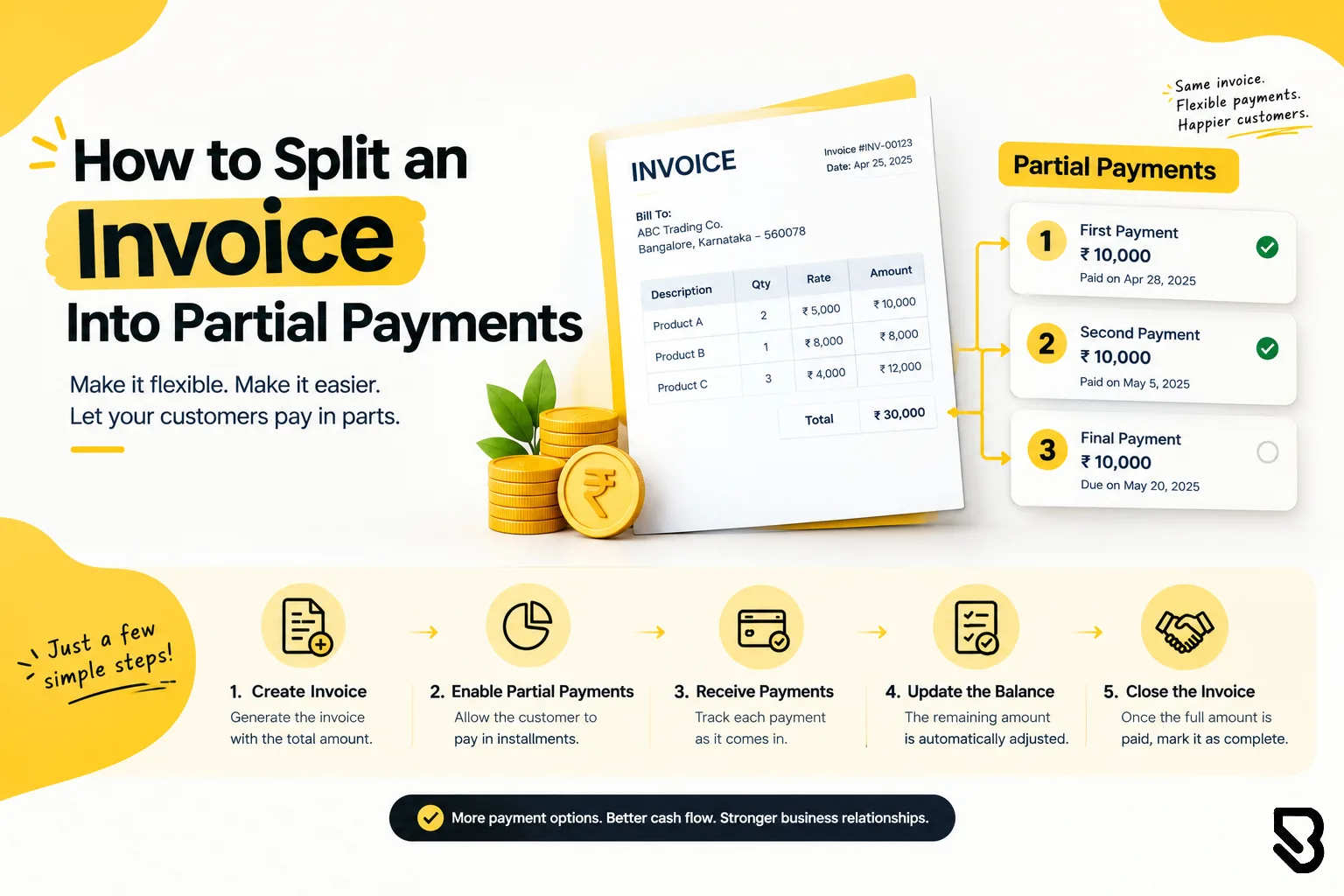
Not every job gets paid in one lump sum. Larger projects, custom orders, and long engagements often call for breaking the total amount owed into smaller, scheduled payments rather than billing everything at once. Done well, splitting an invoice into partial payments protects cash flow on both sides. Done poorly, it creates confusion about what's actually been paid and what's still outstanding.
Why businesses split invoices into partial payments
Splitting payments spreads the financial commitment out for the client, making larger purchases more manageable, while giving the seller cash flow throughout a longer project instead of waiting until the very end to get paid. It's especially common for custom work, large equipment orders, or multi-month contracts, where doing all the work before seeing any payment would put too much financial strain on the business delivering it.
Common structures for splitting payments
A deposit followed by a final payment on completion is one of the simplest structures: a percentage upfront to secure the work, with the remainder due once it's delivered. Milestone-based billing ties specific payments to specific stages of a project, so each invoice corresponds to a defined chunk of completed work rather than an arbitrary date. Installment plans divide the total into equal, scheduled payments over a set period, which is common for larger one-time purchases rather than ongoing services.
What each partial invoice should clearly show
Every partial invoice should state the total project or order value, what this specific payment covers, how much has already been paid, and what remains outstanding after this invoice is settled. Without that running total, it's easy for either party to lose track of where things stand, especially across a project with several partial payments spread over weeks or months.
Keeping the numbering and records clean
Each partial invoice should have its own unique invoice number, even though they're all tied to the same underlying project or order. Referencing the original quote, contract, or purchase order number on every partial invoice keeps them linked together in the records, so anyone reviewing the account later can easily see which payments belong to which job.
When partial billing isn't worth the complexity
For smaller jobs or short engagements, splitting a modest invoice into multiple payments usually adds more administrative overhead than it's worth, for both the business and the client. Partial billing earns its complexity on larger, longer, or higher-risk projects, where protecting cash flow through the life of the work outweighs the extra tracking involved.
Communicating the payment schedule upfront
Whatever structure is used, the client should see the full payment schedule before work begins, not discover it invoice by invoice. Agreeing on the number of payments, amounts, and due dates in the original quote or contract avoids disputes later and makes each partial invoice feel like part of an agreed plan rather than a surprise.
Billaze's invoice generator makes it easy to create a clear, numbered invoice for each partial payment, so both sides always know exactly what's been paid and what's still due.