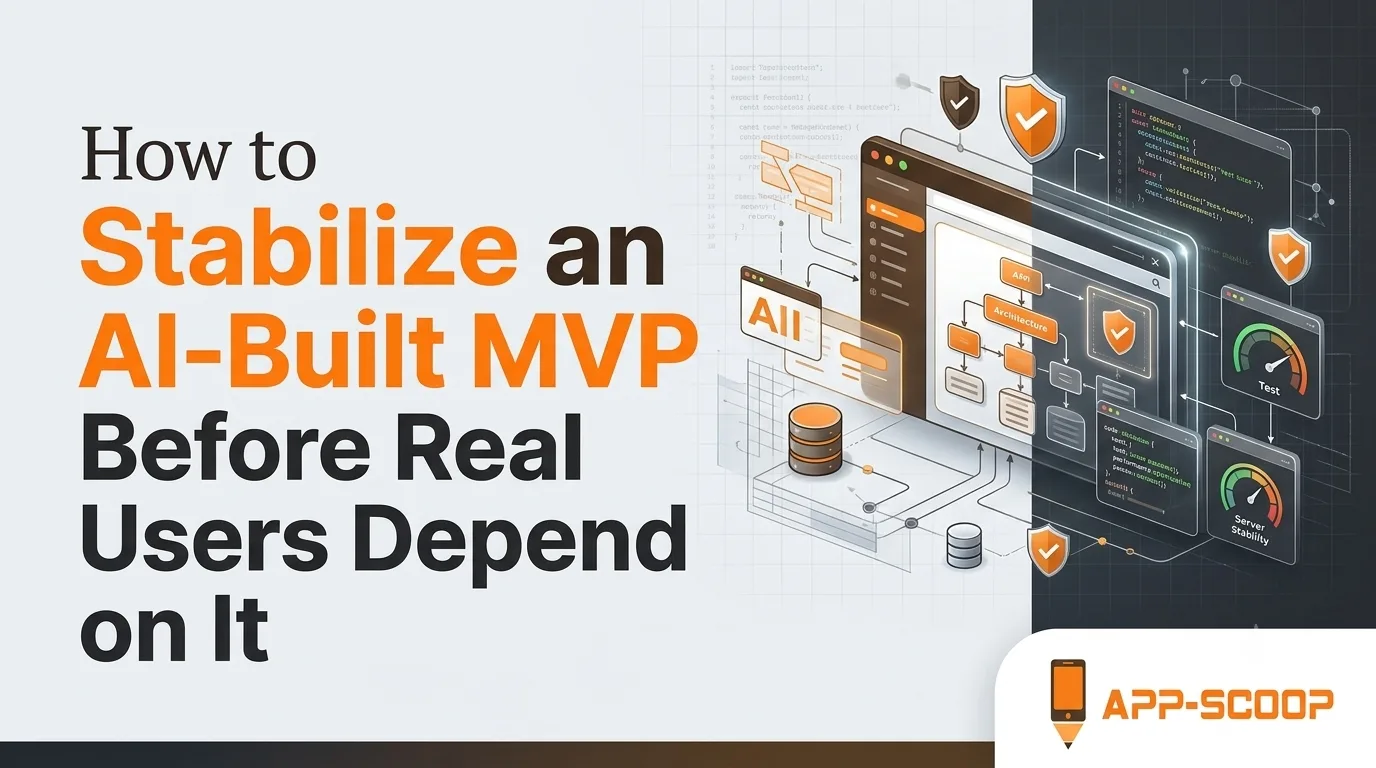
Coding tools powered by Artificial Intelligence (AI) have sped up the process of creating software. Founders can build an early version of an application without using the traditional software development process from beginning to end. While it is not difficult to build an application to demonstrate core functionality, it takes much more effort to build an application to showcase the features to real users.
As an application garners more early interest, that interest may quickly outpace the application’s core features, which may lead to unforeseen issues. The application may have problems with authentication, database requests, integrations with external applications, and performance.
Founders should think beyond product scope and consider the underlying architecture and platform of an AI-built MVP. They should think beyond features and stabilize an AI-built MVP by defining and answering the following questions.
Why Does An AI-Built MVP Become Difficult to Maintain?
AI coding tools can quickly generate functional code, but that does not guarantee that an application will be structured in a way that eliminates risks. Without a defined and consistent architectural plan, different components may be structured in an inconsistent manner, leading to unforeseen issues.
- Database Inconsistencies: Unexpected results can occur because of sub-optimal planning of data relationships and/or database operations.
- Performance Constraints: Inefficiencies in resource usage become more pronounced as the number of queries and transactions increase.
Integration Issues: Payment gateways, external APIs and other integrated services can break due to changes in responses, credentials and/or network conditions.
These issues do not demonstrate that AI-assisted development is inappropriate for building production systems. They show that generated code still requires engineering judgment, review and accountability.
1. Start with a Technical Audit, Not an Immediate Rewrite
Before making any changes, it is critical to understand the current state of the system. Founders sometimes think that the only option to stabilize their MVP is to rebuild it. Rebuilding can extend development time and introduces unnecessary cost and risk. A technical audit helps determine what components can be trusted, which require modification and which present risks.
- Architecture and Dependencies: Understand how various components of the frontend, backend and databases integrate with each other and with external services. Identify components which are coupled with many other components.
- Code: Determine duplicated code, illogical code, code which violates coding standards and modules which are difficult to maintain.
- Security: Determine the integrity of authentication and authorization. Determine how sensitive data is handled.
- Performance: Determine the cause of slow queries and why application operations are inefficient.
- Testing: Determine if important user journeys are supported by automated tests. Determine if tests accurately reflect expected behaviors.
The goal of a technical audit is to generate a prioritized list of issues, not to simply provide a laundry list of issues.
2. Strengthen the Architecture Before Adding More Features
MVPs shouldn't have an overly complicated enterprise architecture, but they should have a structure that supports the intended features and expected growth. One way to find opportunities to improve the architecture is to identify application components that are unnecessarily coupled.
Authentication, billing and user management should not be coupled to the business logic layer. Consider your database design. Relationships, constraints and queries affect how the data is populated and retrieved. Design choices affect how data is populated and what queries are run to retrieve data.
Remember to look at your boundaries with third-party integrations and APIs. Well defined interfaces decrease the likelihood of unexpected failures. The goal is to design and implement an architecture that is reasonable for the needs of the application and can grow as the application grows.
3. Treat Security as a Production Requirement
There are a few areas of security that founders should review. Authenticating users and managing users' sessions are the basis of implementing role-based permissions. Using OWASP ATA, founders should review the security of APIs, inputs and how sensitive data is logged.
Monitoring and logging should occur throughout, and errors should be handled. Reviewing dependencies and third-party integrations is critical.
The OWASP Top 10: 2025 lists the top security risks in web applications as broken access control, security misconfigurations, failures in software supply chain integrity and authentication weaknesses.
This information serves as a guide for development teams to organize their security assessments. However, checking a list will not ensure security. A real-world assessment would evaluate how an application responds to all possible data and permission combinations, as well as how it responds to unforeseen and/or malicious requests.
An application should be built in such a way that it naturally authorizes access to sensitive data and functions, and does not explicitly enforce access controls at every step, which can adversely impact usability and cause access control to be broken or bypassed in numerous ways.
4. Build a Testing Process Around Real User Journeys
An MVP can still contain critical flaws that affect real world usage. For example, simply complying with the legal requirements of a button does not guarantee that the button is functioning correctly.
An application's most important user journeys should be identified. Critical user journeys may include account onboarding, selecting a subscription, payment, account management, and others. For each user journey, an application should be tested in both normal and abnormal conditions.
A good testing strategy would be to verify individual components or functions (unit testing), and to verify integrated components and systems (integration testing), and check end-to-end user journeys (end-to-end testing).
Also, testing should validate previously working functionality is not adversely impacted by new changes to the application (regression testing). Test the application's limit and highlight edge cases, which may include invalid input, requests or commands, and payment failures.
The goal of testing should be to identify weaknesses before they impact users. This will help prevent problems that may adversely impact the usability of the application.
5. Improve Performance and Prepare for Actual Usage
When small user groups test an application, performance bottlenecks may not occur. Bottlenecks may show up only with a larger user base. Therefore, performance should be measured under the anticipated real world conditions, and improvements made as needed.
As discussed previously, an application may have a slow database operation. In that case, the developers may check if the queries are efficient, if the database is properly indexed, or if the data being retrieved is unnecessary. If a database operation is slowing down the application, developers should look into caching.
Potential configuration changes to the application should be made based on the expected changes to the deployed application. Bottlenecks can also be identified through the use of load testing. In general, if an application has multiple transactions per second and can still process transactions in a timely manner and error-free, it should be considered production-ready.
However, there are many factors that vary on a case-by-case basis.
6. Establish Monitoring and Controlled Launch Process
Stabilization should continue after development and testing is complete. Once an application is deployed to production, problems may still exist. To identify problems that occur in the field, the deployed application should also be monitored.
Application availability and the performance of the back end (e.g. database performance, performance of transactions that affect the bottom line of the business) should be monitored. Changes should still be made through a controlled process.
Review, testing and deployment should be done through a process that allows the team to identify problems that may occur when the changes are deployed to all users. Backups and the restoration of backups should be tested to ensure that the backups would be useful in case of a failure.
Finally, clear responsibility for production issue investigations. Without ownership, even small problems can remain unresolved and impact customer confidence.
7. Know When to Fix, Refactor or Rebuild
Not every AI-built MVP requires a complete rewrite. This decision must be taken based on the state of the existing codebase. An empirical way of making this decision is:
- Fix: The core architecture of the app is good and the issues are attributed to defects.
- Refactor: The application functions well but its architecture makes it difficult to modify or maintain the app.
- Rebuild selected components: Certain modules of the app are so unreliable and insecure that modification of the app is not sensible.
- Rebuild the application: Architectural issues of the app, make it unsuitable to meet the requirements for which it was built.
A more cautious approach, which is the focus of App-Scoop, takes a technical view, rather than assuming or presuming what the original developers of the app might have done. For founders who need experienced support, App-Scoop works with AI-built apps to determine the critical areas that need modification.
Its approach integrates an Execution Blueprint with architecture-led engineering, launch and stabilization work.
Conclusion
Creating an MVP is just the first step in product development. To transition an MVP into a product that can support end users, consider architecture, security, testing, performance, and monitoring. The application might not be able to support its end users reliably.
Adding more features or completely replacing the codebase probably isn't the best next step. The best next step is to define what works, assess what does not, and prioritize the most serious issues.
A software product can be built by augmenting the speed of AI-assisted software development with discipline in software engineering and ownership of the product.
Frequently Asked Questions
1. What does it mean to stabilize an AI-built MVP?
Stabilizing an AI-built MVP means identifying and addressing technical weaknesses that could affect its reliability, security, performance and maintainability. The process involves reviewing the codebase, improving architecture, testing important functionality and preparing the application for production usage.
2. Does an AI-generated MVP always need to be rebuilt?
No. A complete rebuild is not always necessary. If the existing architecture and core functionality are suitable, targeted fixes and refactoring may be sufficient. A technical assessment helps determine which components can be retained and which require replacement.
3. How can founders identify whether an AI-built MVP is production-ready?
Founders should examine whether critical user journeys work consistently, security controls are properly implemented, important functionality is tested, performance meets expected requirements and monitoring and recovery procedures are in place. Production readiness depends on the application's specific risks and intended usage.
4. Is AI-generated code safe to use in a commercial application?
AI-generated code can be used in commercial applications, but it should undergo appropriate engineering review and testing. Developers need to understand the code, verify its behaviour and assess potential security vulnerabilities before deploying it.
5. When should a startup stabilize its AI-built MVP?
Ideally, stabilization should begin before the application becomes dependent on by customers, business operations or important transactions. However, existing products can also undergo technical assessment and stabilization after launch, with priorities determined by the severity of identified risks.