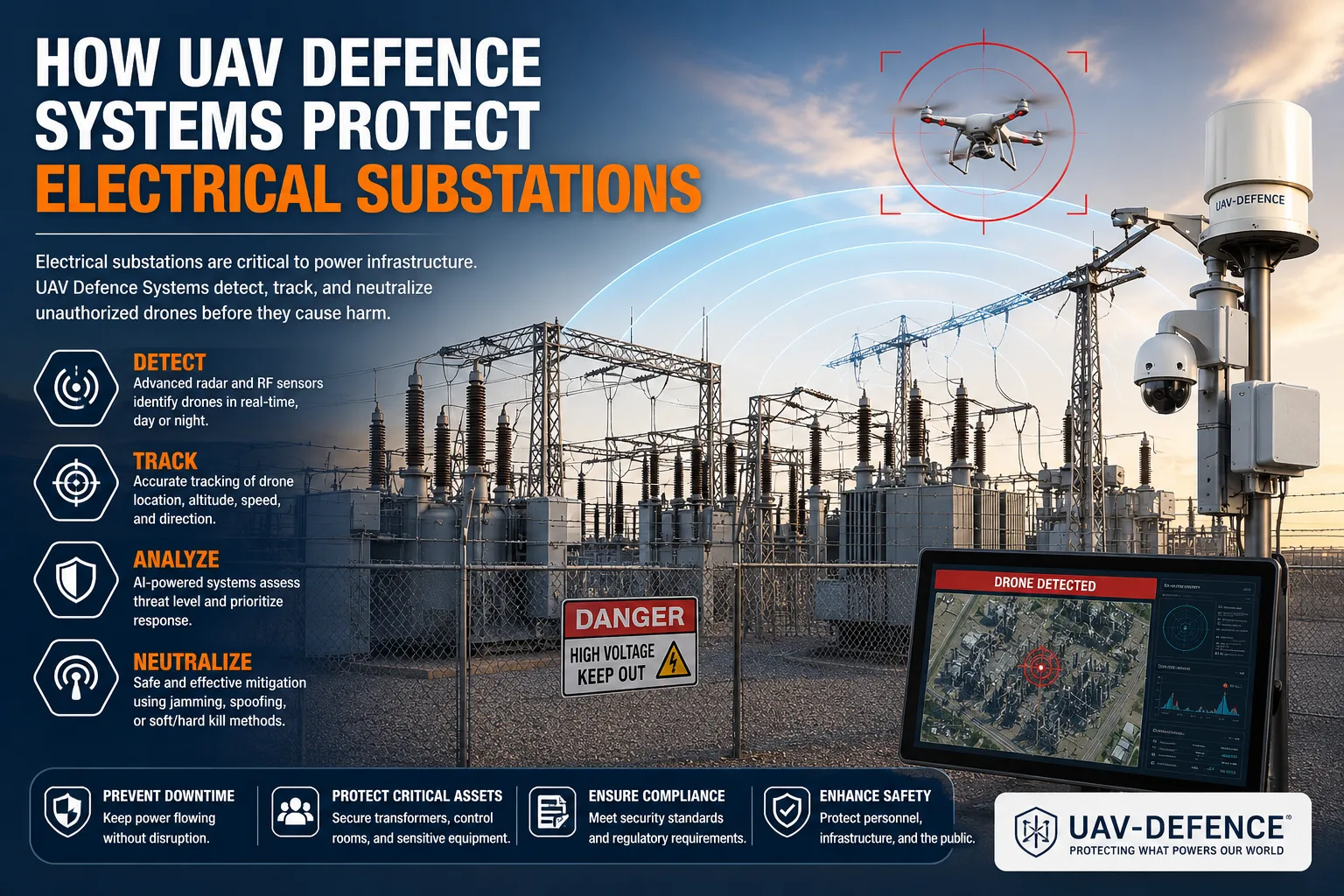
Electrical substations contain exposed equipment and infrastructure that is essential to electricity distribution. Unauthorised drones can be used for surveillance, disruption or to carry hazardous payloads, creating an aerial security concern for critical infrastructure.
Why Substations Need Drone Detection
A perimeter fence cannot prevent an aircraft approaching from above. UAV defence for electrical substations therefore needs an airspace layer that can detect an approaching drone before it reaches sensitive equipment.
Detection gives security personnel time to assess the aircraft, track its movement and follow site response procedures. Detection systems can use radar, radio-frequency, electro-optical, infrared or acoustic technologies, either separately or in combination.
How Radar Detects A Drone
Radar sends electromagnetic waves into the surrounding airspace and analyses the signals reflected by objects. Counter-UAS radar can provide information such as range, direction, altitude and movement, helping operators understand where a drone is going.
The term 'DJI drone radar' commonly refers to radar detection capable of detecting and tracking small commercial drones. Radar can be useful even when a drone is not detected through its control signals. UAV Defence lists dedicated UAV defence radar systems as part of its product range.
Why Radar Matters Around Electrical Equipment
Substations need awareness beyond the fence line. Radar can monitor surrounding airspace and provide early warning before a drone reaches transformers, switching equipment or other restricted areas.
Radar also works best as part of a wider detection architecture. UAV Defence provides radar and drone detection technologies, alongside systems designed to respond to unauthorised drone activity. The right combination depends on the site's layout and threat profile.
From Detection To Response
Detection is only one part of substation security. Once a drone is identified, security teams need a documented process covering verification, escalation and reporting.
Mitigation technologies may also be subject to aviation, communications and other legal requirements. CISA advises critical-infrastructure operators to use legally approved counter-UAS technologies and understand who has authority to take action.
For operators assessing UAV defence for electrical substations, start with a site-specific threat assessment. Consider the protected area, likely drone approach routes, required detection range and the authority available for response measures.
UAV Defence positions its C-UAS technologies for critical infrastructure applications, supporting an integrated approach to drone detection and response.
FAQs
Can Radar Detect Small Drones?
Yes. Radar can detect small low-altitude aircraft by analysing reflected electromagnetic signals, although performance depends on the system, environment and target.
Why Use Multiple Detection Technologies?
Different sensors have different strengths. Combining technologies can improve situational awareness and help address detection limitations.
Does Detection Automatically Stop A Drone?
No. Detection identifies or tracks a potential threat. Any mitigation action requires an appropriate response process and legal authority.
What Should Operators Assess First?
Start with the site's layout, surrounding airspace, likely threats, required detection range and applicable rules for response measures.