
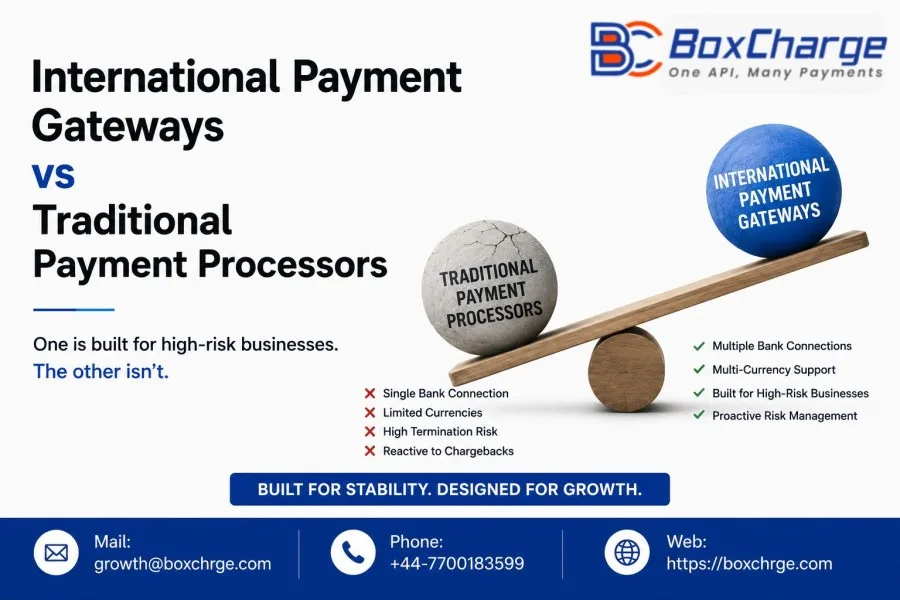
Traditional payment processors were never built for high-risk businesses. They were built for predictable merchants — clean chargeback records, stable industries, zero regulatory complexity. Not nutraceutical brands in Texas. Not adult platforms in the UK. Not CBD retailers in Colorado or gaming operators in Ontario.
If things feel stable on a mainstream processor right now, that's not because they understand your business — their algorithm just hasn't flagged you yet. That's the honest reality behind international payment gateways vs traditional payment processors, and why high-risk merchants across the US, UK, Canada, and Australia are switching before they're forced to.
What's the Actual Difference?
A traditional payment processor has an acquiring bank relationship with a dashboard on top. It works — until your chargeback ratio makes their risk team uncomfortable or your industry triggers a compliance review. Then they close your account. No warning. No appeal.
An international payment gateway for high-risk merchants is built differently:
- Multi-currency payment processing from day one — USD, GBP, CAD, AUD, EUR all from one account without separate acquiring relationships per country
- Upfront high-risk underwriting — compliance answered before approval, not flagged six months later by an automated system
- Chargeback management at the transaction level — real-time fraud scoring, 3D Secure, velocity checks on every payment, not in a monthly report after damage is done
- Multiple acquiring bank connections — if one bank tightens its risk appetite, volume reroutes, and your checkout stays live
A traditional processor is one lane. A high-risk payment gateway is infrastructure built for the traffic your business actually generates.
Where Traditional Processors Break Down
1: The approval that wasn't really one: A nutraceutical brand in California gets onboarded in 48 hours — no questions asked. Six months later, mid-Q4, the termination notice arrives. The processor never did real underwriting. Starting over cost them weeks of revenue they never recovered.
2: The cross-border wall: A UK subscription brand expands into Canada and Australia. Real cross-border payment processing at scale means separate high-risk merchant accounts per market, different compliance per jurisdiction, and settlement delays of three to five days. Customers in Sydney hit currency friction and leave. Faulty cross-border setups cost US merchants $3.8 billion in lost sales last year.
3: The reserve trap: A CBD retailer in Colorado hits $60,000 monthly. After a chargeback spike, the processor bumps the rolling reserve from 5% to 15% with no notice — $9,000 a month locked indefinitely.
What a Specialist Gateway Actually Changes
1: No single point of failure: A real high-risk payment gateway routes volume across multiple acquiring banks simultaneously. If one adjusts its risk policy, traffic reroutes — your checkout stays live.
2: Cross-border becomes a growth channel: A genuine international payment gateway for high-risk merchants handles multi-currency payment processing natively — Toronto in CAD, London in GBP, Melbourne in AUD — settled in your preferred currency without separate accounts per market.
3: Underwriting that fits your vertical: An offshore payment gateway or specialist international acquirer has worked your industry before. The underwriting is written around your actual numbers, not a generic template. Fewer terminations, more predictable reserves.
The Verticals Feeling This Most
- Nutraceuticals and supplements: domestic processors flag product claims fast; international acquirers with vertical experience don't
- Adult content platforms: mainstream processors have exited; a specialist high-risk payment gateway is the infrastructure, not a fallback
- CBD and hemp retailers: US federal vs. state legal complexity most domestic processors won't touch; the right international acquirer already has
- Online gaming and gambling: a proper international payment gateway handles multi-market licensing from one account
- Subscription businesses: chargeback rates climbed 59% in 2024; recurring billing needs processors built for it
Don't Wait for a Shutdown to Make the Switch
Every merchant who moves to a specialist international payment gateway for high-risk merchants says the same thing six months later — they wish they hadn't waited.
When you stop managing processor instability, you get your attention back. You scale. You run the business rather than defend it.
- Approval in 24–48 hours: underwritten by specialists who know your vertical
- Multi-currency, multi-market processing: US, UK, Canada, Australia, EU from one account
- No MATCH list barriers: we work with merchants others turn away
- Industry-specific underwriting: built around your risk profile, not against it
Every day you process on infrastructure that wasn't designed for your business is a day you're one flag away from starting over.
Apply for Your High-Risk International Payment Gateway Now. Takes minutes. No obligation. A real underwriter reviews your application — not a bot.
Frequently Asked Questions
Q: What is the difference between an international payment gateway and a traditional payment processor?
A traditional payment processor works through one acquiring bank, built for low-risk businesses. When numbers get uncomfortable, they terminate without warning. An international payment gateway for high-risk merchants connects to multiple acquiring banks, handles multi-currency payment processing across the US, UK, Canada, and Australia from one account, and includes built-in chargeback management from day one.
Q: Why do high-risk merchants need an international payment gateway?
Traditional processors terminate high-risk merchant accounts when risk flags appear — without notice. A specialist high-risk payment gateway is underwritten for your vertical upfront, distributes volume across multiple banks, and handles cross-border payment processing so you sell globally from one account.
Q: Can high-risk merchants accept payments from multiple countries through one account?
Yes. A properly built international payment gateway handles multi-currency payment processing — USD, GBP, CAD, AUD, EUR — from one merchant account. Settlement lands in your preferred currency with no separate accounts per market.
Boxcharge provides international payment gateway solutions and high-risk merchant services for businesses across the US, UK, Canada, and Australia — nutraceuticals, adult content, CBD, firearms, online gaming, and subscription billing.