If you've ever spotted "Jain-friendly" or "no onion, no garlic" on an Indian menu and wondered what it actually means, you're not alone. It's one of the most asked-about - and least understood - dietary traditions in Indian cooking. Jain food isn't a stricter version of vegetarian food; it's a completely separate culinary philosophy, built on centuries of religious discipline rather than modern dietary trends.
At Kalpna, Edinburgh's pure vegetarian Indian restaurant since 1975, we've prepared Jain-friendly dishes for decades. This guide walks through what makes food genuinely Jain, why the rules exist, and how to try it for the first time.
Where the Rules Come From
Jainism's core teaching is ahimsa - non-violence towards every living being, however small. Applied to food, this goes far beyond avoiding meat, fish and eggs. It also rules out root vegetables: onions, garlic, potatoes, carrots and beetroot.
The logic is precise, not arbitrary. Pulling up a root kills the entire plant and disturbs the microorganisms living in the soil around it. Picking a tomato or a handful of spinach leaves the plant alive. That distinction - harm to the whole organism versus harm to a part of it - sits at the centre of every Jain kitchen decision.
The discipline extends to timing too. Many practising Jains avoid eating after sunset, since cooking in low light risks harming insects too small to see, and some observe fasting days tied to the lunar calendar.
What Stays Off the Plate
- Onions, garlic and all root vegetables - potatoes, carrots, radish, beetroot
- Mushrooms - their growth pattern makes harm-free harvesting difficult, and some fungi are treated as a separate life form under Jain thought
- Meat, fish, eggs and honey - excluded under the same non-violence principle
- Alcohol - avoided for dulling awareness and self-restraint
None of this makes the food bland. Jain cooks have spent generations solving the flavour problem without onion or garlic, leaning on asafoetida (hing), ginger and a wider spread of greens and gourds to build the savoury base a dish needs.
The Jain Pantry
- Lentils and pulses - moong dal, chana dal and toor dal supply most of the protein
- Above-ground greens - spinach, fenugreek leaves, cabbage
- Gourds and squash - bottle gourd and pumpkin stand in for potatoes
- Asafoetida and ginger - the flavour engine that replaces onion and garlic
- Yoghurt - used in curries and served as a cooling side
Whole spices - cumin, coriander, mustard seed, turmeric - do the rest of the work, which is part of why Jain food shares real overlap with the wider health case for Indian spices health benefits.
Dishes Worth Ordering
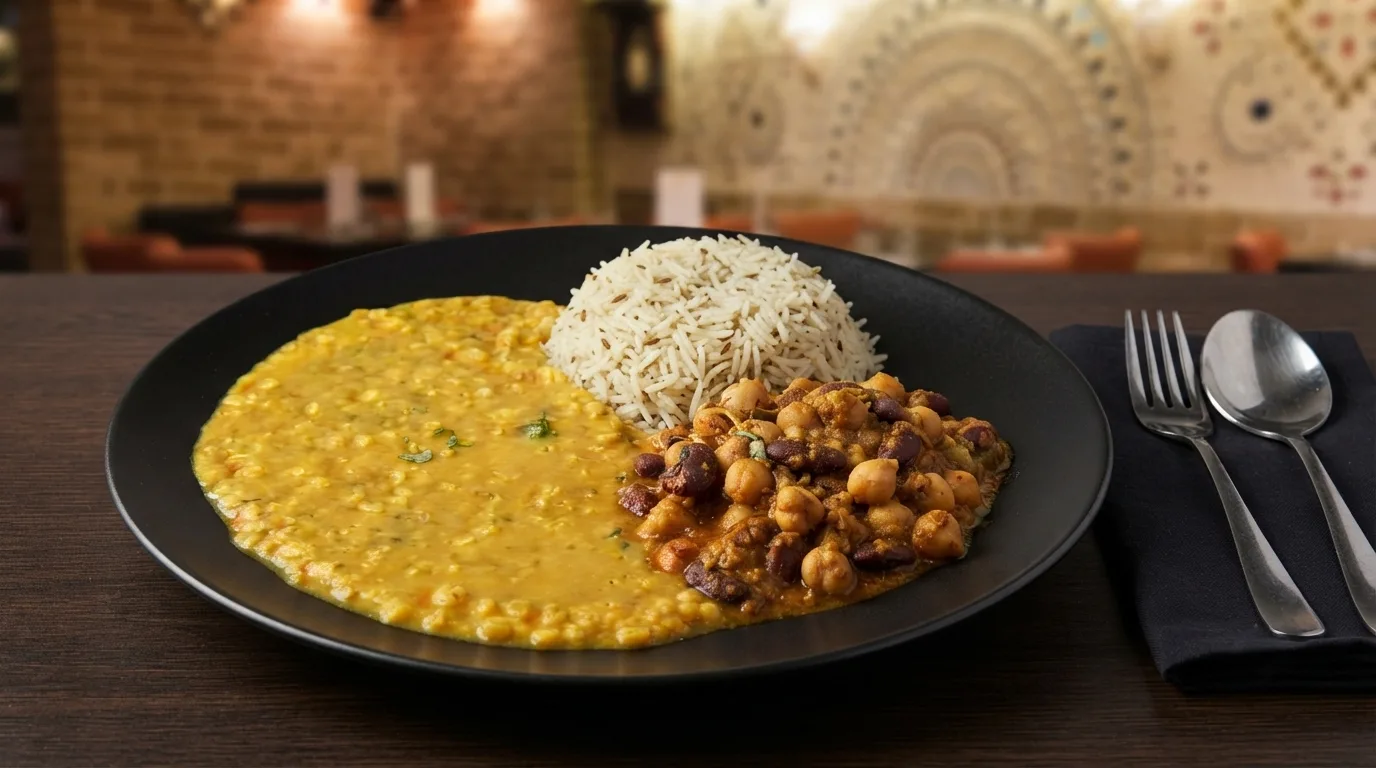
Jain Dal - a lighter, cleaner take on the familiar lentil dish, built on cumin, ginger and asafoetida instead of an onion base.
Jain Kadhi - a yoghurt and gram flour curry, tempered with mustard seed and curry leaf, served with rice.
Jain Sabzi - a broad category of dry-cooked vegetable dishes using gourds, beans or cabbage rather than potato.
Jain Khichdi - rice and lentils simmered soft and mild; the go-to dish during fasting periods because it's so easy to digest.
Jain Thali - the full spread: dal, a vegetable dish, rice, roti and a small sweet, all built without onion, garlic or root vegetables. It follows the same structure as any Indian thali Edinburgh diners already know, minus a few key ingredients.
Not Just "Vegetarian Minus Meat"
A common assumption is that Jain food is vegetarian food with the meat taken out. It isn't. A vegetarian and a Jain version of the same dish can look identical on the plate and still have a completely different ingredient list once onion, garlic and root vegetables are removed. It's a distinct culinary system with its own techniques - not a subtraction from another one.
Why It's Worth Trying, Jain or Not
Because the ingredient list is so limited, Jain cooking often gets more out of technique - careful tempering, layered spicing, building depth without the two ingredients most cuisines lean on hardest. Many dishes end up naturally light, easy to digest, and often vegan by default, since dairy is usually the only animal product involved and even that can be adjusted.
Ordering It With Confidence
- Just ask - most Indian kitchens, Kalpna included, will happily modify a dish to Jain standards on request
- Start with a thali - the easiest way to taste several dishes in one sitting
- Expect subtlety - without onion and garlic, the flavour is cleaner and more delicate, not louder
- Pair it simply - a light yoghurt drink or dal suits the meal best
Fasting Season and Jain Discipline
The discipline is most visible during Paryushan, an annual period of fasting and reflection. Many observant Jains reduce to one meal a day, drop leafy greens on top of the usual restrictions, and rely on the simplest dishes - plain khichdi, a thin dal - for the entire period. It's a good reminder of why technique matters so much in Jain cooking: restriction, sustained over generations, forces real skill.
Try It in Edinburgh
Kalpna has served Edinburgh's vegetarian and Jain communities since 1975, and adapting dishes to Jain requirements has always been part of how the kitchen runs. If you're exploring plant based eating Scotland more broadly, Jain cuisine is one of the most disciplined and rewarding starting points on the menu.
Book a table Edinburgh vegetarian diners have trusted for decades, and let us introduce you to Jain cooking done properly.
Frequently Asked Questions
Q: What makes food Jain rather than just vegetarian?
A: It follows ahimsa - non-violence to all living beings - which rules out root vegetables like onion, garlic and potato on top of the usual meat, fish and egg restrictions.
Q: Why no onion or garlic?
A: Harvesting a root kills the whole plant and disturbs the soil ecosystem around it. Above-ground vegetables can be picked while the plant survives.
Q: Is Jain food vegan?
A: Mostly. Dairy is the main animal product that appears, and it's often adjustable or already absent.
Q: Can a restaurant make a regular dish Jain-style?
A: Yes - most Indian kitchens, including Kalpna, will prepare dishes without onion, garlic or root vegetables on request.
Q: What's the best first dish to try?
A: A Jain thali - it gives you dal, a vegetable dish, rice and roti in one sitting.
Q: Where can I try authentic Jain food in Edinburgh?
A: Kalpna, which has served Jain-friendly dishes as part of its vegetarian menu since 1975.