A pharmaceutical distributor in Nairobi gets a shipment of antimalarial tablets from his usual supplier. Everything looks fine. The paperwork is in order. The medicines are authentic. He starts selling to hospitals and pharmacies. Three weeks later, he gets a call from someone at one of his pharmacy clients. They've just been inspected by KEBS and told that the antimalarial they're stocking doesn't meet Kenyan standards for dissolution rate. The pharmacy gets a warning. The distributor gets questions he can't answer about why he's selling products that don't meet KEBS requirements.
He never knew KEBS had specific standards for that medication. He thought as long as the medicine was authentic and from a legitimate manufacturer, it was fine for Kenya. Turns out, that's not how it works.
This kind of surprise inspection happens more often than most distributors want to admit. KEBS — the Kenya Bureau of Standards — has detailed technical specifications for pharmaceutical products, and many distributors, pharmacies, and even some healthcare facilities aren't fully aware of what those standards require.
What KEBS Actually Does
The Kenya Bureau of Standards is a government organization responsible for developing and implementing standards across multiple sectors in Kenya, including pharmaceuticals. They're not the same as the Pharmacy and Poisons Board, even though their work overlaps sometimes. KEBS focuses on product specifications and quality standards. PPB focuses on licensing and regulatory approval.
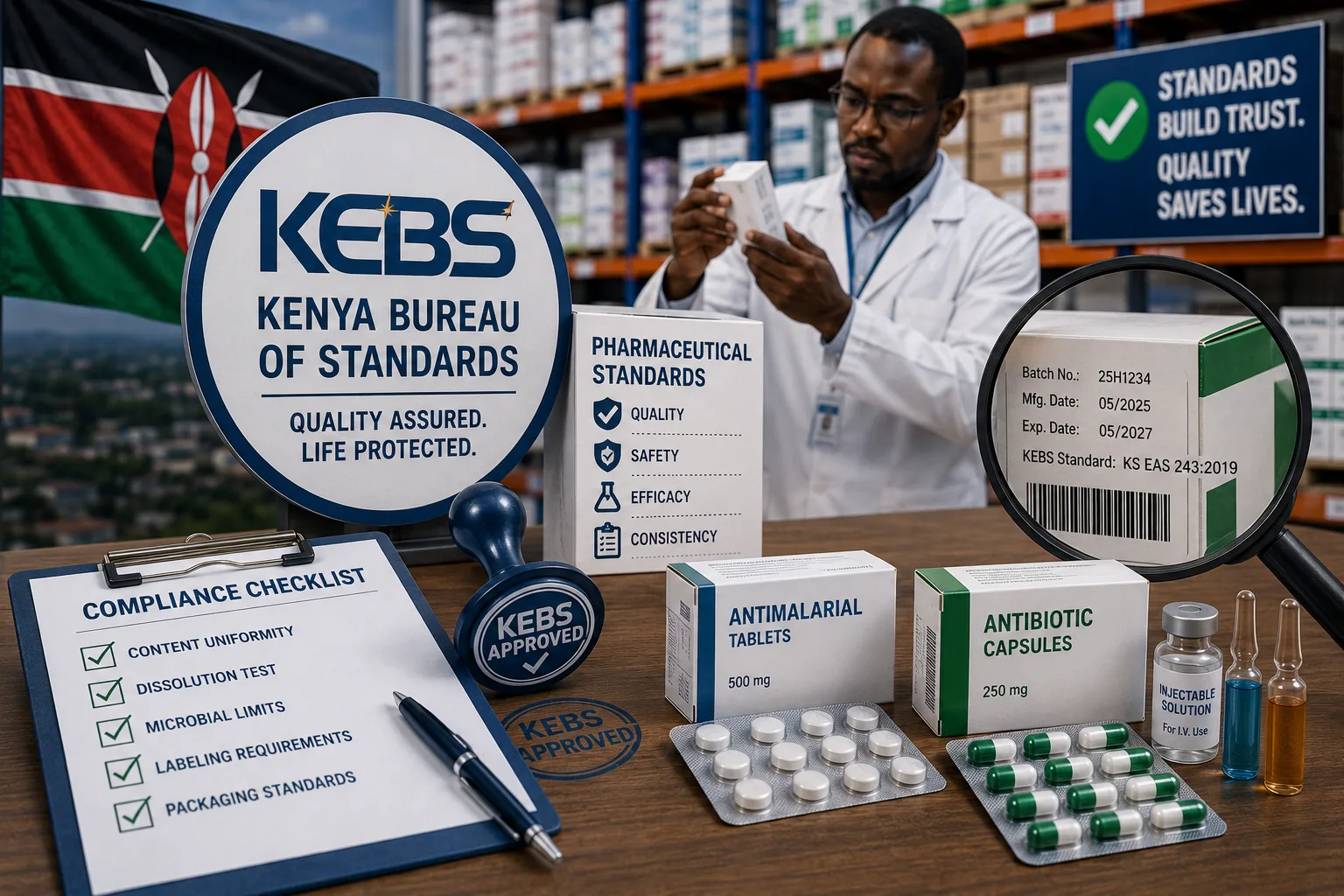
KEBS publishes standards for specific medicines and medicine categories. These standards are detailed. They specify things like:
Content uniformity — how consistent the active ingredient amount is from tablet to tablet or dose to dose. If a standard says tablets must contain 500mg of a drug with no more than 10 percent variation, that's a KEBS specification.
Dissolution rates — for tablets and capsules, how quickly they dissolve in simulated body fluids. A tablet that doesn't dissolve properly won't be absorbed correctly. KEBS specifies acceptable dissolution parameters for different medicine types.
Microbial limits — acceptable levels of bacteria, fungi, and other microorganisms in products, especially important for injectable medicines and those used in vulnerable populations.
Physical properties — hardness, friability (tendency to crumble), color stability. A tablet shouldn't fall apart when handled, and colors shouldn't fade or change unexpectedly.
Packaging and labeling — specific requirements for how medicines are packaged, what information must appear on labels, warning labels, storage instructions. This is where a lot of distributors actually get tripped up because label requirements in the manufacturer's country don't always match Kenya's requirements.
KEBS publishes these as Kenya Standards (KS) documents. There are hundreds of them, covering everything from aspirin to antibiotics to herbal preparations.
Why This Matters for Distributors
Here's the practical reality: if you're distributing pharmaceutical products in Kenya, you need to ensure they meet KEBS standards. Not just regulatory approval, not just pharmaceutical quality — KEBS standards specifically.
Why? Because healthcare facilities, pharmacies, and even individual consumers are increasingly aware of KEBS standards. When KEBS conducts facility inspections — which they do, routinely — they're checking whether the products being stocked meet published standards. If a facility is found stocking medicines that don't meet KEBS requirements, they can face fines, warnings, or in serious cases, closure.
For a distributor, that means your client facilities are now asking you whether your products meet KEBS standards. And you need to be able to say yes with confidence, backed by documentation.
The Practical Compliance Challenges
Knowing KEBS standards exist and actually implementing compliance are two very different things.
Finding current standards is the first challenge. KEBS publishes standards, but they're not always easy to access or track. There are hundreds of them. They get updated periodically. A distributor needs to know which standards apply to which medicines and whether current products meet those standards. This requires actual research — checking KEBS publications, contacting suppliers, requesting test certificates from manufacturers.
Supplier coordination is huge. As a distributor, you don't manufacture medicines — you source them. So you depend on your suppliers to ensure their products meet KEBS standards. But not all suppliers think about KEBS requirements for the Kenyan market specifically. Some manufacturers produce to their home country's standards or to international standards, which may not perfectly align with KEBS requirements.
This is why a distributor needs suppliers who understand Kenya's specific requirements. A manufacturer in India might produce medicines that meet Indian standards and WHO standards without necessarily meeting Kenya-specific KEBS requirements. Same medicine, different standards, potential compliance gap.
Labeling and packaging cause more problems than people expect. A medicine that meets the active ingredient standard might have a label that doesn't meet KEBS labeling requirements. Storage instructions might be in the wrong format. Batch numbers might not be positioned where KEBS expects them. Some distributors repackage or relabel medicines, which creates additional compliance responsibility — the relabeled product now needs to meet KEBS standards too.
Documentation burden is real. Healthcare facilities increasingly want proof that products meet KEBS standards. That means test certificates, manufacturing documentation, anything showing the product was tested and meets requirements. If you can't provide that documentation, facilities get nervous about stocking your products.
How Competent Distributors Actually Handle This
The ones navigating this successfully have a system.
They maintain an inventory of applicable KEBS standards — literally, a list of which KS documents apply to which medicines they distribute. When they're adding a new product, they check: what KEBS standard applies? Do we have a copy? What are the requirements?
They work with suppliers who can provide test certificates. Before ordering from a new supplier, they ask: "Can you provide test certificates proving your products meet Kenya's KEBS standards?" If the supplier can't or gets evasive, they move on. If they can, that's a huge advantage because now the distributor has documentation.
They maintain communication with their suppliers about Kenya-specific requirements. Instead of just ordering and receiving, they actively discuss compliance. "This shipment is for Kenya, so it needs to meet KS [standard number]. Can you confirm your batch meets that?" It's one extra conversation that prevents problems later.
They track updates to standards. KEBS updates standards periodically. A responsible distributor monitors those updates and ensures they're stocking products that meet current requirements, not outdated ones.
They educate their clients. When selling to hospitals or pharmacies, they communicate about KEBS compliance. "This product meets KEBS standard KS [number]. Here's documentation." It builds confidence and protects both the facility and the distributor if an inspection happens.
The Supplier Relationship Angle
Here's where supplier quality matters. A supplier who understands Kenya's market and KEBS requirements is worth paying a bit more for.
Someone supplying the Kenyan market from overseas needs to understand that Kenya has specific pharmaceutical standards. They need to either source medicines that already meet those standards or have processes in place to verify compliance. They need to understand labeling requirements. They need to be responsive when a distributor asks about KEBS compliance.
When you're looking for reliable suppliers for your Kenyan pharmaceutical distribution business, seeking out exporters who actively engage with Kenya-specific standards and can demonstrate KEBS compliance documentation is a smart approach. Resources highlighting established pharmaceutical exporters with proven Kenya market experience can help you identify suppliers who understand these requirements and have built compliance into their operations, rather than treating it as an afterthought.
What Happens When You Don't Comply
The consequences of non-compliance are real, though they often sneak up on distributors.
A healthcare facility gets inspected by KEBS and finds products that don't meet standards. The facility gets flagged. If it's serious, they might be directed to remove the products from shelves. The facility then calls the distributor wanting to know why they were sold non-compliant products. The distributor's relationship with that facility is damaged.
If KEBS traces the non-compliant products back to the distributor, the distributor themselves can face regulatory action — fines, license suspension, loss of business.
Beyond the regulatory consequences, there's the market consequence. When word gets around that a distributor is selling non-compliant products, healthcare facilities stop trusting them. Finding new clients becomes harder. Existing relationships get strained.
Moving Forward
The reality is that KEBS compliance isn't optional if you want to distribute pharmaceuticals sustainably in Kenya. It's not something you can half-do or ignore and hope nobody notices.
What's required is understanding which KEBS standards apply to your product portfolio, working with suppliers who can demonstrate compliance, maintaining documentation, and staying informed about standard updates.
It's not the most exciting part of pharmaceutical distribution. Nobody goes into this business dreaming about managing KEBS compliance documentation. But it's the framework that determines whether you can operate legally and maintain your relationships with healthcare facilities.
The distributors thriving in Kenya's market right now aren't necessarily the ones with the cheapest products. They're the ones who've built systems ensuring everything they sell meets applicable KEBS standards. They've educated their suppliers. They've trained their sales teams. They can walk into a healthcare facility and confidently say, "Everything we're selling you meets KEBS requirements, and here's the documentation to prove it."
That's what separates distributors who hit unexpected compliance walls from ones who operate smoothly. And in a market where healthcare facilities are getting serious about standards compliance, that difference matters more every year.