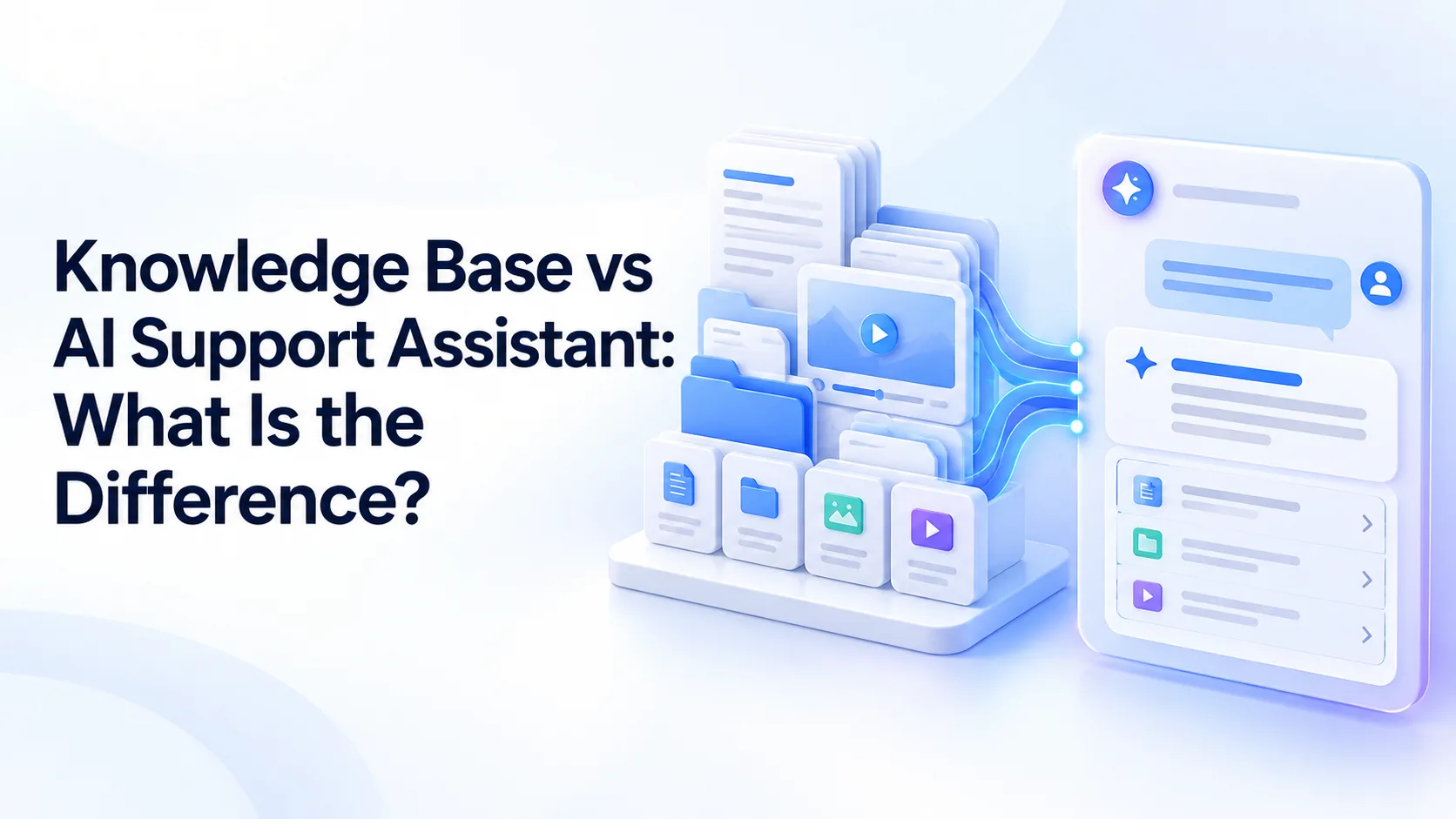
A knowledge base and an AI support assistant can both help customers find answers without contacting a support agent. However, they provide different ways of accessing information.
A knowledge base organizes approved content into articles, guides, FAQs, videos, and reference pages. Customers search or browse this content and decide which resource answers their question.
An AI support assistant accepts a question in natural language, searches available sources, and presents a direct response. It may also point users to the article, document, or video that supports the answer.
These systems can work independently, but they are generally more useful when connected.
What Is a Knowledge Base?
A knowledge base is a structured collection of information about a product, service, or internal process. It usually includes setup instructions, troubleshooting guides, policy explanations, product documentation, and answers to common questions.
Content is commonly organized by topic, product area, audience, or task. Customers can browse categories or enter keywords into a search bar.
A well-maintained knowledge base gives the organization control over what information is available. Writers and subject experts can review each resource, update it after product changes, and assign ownership.
A knowledge base can include several content formats. Written articles may explain exact steps, while videos can demonstrate processes that are easier to understand visually. Teams using Cincopa can organize support and training videos into galleries or portals and connect them with their written documentation.
The customer still needs to find the correct resource and interpret the information.
What Is an AI Support Assistant?
An AI support assistant provides a conversational way to access support knowledge.
Instead of browsing categories or trying several keywords, a customer can ask a complete question such as, “Why can’t the user I invited access the project?” The assistant then searches its available sources and produces a relevant response.
Depending on the system, the answer may be based on help-center articles, product documentation, PDFs, video transcripts, metadata, or other approved materials.
Cincopa’s VideoGPT, for example, can help users ask questions across available library content. This can include videos, PDFs, titles, descriptions, chapters, tags, approved summaries, and transcripts. When suitable source information is available, the response can guide the user toward a relevant recording or resource.
The assistant does not replace the need for accurate content. Its answer depends on the quality, relevance, and currency of the information it can access.
Knowledge Base and AI Support Assistant Compared
AreaKnowledge baseAI support assistantMain interactionSearch and browseAsk a questionTypical responseArticles, videos, or documentsA generated answer with relevant sourcesUser effortUser selects and interprets contentAssistant identifies and summarizes relevant informationContent controlEditors publish approved resourcesAssistant works from connected sources and instructionsBest suited forDetailed guidance and referenceFast answers and content discoveryMain limitationUsers may not know the right terminologyAnswers may be incomplete if source content is weakMaintenance needUpdate articles and mediaUpdate sources and review answer qualityThe two approaches solve related problems. A knowledge base stores and structures information, while an AI assistant changes how people reach that information.
Search and Conversation Are Different Experiences
Traditional knowledge-base search usually depends on keywords. If a customer searches for the terms used in an article title, the correct result may appear immediately.
Problems arise when customers use different language. A support team might call a feature “workspace permissions,” while customers ask how to control who can open a project.
An AI assistant can interpret the intent behind a natural-language question and connect it with content that uses different terminology. This can reduce the need for customers to guess the correct search phrase.
Cincopa combines conventional organization through libraries, galleries, and metadata with VideoGPT’s question-based access. Customers can browse content when they know what they need or ask a question when they do not know where the answer is stored.
Both methods remain valuable. Browsing is useful when someone wants to explore related resources, while conversation is useful when the person has a specific question.
The Knowledge Base Remains the Source
An AI support assistant needs dependable source material. Without it, the assistant may provide a vague answer, miss an important condition, or respond using outdated information.
The knowledge base should therefore remain the controlled layer where teams maintain approved facts, procedures, policies, and explanations. Content owners need to review materials after product changes and remove obsolete guidance.
This includes recorded knowledge. A support video can remain searchable long after its interface or instructions become outdated. If VideoGPT or another assistant uses that recording, the age of the content becomes part of answer quality.
Teams using Cincopa should give important videos clear titles, descriptions, owners, and review dates. Approved summaries can provide additional context, especially when a transcript contains specialized terminology that requires human review.
AI makes knowledge easier to access, but it does not remove the need for content governance.
AI Assistants Can Connect Different Formats
A traditional help center may separate articles, PDFs, and video libraries. Customers may search one system without realizing that the answer is stored in another.
An AI support assistant can create a more unified entry point when it has access to several approved formats. A question might be answered using a written procedure, supported by a PDF, and connected to a video demonstration.
This is relevant for Cincopa because VideoGPT can work across multiple types of library information. A customer asking how to complete a task may receive an answer connected to both written and recorded knowledge, depending on what sources are available.
Video adds visual context, while documents provide details that are easier to scan or copy. An effective assistant should direct the customer to the format that best supports the task.
When a Knowledge Base Works Better
Some customers prefer to browse and read complete documentation. They may want to understand a topic in depth, compare related options, or confirm an exact policy.
Written knowledge-base articles are also well suited to commands, configuration values, error-code references, legal information, and procedures that users must follow precisely.
A complete article allows readers to see prerequisites, exceptions, warnings, and escalation instructions together. An AI response may summarize the most relevant part, but the underlying article remains useful as the full reference.
Knowledge bases also provide a stable destination that support agents can link to in emails and chat conversations.
When an AI Support Assistant Works Better
An AI assistant is helpful when customers know their problem but do not know how the organization describes it.
It can also help with large content libraries. As the number of articles, videos, and documents grows, browsing becomes more difficult. Several resources may appear relevant, and customers may not know which one contains the answer.
With Cincopa VideoGPT, a user can ask a question across the available library instead of manually opening multiple videos or documents. When a timestamped transcript is available, the system can direct the user toward the relevant spoken moment in a recording.
This can be useful for support portals, training libraries, product education collections, and internal knowledge resources.
Some questions will still require a person. Account-specific problems, security concerns, billing disputes, and cases requiring system logs may need access or judgment beyond the assistant’s sources.
Why Source Transparency Matters
Customers should be able to understand where an AI-generated answer came from.
A response is more useful when it links to the related article, document, or video. The customer can check the full instructions, review additional context, and decide whether the source matches their situation.
For video answers, a link to the relevant recording or moment is more useful than a general link to a large library. Cincopa can connect answers with source videos, while transcripts provide timestamp information needed for precise spoken-moment references.
If an answer cannot be supported by the available content, the assistant should say that clearly and provide an escalation path. A confident unsupported answer can create more support work than no answer at all.
How the Two Systems Work Together
A practical support setup uses the knowledge base as the maintained source and the AI assistant as an access layer.
The knowledge base stores approved articles, videos, PDFs, and troubleshooting guides. The AI assistant helps customers reach the relevant information using natural questions.
In a Cincopa-based video knowledge library, teams can organize recordings, add metadata and transcripts, connect supporting documents, and allow VideoGPT to use the approved content. Customers can browse the library or ask a direct question.
Support teams can also study unanswered questions and weak search results. These gaps may reveal that an article is missing, a video needs clearer metadata, or the product itself is creating repeated confusion.
Measuring Their Effectiveness
A knowledge base is often measured through article usage, search success, feedback, and ticket deflection. An AI assistant may also be evaluated through answer relevance, source usage, unanswered questions, escalation rates, and customer satisfaction.
Neither system should be judged only by activity. A heavily viewed article may still be confusing, and a frequently used assistant may still provide incomplete answers.
For Cincopa content, video engagement and VideoGPT question patterns can help teams understand what customers are looking for. These signals should be considered alongside support tickets and successful task completion.
The strongest result is that customers receive an accurate answer, understand what to do next, and complete the task without unnecessary effort.
Final Thoughts
A knowledge base stores and maintains support information. An AI support assistant provides a conversational way to retrieve and apply that information.
A knowledge base offers structure, control, and complete reference material. An AI assistant can reduce search effort and connect questions with relevant content across different formats.
Cincopa can support both parts of this model for video-centered knowledge. Teams can organize and manage support recordings and documents, while VideoGPT helps users ask questions across the available library.
The quality of the experience still depends on accurate sources, clear ownership, regular updates, and transparent links between answers and the content that supports them.