The automotive thermal chain has changed more in the last two decades than in the previous fifty years. Air conditioning, battery cooling, charge-air cooling, oil cooling, and cabin comfort no longer sit in isolated compartments; they are expected to share packaging space, reduce vehicle mass, and deliver higher efficiency under stricter emission and range targets. Within this mobility shift, the aluminum multi-channel tube has emerged as a natural candidate for auto air-conditioning and related heat-transfer hardware because it combines a flat rectangular extruded profile with multiple internal channels, creating stronger heat transfer per unit volume while remaining lightweight and corrosion-resistant. For light vehicles in particular, where every kilogram affects consumption and handling, the ability to specify an aluminum multi-channel tube in condensers and evaporators is not a marginal improvement but part of the structural thermal strategy.
In parallel, the aluminum micro-channel tube answers the same mobility challenge from the perspective of precision and braze-ready manufacturing. The micro-channel product family—often discussed alongside multi-port extrusion—provides finely divided passages in a flat aluminum body, with controllable wall thickness, width, and coating systems. According to CHAL’s product context, such tubes can be supplied with zinc spraying or flux coating, features that matter enormously in automated furnace brazing where consistency decides yield. An aluminum micro-channel tube therefore helps automotive tier suppliers move toward all-aluminum coils and parallel-flow condensers that are easier to recycle, lighter to mount, and more thermally responsive than legacy copper-and-aluminum hybrids.
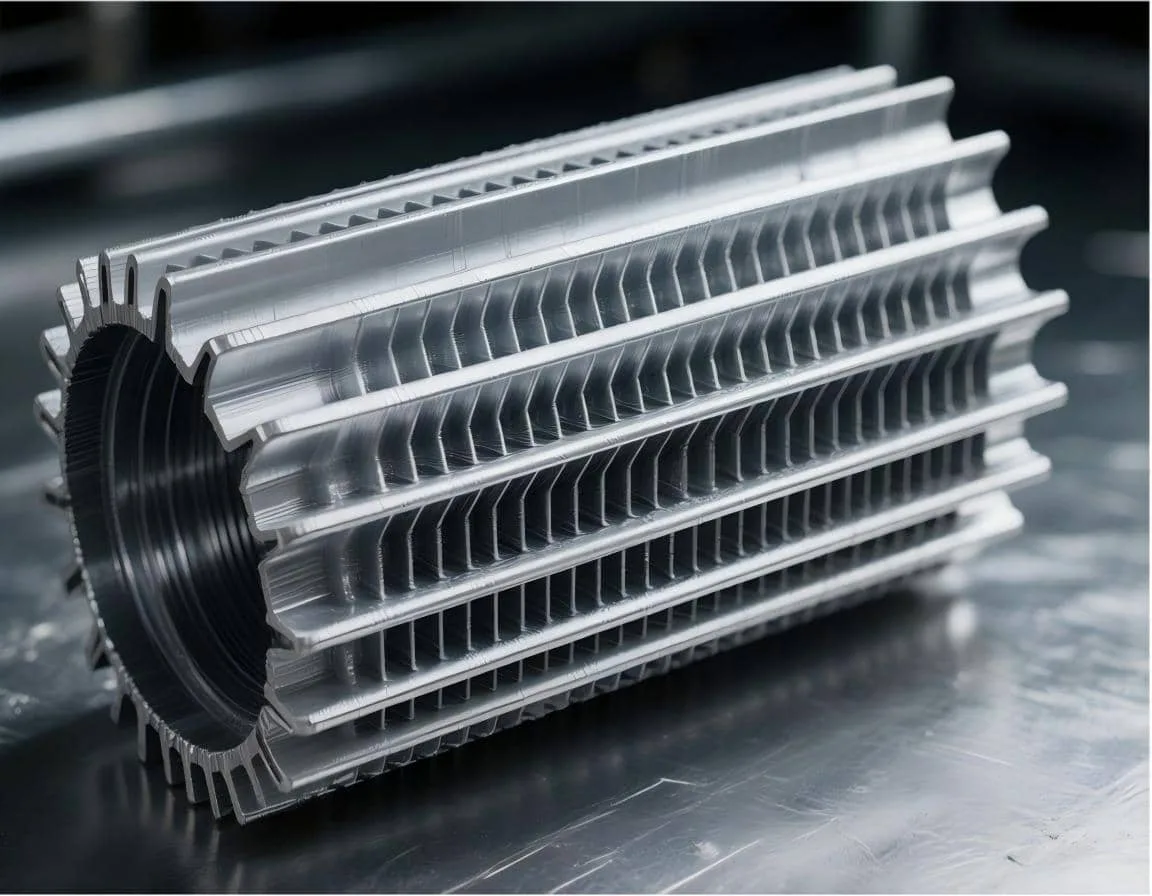
Yet automotive platforms are rarely uniform. A passenger car may use compact brazed modules under the hood, while a commercial roof-unit, a refrigerated van, or a stationary workshop conditioner may prefer extended-surface construction. Here the aluminum finned tube becomes relevant because it converts a base tube into a high-area radiator element. The aluminum finned tube increases external surface dramatically, supports firm fin-to-tube contact, and suits applications such as air coolers, condensers, evaporators, and industrial coils that feed from the same thermal competence base. Even when the headline project is vehicle lightweighting, support equipment and ancillary loops often benefit from finned aluminum because the heat rejection duty is air-side dominated.
What makes this trio compelling for mobility engineers is that the materials story is consistent across all three. Aluminum is easy to form, compatible with many fin stocks, and capable of good mechanical behavior in compact sections. An aluminum multi-channel tube gives designers flatness, thin walls, and the option of special shapes such as sharp-corner, internal-tooth, zinc-sprayed, conjoined, or intercooler flat pipes; an aluminum micro-channel tube pushes the internal geometry even finer for maximum compactness; and an aluminum finned tube answers the external-area problem with solid, serrated, or custom fin formats. The designer does not have to change metal systems between subsystems—instead, the project can remain inside one aluminum engineering language.
Another mobility advantage is assembly simplification. Multi-port products reduce the number of joints compared with assembled round-tube headers in certain designs, and micro-channel coils can integrate brazed fin paths more directly. Meanwhile, an aluminum finned tube can reduce joint count relative to bare-tube banks in some stationary or semi-mobile installations, lowering leak risk and accelerating mounting. For automotive programs where validation cycles are long and warranty exposure is serious, the ability to cite predictable aluminum behavior—low density, adequate strength, stable oxidation, non-toxic oxide under normal duty, and established extrusion or finning processes—helps the whole specification survive from prototype to production.
Looking forward, electric drivetrains will only deepen this direction. Battery thermal management needs flat, repeatable, lightweight distribution; cabin systems still need efficient condensing and evaporating; and front-end modules must reject more heat in less space. The aluminum multi-channel tube, the aluminum micro-channel tube, and the aluminum finned tube each represent a different scale of answer to the same question: how to move thermal energy out of or into a moving machine without paying a heavy mass penalty. CHAL’s emphasis on varied sizes, alloys, coatings, and fin configurations suggests that the future of automotive thermal management will be less about a single heroic component and more about orchestrating these aluminum tube types into one coherent, recyclable, and manufacturable mobility platform.
Lightweight Mobility and Automotive Thermal Management with Aluminum Tubes
The automotive thermal chain has changed more in the last two decades than in the previous fifty years. Air conditioning, battery cooling, charge-air cooling, oil cooling, and cabin comfort no longer sit in isolated compartments; they are expected to share packaging space, reduce vehicle mass, and d