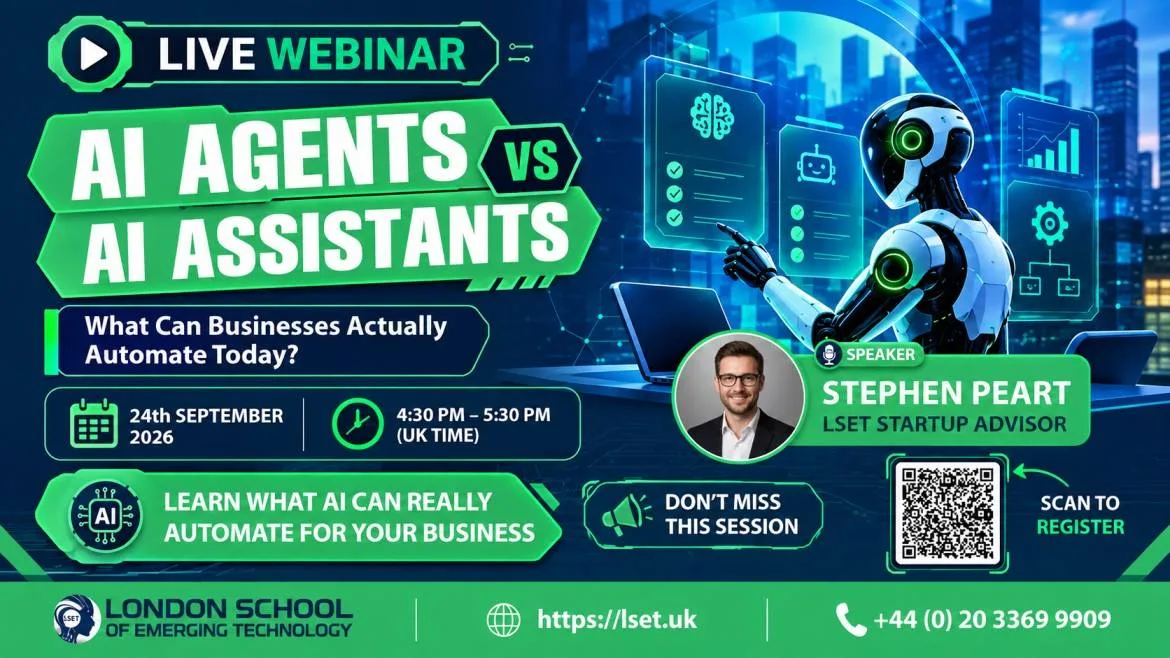
LONDON, UK — September 2026 -Artificial intelligence is changing the way businesses approach everyday work. From customer support and marketing to data handling and internal operations, organisations are looking at ways to use AI not only to assist employees but also to support complete business workflows.
Against this backdrop, the London School of Emerging Technology (LSET) is focusing on a practical question through its new session, “AI Agents vs AI Assistants: What Can Businesses Actually Automate Today?”
The session looks at the growing difference between AI assistants, which primarily support people with individual tasks, and AI agents, which can be designed to work through defined business processes and carry out multiple connected actions.
From AI Assistance to Business Automation
AI assistants have quickly become part of professional workflows. Employees can use them to draft emails, summarise documents, organise information, generate ideas and support research.
An AI agent approaches the process differently. Instead of waiting for a person to provide every instruction, an agent can be designed around a particular objective and, where appropriate permissions are provided, work with connected tools and systems to complete several steps.
For a business, that distinction can be important.
A sales employee, for example, might ask an AI assistant to prepare a follow-up email after speaking with a potential customer. In a more automated workflow, an AI agent could potentially receive a new enquiry, gather approved information, prepare a response, update a CRM record and create a follow-up task.
The exact level of automation depends on the organisation, its systems and the controls it puts in place. The larger point is that AI is increasingly being considered as part of the workflow itself rather than only as a tool for generating answers.
Where Businesses Are Looking at AI Automation
The potential applications of AI automation extend across different areas of an organisation.
Businesses exploring AI Agents vs AI Assistants may consider AI-supported workflows for:
- Customer enquiries and support requests
- Sales and lead management
- Marketing operations
- Document and information processing
- Research and reporting
- Internal administrative work
- Data organisation
- Repetitive workflow management
The choice between an AI assistant and an AI agent depends on the task.
When an employee needs help with writing, research or decision preparation, an assistant may be appropriate. When a process contains several repeatable steps that can be clearly defined, an agent-based approach may offer another option.
Building the Right AI Skills
Understanding these technologies also requires people who can work comfortably with artificial intelligence and related technologies.
LSET provides learning opportunities around emerging technology, including its Artificial Intelligence course, which can be explored by professionals and learners interested in developing their understanding of AI.
Explore LSET's Artificial Intelligence course:
As AI becomes increasingly connected with automation, data and software systems, knowledge of related technologies can become useful for people looking to build or advance their careers in this area.
Connecting AI with Machine Learning
AI agents are part of a much wider technology landscape that includes artificial intelligence, machine learning and automation.
Machine learning provides systems with methods for learning patterns from data and making predictions or classifications. When combined with other technologies, these capabilities can support applications across areas such as business analysis, intelligent automation and decision support.
LSET also provides resources focused on Robotic AI and Machine Learning, giving learners and technology professionals another area to explore within the broader AI ecosystem.
Explore the AI and Machine Learning resource:
AI Skills and the Changing Career Landscape
The development of AI is also changing the skills expected across technology-related roles.
Professionals working with data, software, automation and digital systems are increasingly encountering AI-powered tools in their work. For people planning their next career step, understanding how technologies such as AI and machine learning are being applied can help them identify areas for further learning.
LSET has also explored this subject through its resource on advancing a career with AI courses and opportunities in the evolving machine-learning landscape.
Human Oversight Remains Important
Greater automation does not mean that every business process should be handed completely to an AI system.
Businesses still need to decide what an AI system can access, which actions it can perform and when a person should review its work. This becomes particularly important when workflows involve sensitive information, financial activity, customer decisions or other situations where an incorrect action could have significant consequences.
A practical approach is to identify repetitive tasks first, determine which steps can be automated and keep people involved at points where judgement or approval is required.
This can allow businesses to benefit from automation without treating AI as a replacement for every human decision.
Choosing the Right Use Case
For organisations considering AI agents, the first step does not necessarily need to be selecting a particular AI platform.
The process can begin with a simple question: Which business activity takes time because employees repeatedly perform the same steps?
Once a company identifies that process, it can examine whether AI assistance, workflow automation, or an AI agent could provide useful support.
The results can then be measured through practical indicators such as processing time, manual workload, response time or the number of repetitive tasks completed.
This approach keeps the focus on the business problem rather than on technology for its own sake.
LSET's Role in Emerging Technology
The London School of Emerging Technology (LSET) focuses on education and learning around emerging technologies and digital skills. Its resources cover areas connected with artificial intelligence, machine learning and other technology-driven developments.
The discussion around AI agents and AI assistants forms part of a wider conversation about how organisations can use emerging technologies in practical workplace situations.
Looking Ahead
The difference between an AI assistant and an AI agent is ultimately about more than terminology.
An assistant can help a person complete a task. An agent can potentially become part of a defined workflow and carry out a sequence of actions within established boundaries.
As businesses continue to experiment with AI, understanding this difference can help organisations think more carefully about where automation makes sense, where human involvement is required and what skills employees need for an increasingly technology-driven workplace.
LSET's focus on AI Agents vs AI Assistants brings these questions into the wider discussion around business automation and the future of work.
About London School of Emerging Technology
The London School of Emerging Technology (LSET) is an education and technology-focused organisation providing learning resources and programmes around emerging technologies and digital skills.
London School of Emerging Technology (LSET)
London, United Kingdom
Website: https://lset.uk/