The Hidden Cost of Saving Money on Marine Parts
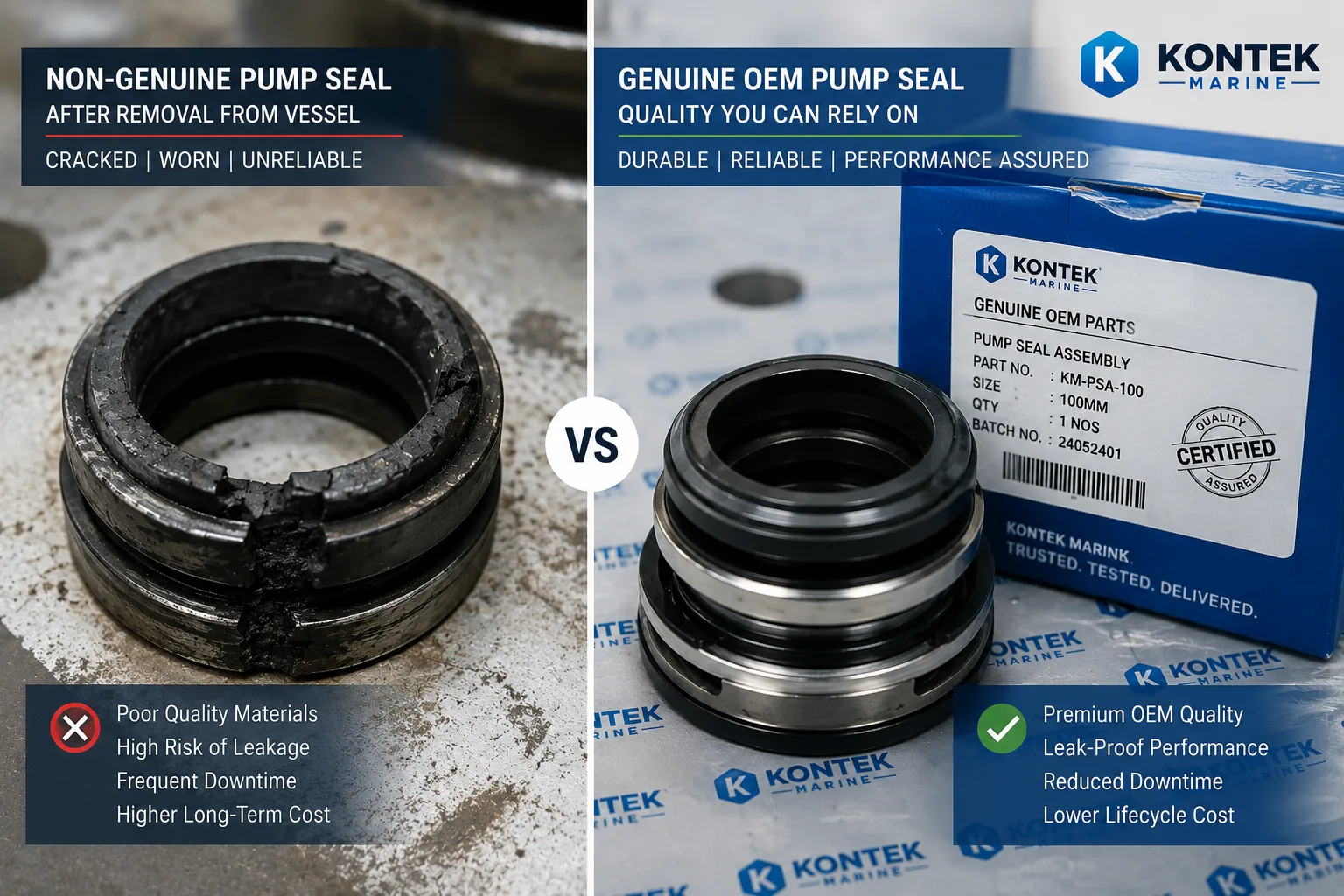
A non-genuine seal that fails inside a main engine cooling pump does not cost the price of the seal. It costs the engine overhaul, the off-hire time, and the implications at the next class survey expenses that can run fifty to a hundred times the value of the original component. Fleet managers who have worked through that calculation once rarely look for the cheapest option twice.
Choosing a verified Marine Spare Parts Supplier who stocks genuine OEM components and keeps them clearly separated from compatible alternatives is the most straightforward form of risk management available in vessel maintenance procurement. Kontek Marine — verified Marine Spare Parts Supplier in India operates on exactly that principle, supplying certified parts to vessel operators, shipping companies, and shipyards across India and internationally.
What Makes a Marine Part "Genuine OEM"?
OEM means the part is manufactured by or for the original equipment manufacturer, built to the same tolerances, material specifications, and testing standards as the component fitted at the shipyard. Compatible alternatives may perform adequately during the break-in period, but they rarely hold up under sustained marine operating conditions, the combination of heat cycles, vibration, salt air, and continuous pressure that exposes inferior material quality quickly.
Genuine OEM parts carry traceability. Every component has a confirmed part number, a batch reference, a certificate of conformity, and a declared country of origin. When a class surveyor asks about a replaced component during an annual or special survey, that documentation is what protects the vessel's record. An undocumented replacement in a safety-critical system is a surveyor query that takes time and cost to resolve.
Kontek Marine helps clients source and buy genuine OEM marine spare parts through verified supply channels. Part numbers are confirmed before dispatch, authenticity is checked at the point of procurement, and supporting documentation is provided on every order as standard — not on request.
The Five Risks of Non-Genuine Marine Parts
The consequences of using non-OEM components are not hypothetical. They follow a pattern that maintenance teams across the industry recognise:
- Premature failure — heat, vibration, salt air, and pressure cycles expose inferior material quality fast, often well within the expected service interval of a genuine part
- Warranty voidance — most OEM manufacturers require genuine replacement parts as a condition of continued warranty coverage on their equipment
- Classification survey complications — non-OEM parts fitted in safety-critical systems generate surveyor queries that require additional documentation, re-inspection, and in some cases, component replacement
- Port State Control deficiency risk — non-compliant components in regulated systems create inspection flags that can delay departure or result in deficiency notices
- Cascading damage — a failed seal or bearing does not fail in isolation; it damages surrounding components and multiplies the repair cost well beyond the original saving
Classification society requirements for component certification and OEM compliance are published by DNV for vessels in their class — a useful reference for technical managers building or reviewing their planned maintenance system documentation.
Explore Kontek Marine's complete marine services and spare parts to review the full scope of OEM supply, parts categories, and service coverage before making contact.
Kontek Marine's OEM Supply Process
The sourcing process Kontek Marine follows is designed to remove the risk at every stage from part identification through to delivery:
- Part number confirmed before the order is placed — no assumptions about compatibility, no substitutions without the client's explicit knowledge and approval
- Certified OEM stock kept separately from compatible alternatives — origin and approval status labelled on every order, so there is no ambiguity during surveys or audits
- Emergency sourcing available for parts not held in local inventory — lead time is stated from the outset, not revised after the order is committed, and the client is updated at each stage through to delivery
Conclusion
Every vessel deserves a Marine Spare Parts Supplier that operates to the standard the original manufacturer intended, verified parts, complete documentation, and delivery timelines that are honest from the first quote. Kontek Marine's OEM-first sourcing approach, clearly labelled stock, and engineering team knowledge make it the right choice for operators who cannot afford to find out what a non-genuine part costs once it is already inside a running engine. For your next planned or urgent requirement, contact Kontek Marine to request genuine OEM parts and receive a fully documented quotation with confirmed availability.
Frequently Asked Questions
Q1: Can I order genuine OEM marine spare parts through Kontek Marine?
Yes. Kontek Marine sources OEM parts through verified supply channels with part numbers confirmed before dispatch and documentation available on every order.
Q2: How does Kontek Marine separate OEM from compatible parts?
Certified OEM stock is kept separately and labelled by origin and approval status. Every order is documented, so there is no mix-up during class surveys or port inspections.
Q3: What documentation comes with a Kontek Marine OEM parts order?
Packing list, certificate of conformity, country of origin, and, where applicable, a manufacturer's warranty or test certificate are included as standard, not on request.
Q4: Can Kontek Marine source OEM parts for less common engine brands?
Yes. Kontek Marine covers a wide range of brands across main engines, auxiliaries, and deck machinery. For less common makes, the team confirms availability and lead time before commitment — no guessing, no surprises.
Q5: Does Kontek Marine handle emergency OEM parts sourcing?
Yes. Emergency sourcing is available for parts not in local inventory, with transparent lead times stated from the outset and the client updated at each stage through to delivery.